
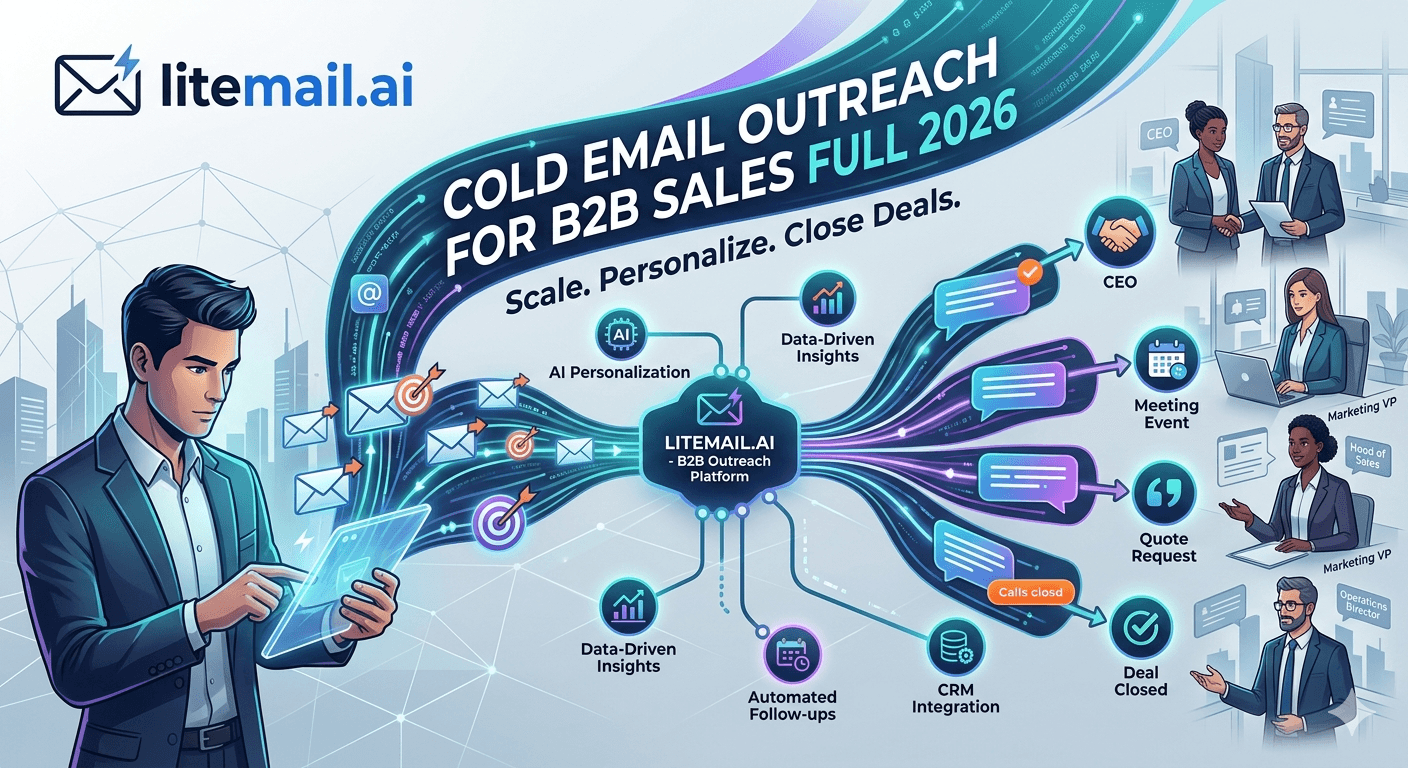
Cold email still works in 2026. But the version that works looks different from what most B2B teams are running. The gap between teams getting 4–8% reply rates and teams stuck at 0.5% isn't copy — it's infrastructure, targeting precision, and the sequence logic that follows the first send. This guide covers all three.
Why Most B2B Cold Email Fails in 2026
Three failure modes account for the vast majority of underperforming cold email programs. Each is fixable — but only if you diagnose the right one first.
Failure Mode | Symptom | Root Cause | Fix |
|---|---|---|---|
Infrastructure failure | Open rate under 15%, emails bouncing, Postmaster shows Low/Unknown | Fresh inbox, broken DNS, shared IPs, no warmup history | Pre-warmed inboxes, fix DNS, dedicated IPs |
Targeting failure | Open rate OK (30%+), reply rate under 0.5% | Wrong ICP, wrong title, wrong timing, irrelevant offer | Narrow ICP, trigger-based targeting, role-matched messaging |
Copy failure | Open rate OK, reply rate 0.5–1%, low meeting quality | Generic opener, weak CTA, too long, no specificity | Problem-led opening, single CTA, under 100 words |
Most teams diagnose failure mode 3 when the actual problem is failure mode 1 or 2. They rewrite copy on campaigns that never land in the primary inbox. Or they send perfectly-written emails to the wrong person at the wrong time. Diagnose the right layer first — then fix it.
Infrastructure: The Foundation That Determines Your Ceiling
Cold email infrastructure determines the maximum deliverability you can achieve. Copy and targeting optimise within that ceiling — they can't raise it.
The Infrastructure Stack for B2B Cold Email
Every serious B2B cold email operation needs four infrastructure components working correctly before the first campaign send:
Pre-warmed inboxes with genuine sending history. Fresh Google Workspace or Microsoft 365 inboxes land in spam 40–60% of the time on cold lists. Pre-warmed inboxes with 4–12 weeks of genuine sending history show Good or High reputation in Google Postmaster Tools and deliver to primary inbox at 88–96%. Litemail pre-warmed inboxes provide this from $4.99/inbox with no minimum order and 24-hour delivery.
Separate cold email domain. Never send cold email from your primary business domain. Register a variant (company-outreach.com, company-hq.com) and run all cold email from that domain. If it gets flagged, your primary domain stays clean.
SPF, DKIM, and DMARC correctly configured. All three must pass. One misconfigured record eliminates the deliverability advantage of your warmup history. Litemail inboxes ship with all three pre-configured — verify on mxtoolbox.com on delivery.
Dedicated IP addresses. Shared IPs mean another sender's bad campaign day affects your deliverability. Dedicated IPs isolate your reputation entirely. All Litemail inboxes use dedicated US and EU IP addresses.
✅ Infrastructure Verification Checklist
Before the first campaign send: (1) Google Postmaster Tools shows Good or High reputation. (2) MXToolbox shows green on SPF, DKIM, DMARC, MX, and blacklist. (3) Mail-tester.com score is 9/10 or 10/10. (4) Gmail header check shows SPF PASS, DKIM PASS, DMARC PASS. These four checks take 15 minutes and protect your entire campaign budget.
List Building and ICP: The Variable Most Teams Under-invest In
A 1% improvement in targeting precision is worth more than a 10% improvement in subject line open rate. The prospect list determines the ceiling on your campaign outcomes — infrastructure and copy optimise within it.
Defining a Useful ICP for Cold Email
An ICP that works for cold email is specific enough to drive personalisation. "B2B SaaS companies" is not an ICP. "Series A–B SaaS companies with 20–150 employees selling to enterprise buyers, where the VP of Sales owns the pipeline generation problem" is an ICP. That level of specificity tells you which title to target, what pain to open with, and which triggers to look for.
Trigger-Based Targeting: The Highest-ROI List Strategy
Trigger-based targeting — reaching out to prospects at the moment a specific event makes them most likely to need your product — is the highest-ROI list building approach in 2026. Relevant triggers:
New leadership hire: New VP of Sales, new CMO, new CFO — new leaders evaluate vendors. Target within 30 days of the hire announcement.
Funding announcement: Series A/B/C rounds create immediate budget and hiring plans. Target within 2 weeks of the announcement.
Hiring for specific roles: A company posting 5+ SDR roles is scaling outbound. Target the Sales leader immediately.
Technology change: Companies switching CRMs, adding a sales engagement tool, or changing their tech stack signal active evaluation periods.
List Hygiene Before Every Campaign
Run every list through NeverBounce or ZeroBounce before the first campaign send. Keep hard bounce rate under 2%. Keep spam complaint rate under 0.08%. These aren't aspirational targets — they're the thresholds where Google and Microsoft start degrading your domain reputation regardless of inbox quality.
Cold Email Copy That Drives B2B Sales Conversations
The copy rules that work in 2026 are different from 2021. Buyers have seen every template. The only cold email copy that gets responses is specific, relevant, and short.
The Opener: Earn the Read in the First Line
Your first sentence must be specific to the recipient or their situation. Not "I came across your profile" — that tells the reader nothing. Specific means: referencing their company, a recent event, a specific problem their type of company faces at their stage, or something you genuinely noticed that's relevant.
A cold email opener that works: "Saw [Company Name] closed a Series B last month — congrats. At that stage, the SDR-to-AE ratio usually breaks before it gets fixed. We helped three similar-sized teams restructure their outbound motion after a raise."
Under 50 words. Specific trigger. Specific problem. Evidence without bragging. The reader knows exactly what you do and why you contacted them now.
The Ask: One Small Thing, Not a Demo
Ask for a 15-minute conversation, not a 45-minute demo. Ask one question, not three. The CTA at the end of a cold email should be the lowest-friction next step that gets a response — not the highest-value next step for you.
Length: Under 100 Words for the First Touch
First-touch cold emails over 150 words have measurably lower reply rates in every vertical. Under 100 words forces you to be specific — there's no room for generic filler. If you can't make your case in 100 words, the ICP or offer isn't sharp enough yet.
Sequence Structure: What Comes After the First Email
The first email gets the attention. The sequence gets the meeting. Here's the sequence structure that works for standard B2B sales cold email in 2026.
Touch | Timing | Type | Content Approach | Ask |
|---|---|---|---|---|
Email 1 | Day 1 | Cold intro | Trigger + problem + brief evidence | 15-min call |
Email 2 | Day 4 | Value add | Share a relevant resource or insight — no ask | None |
Email 3 | Day 11 | New angle | Different problem aspect or new trigger reference | 15-min call, renewed |
Email 4 | Day 22 | Social proof | Reference a specific result from a similar company | 15-min call |
Email 5 | Day 35 | Break-up | Acknowledge timing may be wrong, leave door open | Future quarter check-in |
Five touches over 35 days is the right cadence for standard B2B cold email. Email 2 with no ask is the most counterintuitive step — and consistently one of the highest-performing elements when it delivers genuine value rather than a thinly disguised follow-up.
Volume, Rotation, and Scaling B2B Cold Email
Scaling B2B cold email volume safely requires understanding the per-inbox ceiling and the infrastructure math behind it.
Safe cold email sending limit: 30–40 emails per inbox per day for pre-warmed inboxes. Above this ceiling — especially on cold prospect lists — domain reputation degrades within weeks. Scale volume by adding inboxes to the rotation, not by pushing individual inboxes past their ceiling.
Volume formula: daily email target ÷ 35 = inboxes needed. For 500 emails per day you need 15 inboxes ($74.85/month at Litemail's $4.99 rate). Add 20–25% buffer for standby inboxes. Mix Google Workspace and Microsoft 365 at 60/40 — platform diversity protects against single-provider algorithm changes.
When scaling inbox count, add 3–5 new inboxes per week — not all at once. Sudden inbox network expansion triggers the same pattern-matching as sudden volume spikes.
Build Your B2B Cold Email Stack on Pre-Warmed Infrastructure
Litemail pre-warmed inboxes — the foundation of high-performing B2B cold email in 2026. $4.99/inbox. Verified Good/High Postmaster reputation. Automated DNS. Dedicated US and EU IPs. No minimum order.
Get Pre-Warmed Inboxes from $4.99 →
Ready for campaigns in 24 hours · Works with all platforms · Dedicated IPs · No minimum order
About Litemail — Litemail provides pre-warmed Google Workspace and Microsoft 365 inboxes for cold email outreach. From $4.99/inbox with automated DNS, dedicated US and EU IPs, and full admin access. View pre-warmed inbox plans →
Related reading:
Cold Email Ultimate Guide 2026 · B2B Cold Email Lead Generation Guide 2026 · Cold Email Prospecting Guide 2026 · Cold Email Open Rate Benchmarks 2026 · Cold Email Deliverability Guide 2026
Key Takeaways
B2B cold email failure falls into three distinct modes: infrastructure (inbox not landing), targeting (wrong person or timing), and copy (right person, wrong message). Diagnose the correct layer before trying to fix it.
Infrastructure determines your deliverability ceiling. Pre-warmed inboxes with Good/High Postmaster reputation, dedicated IPs, and clean DNS deliver to primary inbox at 88–96% vs 40–60% for fresh inboxes.
Trigger-based list building — targeting prospects within 30 days of a funding round, leadership hire, or technology change — produces 3–5x the reply rate of static ICP-filtered lists.
Keep first-touch cold email under 100 words. Longer emails have measurably lower reply rates across all B2B verticals. If you can't make the case in 100 words, the offer or ICP isn't sharp enough yet.
5-touch sequences over 35 days is the right cadence for standard B2B cold email. Include one value-add email with no ask — it consistently outperforms a pure follow-up sequence.
Scale volume by adding inboxes — not by pushing existing inboxes past 35–40/day. At Litemail's $4.99/inbox, 500 emails per day costs $74.85/month in infrastructure.
Frequently Asked Questions
Does cold email still work for B2B sales in 2026?
Yes. B2B cold email remains one of the highest-ROI outbound channels in 2026 for companies selling to SMB and mid-market buyers. Teams with clean infrastructure, precise ICP targeting, and well-structured sequences consistently generate 3–8% reply rates. The channel is more competitive than 2020 — which raises the floor on what "good" looks like, but doesn't eliminate it as a viable pipeline source.
What reply rate should I expect from B2B cold email in 2026?
With pre-warmed infrastructure, a verified list, trigger-based targeting, and tight copy — 3–6% reply rate is realistic for most B2B verticals. Generic campaigns to broad lists typically return under 1%. The variable that moves reply rate most is targeting precision — the relevance of your email to the recipient's current situation — not copy optimisation or send volume.
How many cold emails should I send per day per inbox?
30–40 emails per inbox per day for pre-warmed inboxes. Above this ceiling, domain reputation degrades within weeks even on clean lists. Scale total volume by adding more inboxes — not by pushing individual inboxes harder. At Litemail's $4.99/inbox, 15 inboxes for 500 emails per day costs $74.85/month.
What's the best cold email sequence length for B2B sales?
5 touches over 35 days for standard mid-market B2B: Day 1 (cold intro), Day 4 (value add, no ask), Day 11 (new angle), Day 22 (social proof), Day 35 (break-up). For SMB shorter cycles work — 3 touches over 14 days. For enterprise with longer buying cycles — up to 7 touches over 45 days. The Day 4 email with no ask is counterintuitive but consistently one of the best-performing touches.
What inbox infrastructure do I need for B2B cold email?
Pre-warmed inboxes (Good/High Postmaster reputation, not fresh accounts), a separate cold email domain (not your primary business domain), SPF/DKIM/DMARC all configured and passing, and dedicated IP addresses (not shared). Litemail provides all four from $4.99/inbox — verified Good reputation, automated DNS, dedicated US and EU IPs, and full admin access. No minimum order — start with exactly the inbox count your volume requires.
How do I scale B2B cold email volume without hurting deliverability?
Add more inboxes — don't push existing inboxes past 35–40/day. Each inbox in your rotation sends 30–40 emails independently. When adding new inboxes, onboard 3–5 per week rather than all at once. Mix Google Workspace and Microsoft 365 at roughly 60/40 for platform diversity. Monitor Google Postmaster Tools weekly — catch reputation changes at Medium (fixable in 1 week) rather than Low (60-day recovery).
What are the most common B2B cold email mistakes in 2026?
Using fresh inboxes instead of pre-warmed (single biggest deliverability mistake), sending from the primary business domain (one bad campaign can damage the main domain reputation), writing first emails over 150 words (measurably lower reply rate), asking for a 45-minute demo instead of a 15-minute call (too high friction), not verifying lists before sending (high bounce rates degrade inbox reputation within days), and diagnosing copy problems when the real issue is infrastructure or targeting.
B2B Cold Email Infrastructure | Litemail Pre-Warmed Inboxes
The foundation of high-performing B2B cold email outreach. Pre-warmed GWS and MS365 inboxes from $4.99. Verified Good reputation. No minimum order.
View Plans & Pricing →
Related reading:
Cold Email Ultimate Guide 2026 · B2B Lead Generation Guide 2026 · Cold Email Prospecting Guide · Open Rate Benchmarks 2026 · Deliverability Guide 2026