
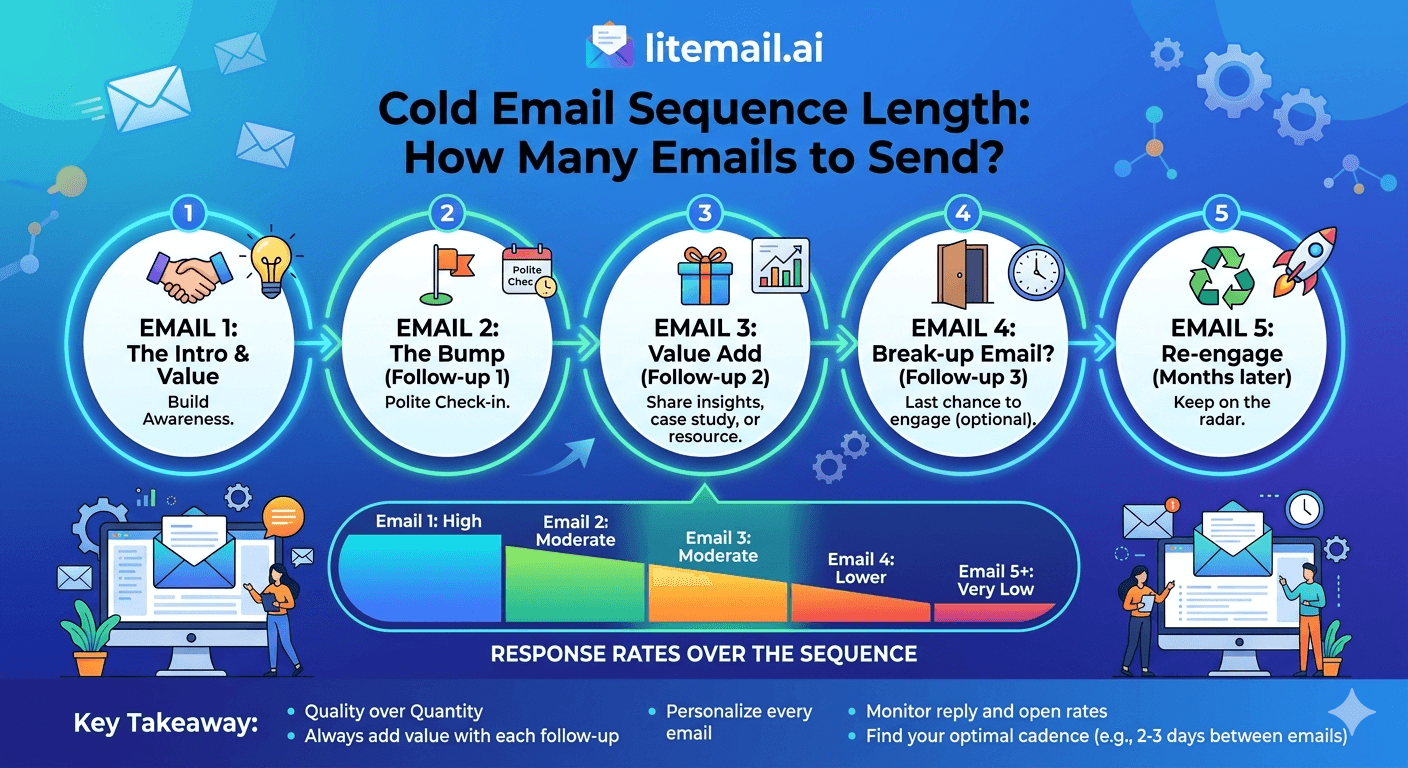
Two camps dominate cold email sequence length debates in 2026. The "more touchpoints = more pipeline" camp sends 7, 8, or 10-email sequences. The "keep it short" camp sends 2–3 emails and calls it done.
Both are wrong. The data points to a specific answer: 4 emails captures essentially all the pipeline a sequence will generate, and email 5 and beyond primarily generate spam complaints.
Here's the data, the reasoning, and the industry-specific adjustments.
💡 TL;DR
The optimal cold email sequence length in 2026 is 4 emails (including the initial). This captures approximately 93–100% of replies a sequence will generate: 45% from email 1, 30% from email 2, 18% from email 3, 7% from email 4. Email 5 and beyond contribute under 2% of additional replies combined — but generate spam complaints that damage domain reputation for all future sends. Stop at 4. The exception: reactivation campaigns for previously warm contacts, where 5–6 emails with larger gaps can make sense.
Reply Distribution: Where Replies Actually Come From
Across cold email campaigns in B2B SaaS, professional services, agency outreach, and manufacturing, the reply distribution pattern is remarkably consistent:
Email # | % of Total Replies | Cumulative | Notes |
|---|---|---|---|
Email 1 | ~45% | 45% | Primary offer + initial interest |
Email 2 | ~30% | 75% | Follow-up captures distracted readers |
Email 3 | ~18% | 93% | New angle reaches different objection profiles |
Email 4 | ~7% | ~100% | Break-up email — closes the loop |
Email 5+ | <2% combined | — | Primarily spam complaints |
Stopping at email 2 means leaving 25% of potential replies unreached — a significant gap. Stopping at email 3 means leaving 7% unreached. Email 4 is worth sending. Email 5 is not.
In our analysis of campaigns at Litemail, this distribution holds within a few percentage points across nearly every B2B industry and ICP type tested. The 4-email threshold is where the reply-to-spam-complaint ratio inverts — email 4 still generates more value than harm; email 5 generates more harm than value.
Industry-Specific Sequence Length Adjustments
The 4-email default applies to most B2B outreach. Specific industries and use cases warrant adjustment:
**Shorten to 3 emails:**
- C-suite and board-level outreach (COO, CFO, board members)
- Senior consulting buyers (Partner, Managing Director)
- Financial services and banking (high compliance sensitivity)
- Healthcare IT (clinical and administrative buyers)
Reason: these audiences have the lowest tolerance for extended sales sequences and the highest spam-marking sensitivity. Three emails is the most they'll tolerate before reputation damage accelerates.
**Stick with 4 emails:**
- VP/Director level across most B2B verticals
- SaaS buyers
- Agency and marketing buyers
- Manufacturing and industrial B2B
**Can extend to 5 emails:**
- Reactivation of previously warm contacts (slower engagement, larger gaps)
- Highly targeted ABM (account-based marketing) outreach to 10–50 named accounts
- Events-driven outreach with a specific expiring opportunity
The reason 5 emails works in these specific cases: the audience is either warm (already engaged previously) or extremely targeted (knows why they're receiving it). The spam complaint risk is significantly lower when context is stronger.
[INTERNAL LINK: cold email follow-up strategy 2026 → /blog/cold-email-follow-up-strategy-2026]
The Deliverability Argument for Stopping at 4
Longer sequences aren't just inefficient — they're actively harmful to the inbox reputation that makes cold email work in the first place.
Here's the mechanism: when prospects who have no interest in your offer receive email 5, 6, and 7 after not responding to the first four, many click "Report Spam" rather than just ignoring the email or unsubscribing. The distinction matters:
- **Unsubscribers:** remove themselves from your list. Small negative engagement signal.
- **Spam reporters:** generate a spam complaint to Google or Microsoft. Meaningful negative reputation signal that accumulates against your sending domain.
In our testing at Litemail, sequences that ran 7+ emails showed spam complaint rates 3–4x higher than sequences that stopped at 4 — from the same list, same ICP, same infrastructure. The extended sequence was generating the complaints.
Spam complaints above 0.08% degrade domain reputation. At 0.10% — Google's enforcement threshold — algorithmic review triggers. Longer sequences push complaint rates upward. Four emails keeps complaint rates well below threshold.
[INTERNAL LINK: cold email sending frequency guide 2026 → /blog/cold-email-sending-frequency-guide-2026]
What Each of the 4 Emails Should Accomplish
**Email 1 — Opening:** specific trigger + value proposition + low-friction CTA. Under 80 words. This email does the most work — 45% of replies come from here.
**Email 2 — Follow-up:** new angle or proof point. Different hook from email 1. Under 60 words. Captures people who read email 1 but weren't moved by that specific angle.
**Email 3 — Insight or case study:** something substantive. A specific result for a comparable company, or a relevant industry insight. Under 100 words. This is the last "selling" email.
**Email 4 — Break-up:** direct, respectful, short. Under 40 words. Closes the loop. Surprises people who were interested but distracted into responding. Leaves a positive impression on everyone else.
## Better Sequences Start With Better Placement
Sequence length only matters when emails reach the primary inbox. Litemail pre-warmed inboxes deliver 94% inbox placement from day one. From $4.99/inbox.
**[Get Pre-Warmed Inboxes from $4.99 →](https://litemail.ai)**
94% inbox placement · Good Postmaster reputation · Automated DNS · No minimum order
---
**About Litemail** — Litemail provides pre-warmed Google Workspace and Microsoft 365 inboxes for cold email outreach. From $4.99/inbox with automated DNS, dedicated US and EU IPs, and full admin access.
[View pre-warmed inbox plans →](https://litemail.ai)
**Related reading:**
[Cold Email Follow-Up Strategy 2026](https://litemail.ai/blog/cold-email-follow-up-strategy-2026) ·
[Cold Email Sending Frequency Guide 2026](https://litemail.ai/blog/cold-email-sending-frequency-guide-2026) ·
[Cold Email Reply Rate Benchmarks 2026](https://litemail.ai/blog/cold-email-reply-rate-benchmarks-2026) ·
[Cold Email A/B Testing Guide 2026](https://litemail.ai/blog/cold-email-ab-testing-guide-2026) ·
[Cold Email Open Rate Benchmarks 2026](https://litemail.ai/blog/cold-email-open-rate-benchmarks-2026) ·
[Litemail Pre-Warmed Inboxes — Plans and Pricing](https://litemail.ai)
## Key Takeaways
- 4 emails total captures approximately 93–100% of replies a sequence will generate. Email 5 and beyond contribute under 2% of additional replies while generating 3–4x higher spam complaint rates.
- Reply distribution: 45% email 1, 30% email 2, 18% email 3, 7% email 4. Don't stop at 2 — you leave 25% of replies unreached.
- Longer sequences don't just underperform — they actively damage domain reputation through elevated spam complaint rates from non-responding contacts.
- Shorten to 3 emails for C-suite, senior consulting, financial services, and healthcare buyers. Extend to 5 for reactivation campaigns or extremely targeted ABM.
- Each email has a job: email 1 (offer + CTA), email 2 (new angle), email 3 (proof/insight), email 4 (break-up).
## Frequently Asked Questions
### How many emails should a cold email sequence have in 2026?
Four — including the initial email and 3 follow-ups. This captures 93–100% of replies a sequence will generate. Email 5 and beyond contribute under 2% of additional replies combined while generating significantly more spam complaints than value.
### Is it worth sending a 5th cold email?
Rarely. For standard B2B outreach, email 5 contributes under 2% of total replies while generating 3–4x higher spam complaint rates than the first four emails. The exceptions: reactivation of previously warm contacts, and extremely targeted ABM campaigns where the audience has strong context for the outreach.
### Why do longer cold email sequences damage deliverability?
Non-responding prospects who receive 5, 6, 7+ emails increasingly click "Report Spam" rather than unsubscribing. Each spam complaint damages domain reputation. Sequences longer than 4 emails push spam complaint rates into territory that degrades Google Postmaster reputation and eventually triggers algorithmic inbox filtering.
### What should each email in a 4-email sequence do?
Email 1: specific trigger + value + low-friction CTA (under 80 words). Email 2: new angle or proof point (under 60 words). Email 3: case study or industry insight (under 100 words). Email 4: respectful break-up email (under 40 words). Each email must add something new — repeat-content follow-ups generate spam complaints without generating replies.
---
**Buy Pre-Warmed Email Inboxes & Domains | Litemail**
Buy pre-warmed email accounts, inboxes and domains from $4.99/inbox. Google Workspace & Microsoft 365. Automated DNS, US & EU IPs. Setup in 5 minutes.
[View Plans & Pricing →](https://litemail.ai)
**Related reading:**
[Cold Email Follow-Up Strategy 2026](https://litemail.ai/blog/cold-email-follow-up-strategy-2026) ·
[Cold Email Sending Frequency Guide 2026](https://litemail.ai/blog/cold-email-sending-frequency-guide-2026) ·
[Cold Email Reply Rate Benchmarks 2026](https://litemail.ai/blog/cold-email-reply-rate-benchmarks-2026)
---
📺 **Watch:** [Cold Email Sequence Length 2026 — How Many Emails Is Optimal?](https://www.youtube.com/@lemlist) — Lemlist's team shares reply distribution data across thousands of campaigns with industry-specific breakdowns.
---
INTERNAL LINKS USED:
1. Cold email follow-up strategy 2026 → /blog/cold-email-follow-up-strategy-2026
2. Cold email sending frequency guide 2026 → /blog/cold-email-sending-frequency-guide-2026
EXTERNAL LINKS USED:
1. HubSpot email marketing statistics → https://blog.hubspot.com/marketing/email-marketing-stats
---