Most cold email guides are written for agencies or established B2B teams. Startups have different constraints: tighter budgets, no dedicated SDR team, and a burning need to generate early signal before iterating. The setup that works for a 3-person SaaS team at pre-seed looks different from the 50-person GTM machine. Here's the low-cost version that actually gets results.
Minimum Viable Cold Email Stack for Startups in 2026
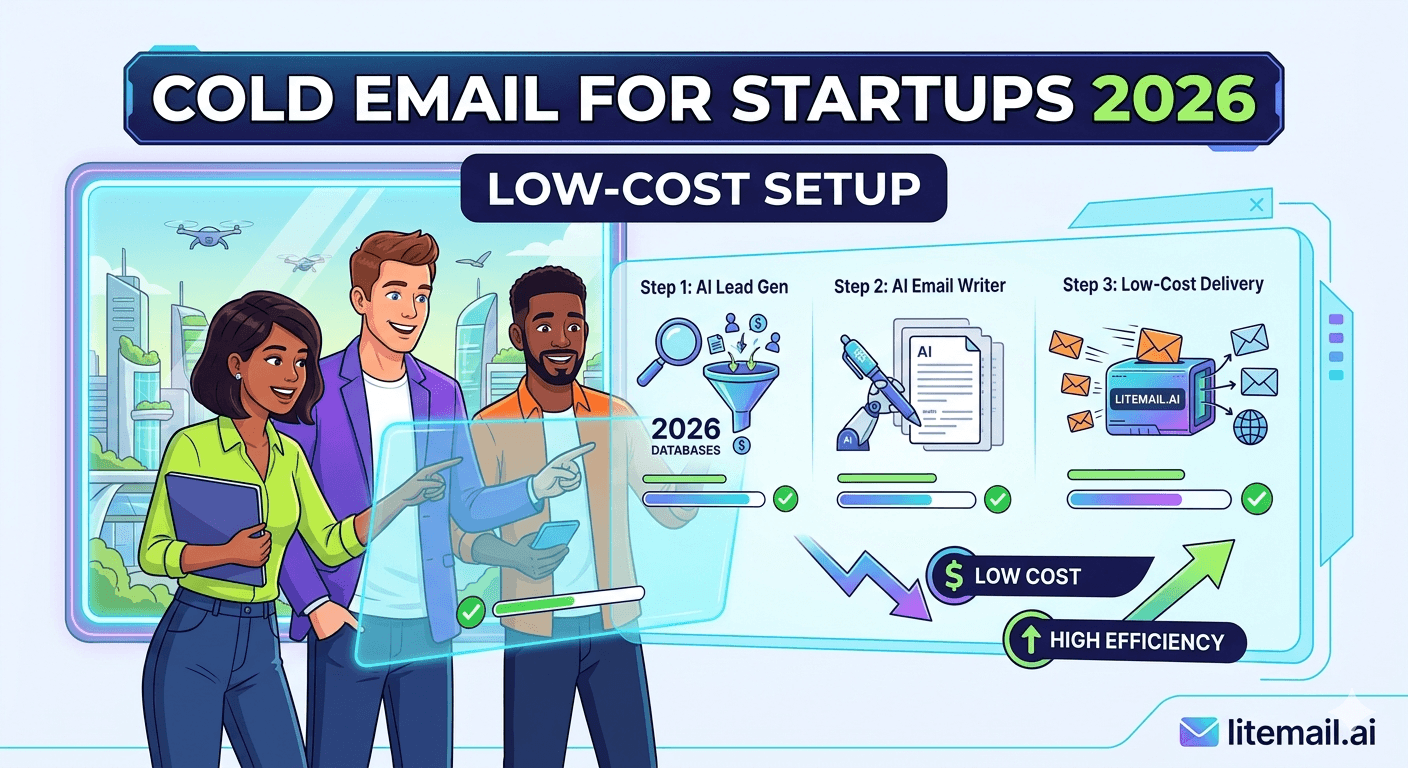
A startup cold email operation needs four components. The total monthly cost for a lean setup is under $130. Here's what each component costs and why it matters.
Component | Tool | Monthly Cost | Why It's Non-Negotiable |
|---|---|---|---|
Inbox infrastructure | 3 × Litemail pre-warmed inboxes | $14.97 | Without pre-warmed inboxes, 40–60% of emails go to spam before anyone reads them |
Campaign platform | Instantly Growth | $37.00 | Sequence management, inbox rotation, basic analytics — the cheapest full-featured option |
Prospecting data | Apollo free tier or basic | $0–$49 | Contact discovery and basic enrichment — free tier covers early-stage needs |
Email verification | NeverBounce PAYG | $5–$15 | Bounce rate above 2% tanks domain reputation — verification protects the infrastructure |
Total | — | $56.97–$115.97/mo | Complete cold email operation for a startup at 75–100 emails per day |
💡 The Common Startup Mistake: Skipping Infrastructure
Most early-stage teams trying to save money on cold email skip the inbox infrastructure — using fresh GWS inboxes they provision themselves without pre-warming. The result: 40–60% spam placement, near-zero open rates, and the conclusion that cold email doesn't work. It worked — the emails just never arrived. Three Litemail pre-warmed inboxes at $14.97/month is the cheapest insurance against this failure mode.
ICP and Targeting: The Startup Advantage
Early-stage startups have a targeting advantage that most established companies don't: founder-led specificity. A founder emailing 50 prospects per day with deep knowledge of their problem gets higher reply rates than an SDR at a 200-person company emailing 500 per day with generic copy.
The startup cold email ICP framework:
Start with your best current customers. If you have 3–5 early customers, profile them precisely — company size, industry, tech stack, growth stage, specific trigger that made them buy. This profile is your initial ICP.
Identify 100–200 near-identical companies. Apollo's filter system lets you find companies matching 5–7 criteria simultaneously. Start with a narrow list that tightly matches your early customer profile.
Send to the right title — not the most senior one. For most startup products, the buyer is a director or VP, not a C-suite executive. C-suite cold email has much lower response rates for early-stage products — they need social proof and market validation before engaging with new vendors.
A 3-person SaaS team we worked with at Litemail selling a developer productivity tool started with 60 emails per day to Engineering Managers and Staff Engineers at Series A–B startups. At 4% reply rate, that's 2.4 replies per day — 12 qualified conversations per week — from a $115/month stack. That's a healthy early-stage pipeline for a sub-$130 monthly investment.
Founder-Written Cold Email: The Copy Approach That Works for Startups
Startup cold email copy has a natural advantage: the founder has genuine context on the problem that no SDR or copywriter can replicate. Lean into this rather than trying to write corporate sales copy.
What Works for Startup Cold Email Copy
Lead with the problem, not the product. You're a pre-revenue or early-revenue startup — your product doesn't have the market recognition to lead with features. Lead with the specific problem you observed that led you to build this.
Short is better. Under 75 words for the first email. Founders who write 200-word cold emails are compensating for lack of confidence in their positioning. If you can't explain the value in 75 words, the positioning needs more work.
Ask for insight, not a demo. Startup cold email CTAs that ask for a 15-minute conversation to "learn about their experience with X" get dramatically higher response rates than demo requests. You're doing customer discovery AND generating pipeline simultaneously.
Be honest about being early-stage. "We're building X — we've seen Y problem and 5 customers are using us to solve it" outperforms corporate-polished sales copy for startup cold email. Authenticity is an asset at this stage, not a liability.
When and How to Scale Startup Cold Email
Don't scale before you have signal. Sending 500 emails per day from a startup with unclear positioning is expensive and produces unclear data. Scale in stages based on what the data tells you.
Stage 1: Signal Finding (50–100 emails/day, 3 inboxes)
First 4–6 weeks. Goal: find which ICP segment responds, which copy angle resonates, and which title opens. Don't optimise anything yet — just collect data. At this stage you want signal, not pipeline. Reply rate above 2% = something is working, keep going. Reply rate under 1% = change ICP or copy before scaling.
Stage 2: Scaling What Works (200–300 emails/day, 7–9 inboxes)
Once you have a ICP segment showing 3%+ reply rates and copy angles that work, add inboxes and scale into the winning segment. Add Litemail inboxes in batches of 3–4. Monitor Postmaster reputation as you scale to ensure domain reputation holds.
Stage 3: Channel Maturity (500+ emails/day, 15+ inboxes)
Once cold email is a reliable pipeline source, add prospecting data investment (Apollo paid plan, Clay for enrichment), optimise sequence structure with A/B testing, and consider hiring a part-time SDR to manage reply handling. At this point the stack looks more like an agency setup — but you built to it based on evidence rather than assumption.
What to Skip in Startup Cold Email (Save the Budget)
These are the tools and tactics that established cold email operations use — but that startups in the first 6 months should skip. They add complexity and cost without proportional value at early volume.
Clay ($149+/month): Excellent at scale, overkill for under 200 emails per day. Apollo free + manual personalisation covers the same ground at early stage.
ZoomInfo ($1,200+/year): Enterprise data pricing that doesn't make sense until you're running high-volume outreach to enterprise buyers. Apollo basic covers the same use case for 95% less cost.
LinkedIn Sales Navigator ($99/month): Worth it when you're running trigger-based prospecting at volume. At under 100 emails/day, LinkedIn free + Apollo handles the targeting without the subscription.
Pitchbox or BuzzStream ($195+/month): Link-building specific platforms — not relevant for startup B2B sales cold email.
A separate warmup tool: With Litemail pre-warmed inboxes, you don't need a warmup tool subscription at all. This is a $25–$69/inbox/month saving compared to fresh inbox + warmup.
Start Your Startup Cold Email Right — Pre-Warmed Infrastructure from $14.97/mo
3 Litemail pre-warmed inboxes for 75–100 emails per day. $14.97/month. Verified Good/High reputation. Automated DNS. No minimum order — start with exactly 3 inboxes.
Get Pre-Warmed Inboxes from $4.99 →
Campaign-ready in 24 hours · No warmup wait · Automated DNS · No minimum order
About Litemail — Litemail provides pre-warmed Google Workspace and Microsoft 365 inboxes for cold email outreach. From $4.99/inbox with automated DNS, dedicated US and EU IPs, and full admin access. View pre-warmed inbox plans →
Related reading:
Cold Email Tool for B2B SaaS Outreach 2026 · Cold Email Compliance for Startups 2026 · B2B Cold Email Lead Generation Guide 2026 · Cold Email Tool Pricing Comparison 2026 · Pre-Warmed Inboxes for SaaS Outbound Teams 2026
Key Takeaways
Minimum viable startup cold email stack: 3 Litemail pre-warmed inboxes ($14.97) + Instantly Growth ($37) + Apollo free/basic ($0–$49) + NeverBounce PAYG ($5–$15) = $56.97–$115.97/month for 75–100 emails per day.
The biggest startup cold email mistake is skipping pre-warmed inboxes to save money — fresh inboxes land in spam 40–60% of the time, producing the false conclusion that cold email doesn't work.
Narrow ICP targeting is the startup advantage. Start with 100–200 prospects tightly matching your best early customers. A 4% reply rate from 60 emails per day = 12 qualified conversations per week — enough early pipeline for most startups.
Founder-written cold email under 75 words, asking for insight rather than a demo, and being honest about being early-stage outperforms polished corporate sales copy at the startup stage.
Don't scale before you have signal. Stage 1: 50–100 emails/day to find ICP and copy angles. Stage 2: scale winning segments. Stage 3: add tooling as complexity justifies it.
Skip Clay, ZoomInfo, Sales Navigator, and warmup tools in the first 6 months. These tools add value at scale — they add cost without proportional value at early-stage volumes.
Frequently Asked Questions
How much does cold email cost for an early-stage startup?
$56.97–$115.97/month for a minimum viable setup: 3 Litemail pre-warmed inboxes ($14.97), Instantly Growth ($37), Apollo free/basic ($0–$49), and NeverBounce pay-as-you-go ($5–$15). This covers 75–100 emails per day — enough to generate meaningful signal and early pipeline. The biggest cost reduction versus typical cold email setups comes from using Litemail pre-warmed inboxes ($14.97) instead of fresh inboxes with warmup tool subscriptions ($75–$210 for 3 inboxes).
Do startups need pre-warmed inboxes for cold email?
Yes — more so than established companies in some ways. Fresh GWS or MS365 inboxes land in spam 40–60% of the time on cold lists, especially when new domains are involved. For startups whose founders are personally reaching out, having cold emails routed to spam before the prospect even sees them is the failure mode that causes teams to incorrectly conclude cold email doesn't work. 3 Litemail pre-warmed inboxes at $14.97/month prevents this from happening.
How many cold emails should a startup send per day?
50–100 emails per day is the right range for the signal-finding stage (first 4–6 weeks). This generates enough data to evaluate which ICP segments respond and which copy angles work without burning through your entire prospect list before you know what's working. Scale to 200–300/day once you have a segment showing 3%+ reply rates. At Litemail's $4.99/inbox, scaling from 3 to 9 inboxes adds $29.94/month.
What should a startup cold email say?
Under 75 words. Lead with the specific problem you built the product to solve — not the product. Ask for a 15-minute insight call ("learning about your experience with X") rather than a product demo. Be honest about being early-stage if it feels right — "we're building X and 5 companies are using it to solve Y" is more credible than corporate-polished sales copy from a company nobody has heard of. Authenticity is an asset at the startup stage.
What cold email tools should startups avoid to keep costs low?
Skip Clay ($149+/month), ZoomInfo ($1,200+/year), LinkedIn Sales Navigator ($99/month), and any standalone warmup tool ($25–$69/inbox/month) in the first 6 months. All of these add value at scale — they add cost without proportional ROI at early-stage volumes. Apollo's free or basic plan covers prospecting. Litemail pre-warmed inboxes cover warmup. Instantly Growth covers sequencing. That's the complete stack for under $120/month.
How long before a startup sees results from cold email?
First replies typically appear within 1–2 weeks of launching on clean pre-warmed infrastructure. Meaningful pattern signal (which ICP segments respond, which copy angles work) takes 3–4 weeks at 50–100 emails per day. First qualified meetings from the channel: 2–4 weeks for most B2B products with a clearly defined problem and tight ICP. The biggest factor in speed to first results is targeting precision — startups that know exactly who their best customer looks like see responses faster than those doing broad exploration.
Cold Email for Startups | Litemail Pre-Warmed Inboxes from $4.99
Start sending on day one, not after 6 weeks of warmup. 3 inboxes for $14.97/month. Minimum viable cold email infrastructure for early-stage startups.
View Plans & Pricing →
Related reading:
Cold Email for B2B SaaS 2026 · Cold Email Compliance for Startups · B2B Lead Generation Guide · Cold Email Tool Pricing Comparison · Microsoft 365 Cold Email for Startups