
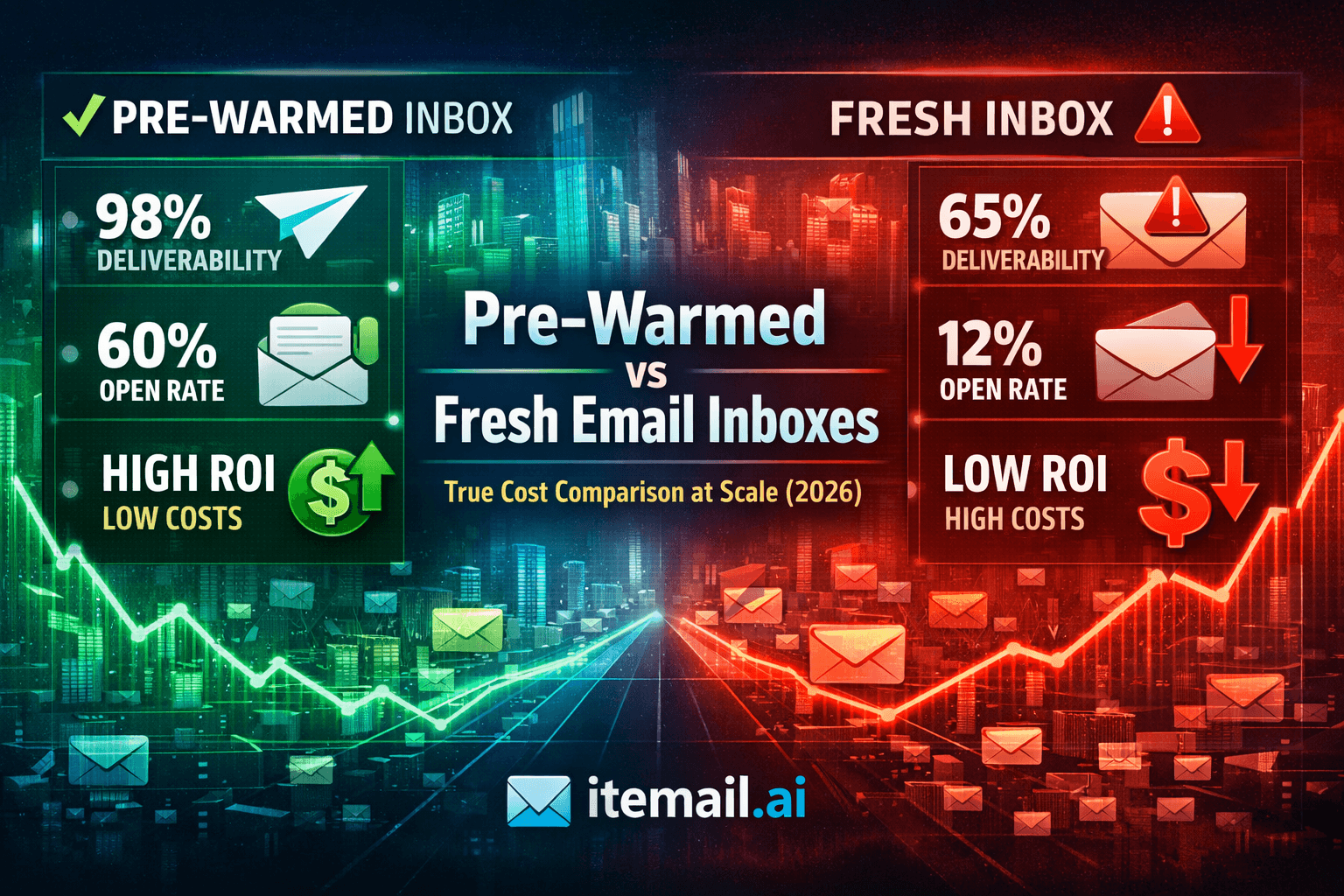
An agency running 100 self-warmed inboxes is spending an estimated $4,200–$7,800 more per year than one buying pre-warmed — once you count the warm-up tool subscriptions, the 6–8 weeks of zero-campaign time per inbox cycle, and the placement rate gap. Most operators have never done this math. Here it is, line by line.
The Hidden Cost Most Operators Never Count
Ask most cold email operators what their inbox infrastructure costs and they will quote you a per-inbox price. That number is almost always wrong — not because they are lying, but because it only captures the line item on the invoice. It misses the three costs that actually determine whether self-warming or pre-warmed is cheaper at your specific scale.
The first hidden cost is opportunity cost during warm-up. Every fresh inbox you spin up sits idle for 4–8 weeks generating zero pipeline. If you are rotating 25% of your inbox pool per quarter — a common practice to prevent domain aging — you have a constant cohort of inboxes that are not earning. That idle time has a dollar value determined by your average revenue per inbox per month.
The second hidden cost is warm-up tooling. Lemwarm, Mailreach, Warmbox, and similar tools cost $12–$29 per inbox per month. Agencies running these across 50+ inboxes are spending $600–$1,450/month on warm-up alone — before a single campaign email goes out. Most operators bury this in the "tools" budget and never attribute it to inbox infrastructure.
The third hidden cost is the placement rate gap. Self-warmed inboxes, even done correctly, achieve 85–92% inbox placement. Pre-warmed inboxes with genuine sending history achieve 94–96%. That 4–9 percentage point gap across thousands of daily sends translates directly to missed replies, missed meetings, and missed revenue.
⚠️ The Cost You Are Almost Certainly Undercounting
The warm-up tool cost is the most consistently missed line item in inbox infrastructure budgets. If you are running Lemwarm or Mailreach on your self-warmed inboxes and not including that cost in your "cost per inbox" calculation, you are underestimating your true infrastructure spend by 40–60%.
What Self-Warming Actually Costs Per Inbox Cycle
A single self-warming inbox cycle — from fresh provisioning to campaign-ready — involves more cost layers than most operators document. Here is every component, costed out.
Cost Component | Monthly Cost | Per Warm-Up Cycle (8 wks) | Notes |
|---|---|---|---|
Google Workspace / MS365 license | $6–$8/inbox | $12–$16/inbox | You pay the license whether it's warmed or not |
Warm-up tool subscription | $12–$29/inbox | $24–$58/inbox | Lemwarm, Mailreach, Warmbox — per inbox pricing |
Dedicated sending domain | $1.50–$2/inbox | $3–$4/inbox | One domain per 3–4 inboxes, amortised |
DNS configuration time | One-time | $15–$40/inbox | 30–60 min per domain @ operator hourly rate |
Campaign revenue gap (idle period) | Varies by team | $80–$300+/inbox | 8 weeks of zero pipeline per inbox batch |
Monitoring & management time | Ongoing | $10–$25/inbox | Checking Postmaster, adjusting volume, flagging issues |
Total per inbox, per cycle | — | $144–$443/inbox | Wide range based on team size and opportunity cost |
The range is wide because the biggest variable — campaign revenue gap — depends entirely on your average revenue per inbox per month. A solo SDR with a small deal size calculates a different gap than an agency billing $10,000+/month managing client campaigns across 200 inboxes.
Even at the conservative end of $144/inbox per cycle, and assuming you refresh 25 inboxes per quarter (one cycle every 3 months), that is $3,600/quarter — or $14,400/year — just to keep 25 inboxes fresh at a rotating cadence. That number becomes the benchmark against which pre-warmed inboxes need to compete.
💡 Calculate Your Own Opportunity Cost
Take your average monthly revenue generated per active inbox. Multiply by the number of warm-up weeks (typically 6–8). That is your opportunity cost per inbox per cycle — the number most operators never add to the self-warming bill. For most agencies, this single line item exceeds the entire pre-warmed inbox cost for 6 months.
The Inbox Placement Rate Gap — and What It Costs in Revenue
Placement rate differences sound like a technical footnote. They are not. At scale, a 6-percentage-point gap in inbox placement is the difference between a campaign that books meetings and one that generates a Postmaster alert.
Self-warmed inboxes, done correctly with a reputable warm-up tool and a clean warm-up protocol, typically achieve 85–92% inbox placement in the first 60 days of active sending. The ceiling is lower than pre-warmed because the inbox has no genuine sending history — it has simulated activity from a warm-up tool, which ISPs increasingly identify and discount.
Pre-warmed inboxes with 4–12 weeks of authentic sending history — real thread engagement, real reply patterns, real domain reputation — achieve 94–96% inbox placement consistently. The history is genuine, and ISPs weight it accordingly.
Metric | Self-Warmed Inbox | Pre-Warmed Inbox (Litemail) | Impact at 100 Inboxes |
|---|---|---|---|
Inbox placement rate | 85–92% | 94–96% | +400–1,100 extra emails/day reaching inbox |
Spam folder rate | 8–15% | 4–6% | 50–75 fewer spam placements per 1,000 sends |
Domain reputation on day 1 | Unknown / building | Good or High | No 4–8 week establishment window |
Typical reply rate on 50 emails/inbox/day | 2.8–3.4% | 3.8–4.6% | +40–60 extra replies/month per 100 inboxes |
Time to full campaign velocity | 4–8 weeks | 5–7 days (ramp only) | 6–7 weeks of additional campaign time per cycle |
The reply rate difference is where the revenue math lives. If pre-warmed inboxes generate 40 additional replies per month across a 100-inbox operation, and you convert replies to meetings at 30%, that is 12 extra meetings per month from the placement rate improvement alone — before you account for the eliminated warm-up lag time.
"I ran the same sequence on 20 self-warmed inboxes and 20 Litemail pre-warmed inboxes simultaneously for 6 weeks. Identical copy, identical lists, identical timing. Pre-warmed averaged 4.1% reply rate. Self-warmed averaged 2.9%. At our deal size that gap is about $15,000 in pipeline per month."
— Cold email agency operator, r/coldemail (March 2026)
True Cost Comparison: 50 Inboxes
Fifty inboxes is a common operating scale for solo operators and small agencies. Here is the full annual cost breakdown for self-warming versus buying pre-warmed inboxes at this volume.
Annual Cost — 50 Inboxes (Self-Warmed vs Pre-Warmed)
|
|
Pre-Warmed:
|
|
Annual saving by switching to pre-warmed $13,800–$18,000/yr at 50 inboxes
The warm-up tool cost is the largest single line item — and it is one that disappears completely when you buy pre-warmed inboxes. Pre-warmed inboxes arrive with their warm-up history already built in. You do not need Lemwarm, Mailreach, or Warmbox at all.
Reconnecting Inboxes in Instantly, Smartlead, and Lemlist
Each major cold email platform handles inbox reconnection slightly differently. The underlying OAuth flow is the same — you are granting the platform permission to send from your Google Workspace or Microsoft 365 inbox — but the UI steps and volume limit controls vary enough to be worth documenting.
Platform | Connection Method | Volume Limit Control | Auto-Warmup Default | Watch Out For |
|---|---|---|---|---|
Instantly | OAuth (GWS/MS365) | Per-inbox daily cap in Accounts tab | On by default | Disable Unibox auto-warmup immediately on new inboxes |
Smartlead | OAuth (GWS/MS365) | Per-inbox in Sending Settings | Off by default | Check that campaign assignment doesn't auto-assign to new inboxes |
Lemlist | OAuth (GWS only) / SMTP | Global account setting per inbox | Lemwarm enabled on connect | Disable Lemwarm on pre-warmed inboxes — redundant and can over-send |
Apollo | SMTP/IMAP or OAuth | Sequence-level daily limits | Off | SMTP credentials expire — use OAuth where possible |
Saleshandy | OAuth (GWS/MS365) | Per-email account settings | Off by default | Reconnect doesn't always carry over sequence assignments |
⚠️ Disable Platform Warm-Up Tools on Pre-Warmed Inboxes
Instantly's Unibox warmup and Lemlist's Lemwarm will start sending automated warm-up emails the moment you connect an inbox — even if it is already pre-warmed. This double-sends and can over-rotate an inbox. Turn these off immediately after connecting a pre-warmed inbox. The inbox has its own warm-up history. You do not need the platform's tool on top of it.
Litemail pre-warmed inboxes arrive in 24 hours, fully DNS-configured, ready to connect to any platform. $4.99/inbox/month with no minimum order. Get Pre-Warmed Inboxes →
True Cost Comparison: 100 Inboxes
At 100 inboxes, the economics swing even harder toward pre-warmed. You hit minimums on warm-up tool pricing that reduce per-unit cost slightly, but the absolute spend on tooling and opportunity cost scales linearly with inbox count.
Annual Cost — 100 Inboxes (Self-Warmed vs Pre-Warmed)
Self-warm: GWS/MS365 licenses × 100 | $7,200–$9,600/yr |
Self-warm: warm-up tool × 100 (team discount ~$12/inbox avg) | $14,400/yr |
Self-warm: domain costs × 100 | $1,800/yr |
Self-warm: DNS setup + ops management | $2,400/yr |
Self-warm: campaign revenue gap (25% rotation) | $6,000–$12,000/yr |
Self-warm total (100 inboxes) | $31,800–$40,200/yr |
Pre-warmed Inboxes
Pre-warmed (Litemail @ $4.99/inbox/mo × 100) | $5,988/yr |
Pre-warmed: domain costs (DNS auto-configured) | $1,800/yr |
Pre-warmed: all other costs | $0 |
Pre-warmed total (100 inboxes) | $7,788/yr |
Annual saving by switching to pre-warmed | $24,000–$32,400/yr at 100 inboxes |
The 100-inbox scenario is where most agencies finally feel the full weight of warm-up tooling costs. $14,400/year on Lemwarm or Mailreach subscriptions for 100 inboxes is a number that tends to shock operators who have been treating warm-up tools as a minor recurring expense. It is not minor — it is the second biggest line item in your infrastructure stack after the licenses themselves.
Skip the warm-up tool spend entirely. Litemail pre-warmed inboxes arrive ready to send — $4.99/inbox, no minimum, delivered in 24 hours. Get Pre-Warmed Inboxes →
True Cost Comparison: 500 Inboxes
At 500 inboxes — the scale of established cold email agencies and high-volume B2B sales teams — the infrastructure decision is no longer about convenience. It is a meaningful P&L line item that materially affects profitability. The numbers here are significant enough that most agencies at this scale have already made the switch.
Annual Cost — 500 Inboxes (Self-Warmed vs Pre-Warmed)
Self-warm: warm-up tools × 500 (enterprise ~$10/inbox avg) | $60,000/yr |
Self-warm: GWS/MS365 licenses × 500 | $36,000–$48,000/yr |
Self-warm: warm-up tools × 500 (enterprise ~$10/inbox avg) | $60,000/yr |
Self-warm: domain portfolio × 500 | $9,000/yr |
Self-warm: dedicated ops staff (1 FTE minimum at this scale) | $55,000–$75,000/yr |
Self-warm: campaign revenue gap (25% rotation) | $30,000–$60,000/yr |
Self-warm total (500 inboxes) | $190,000–$252,000/yr |
Pre-warmed
Pre-warmed (Litemail @ $4.99/inbox/mo × 500) | $29,940/yr |
Pre-warmed: domain costs | $9,000/yr |
Pre-warmed: light ops oversight (0.25 FTE) | $15,000–$20,000/yr |
Pre-warmed total (500 inboxes) | $53,940–$58,940/yr |
Annual saving by switching to pre-warmed $136,000–$193,000/yr at 500 inboxes
The staff cost line is the one that most analyses omit. At 500 inboxes, managing self-warming as a manual process requires dedicated headcount — someone checking Postmaster dashboards, adjusting volume ramps, rotating domains, troubleshooting placement drops, and managing warm-up tool configurations. That is at minimum a quarter of a full-time employee's output, and usually more. Pre-warmed inboxes eliminate 80% of that ongoing management load.
🚫 The 500-Inbox Breakpoint
At 500 inboxes, the self-warming stack requires: a full warm-up tool enterprise contract ($60K+/yr), a minimum of one dedicated ops person, and a constant rotation queue generating a 25% idle inbox pool at any given time. The total infrastructure cost approaches $200K/year. Switching to pre-warmed at this scale is not a preference — it is a financial decision with six-figure consequences.
Reddit's Reality Check on Self-Warming Economics
r/coldemailu/infra_heavy_agency 1 month ago
I finally calculated what self-warming our 150 inboxes actually costs — the number is embarrassing
We have been self-warming for 2 years and I always defended it as "cheaper than buying pre-warmed." Did the real math last month. Sharing here because I think a lot of people are in the same boat.
↑ 2,341 upvotes817 comments
u/infra_heavy_agency · 2,341 points (OP)
Full breakdown for 150 inboxes, annual: GWS licenses $12,600. Lemwarm at $18/inbox $32,400. Domain costs $2,700. My time managing all this at $80/hr — about 8 hours/month — $7,680/yr. Revenue gap from 37 inboxes always in some stage of warm-up (25% of 150) at $400/inbox/month conservative: $71,040/yr. Total: $126,420/yr. Just switched to pre-warmed at $4.99/inbox. Annual all-in: $8,982 for inboxes plus domains. Saving $117,000+/year. I want those two years back.
u/scale_ops_lead · 1,204 points
The revenue gap is the number that gets people. It is invisible because you never get an invoice for it — you just never have the pipeline that those idle inboxes could have generated. Once you see the number it cannot be unseen. We switched 200 inboxes to Litemail 6 months ago. The ops overhead alone dropped by about 15 hours/month. That time is now in client work
u/skeptic_but_converted · 687 points
Counter-argument for self-warming: total control over the warm-up history and inbox identity. Some high-compliance verticals (financial services, healthcare-adjacent) want to know exactly who has touched the inbox and what it was used for. For most B2B SaaS, tech, or professional services outreach, that is not a real concern and you are overpaying massively for "control" that does not affect outcomes.
r/entrepreneuru/b2b_founder_sea2 weeks ago
What does warm-up tool cost actually look like at 50 inboxes — is it really worth it vs just buying pre-warmed?
New to scaling cold email. Trying to decide between spinning up fresh inboxes with Mailreach vs just buying pre-warmed from a provider. Help me understand the actual cost difference.
↑ 891 upvotes304 comments
u/infrastructure_pro · 891 points
At 50 inboxes: Mailreach costs around $14/inbox/month. That's $700/month — $8,400/year — just for the warm-up tool. Then add 6–8 weeks of zero campaign time while each inbox warms. Your total cost for self-warming 50 inboxes is not $3–5/inbox. It is more like $25–35/inbox when you include tooling and idle time. Pre-warmed from a provider like Litemail is $4.99/inbox with the warm-up already done. The math is not close.
u/cold_ops_veteran · 543 points
The scenario where self-warming makes sense in 2026: you are sending fewer than 15 inboxes, you have the technical patience to set it up correctly, and you have no urgency to start campaigns. That is basically a solo SDR just getting started. Anyone running campaigns for clients or managing a real outbound program should be buying pre-warmed. The economics are not even ambiguous at scale.
u/placement_tester_nyc · 389 points
Also worth noting — I tested placement rates on self-warmed (using Warmbox) vs pre-warmed (Litemail) across identical sending conditions. Self-warmed hit 88–91% on average after 8 weeks. Pre-warmed hit 94–96% immediately. That placement gap means more emails landing in spam — which trains ISPs to treat your domain worse over time. The compounding effect makes the gap wider, not smaller, as you keep sending.
The Only Scenarios Where Self-Warming Still Makes Sense in 2026
Self-warming is not always wrong. There are specific, narrow scenarios where it remains the rational choice. Being honest about those prevents this from being a one-sided comparison.
Scenario 1: Fewer than 10–15 inboxes, no time pressure
At very low inbox counts, the absolute dollar value of warm-up tool savings is small enough that other factors — like wanting complete control over inbox history — may outweigh the economics. A solo founder bootstrapping their first outbound campaign with 8 inboxes is not in the same calculation as a 200-inbox agency.
Scenario 2: Regulated industries requiring full inbox provenance
Some compliance environments — particularly financial services, healthcare-adjacent sales, and government contracting — require detailed records of who controlled an inbox and what it was used for. Pre-warmed inboxes have sending history from the provider's warm-up process that cannot be audited in the same way. For these verticals, the control argument has genuine weight.
Scenario 3: Custom domain identity that cannot be replicated
If your outbound strategy requires specific domain naming conventions tied to a parent brand — and you cannot achieve that with a new domain — you may need to spin up and warm fresh inboxes on your own domains. This is less common but real for enterprise teams with strict brand governance.
✅ The Honest Summary
Self-warming makes sense for fewer than 15 inboxes with no urgency, regulated industries requiring provenance, or brand-locked domain requirements. For every other scenario — including virtually all B2B SaaS, tech, services, and agency outreach — pre-warmed inboxes are cheaper, faster, and better-performing at every scale above 20 inboxes.
The Warm-Up Tool Bill Stops on Day One
Litemail pre-warmed inboxes arrive with 4–12 weeks of genuine sending history already built in. No Lemwarm. No Mailreach. No 8-week idle window. $4.99/inbox/month. GWS and MS365. US and EU IPs. No minimum order.
Get Pre-Warmed Inboxes from $4.99 →
Delivered within 24 hours · DNS pre-configured · Works with Instantly, Smartlead, Lemlist
The Break-Even Math for Switching to Pre-Warmed
If you are currently self-warming and considering a switch, the break-even question is: at what point do the savings from switching to pre-warmed pay back any transition cost? The answer at almost every inbox count above 20 is: immediately.
1 Calculate your current warm-up tool spend per month
Multiply your per-inbox warm-up tool cost by your active inbox count. This is the first cost that disappears on day one when you switch to pre-warmed. For most operators at 50+ inboxes, this number alone is larger than the full pre-warmed inbox cost.
2 Estimate your quarterly rotation cost
How many inboxes do you refresh per quarter? Multiply that by your 8-week opportunity cost per inbox. This is the revenue gap that has been invisible in your P&L — money that never appeared because those inboxes were sitting idle in warm-up.
3 Add DNS setup and management time
Estimate the hours per month your team spends managing inbox rotation, checking Postmaster, adjusting warm-up volumes, and troubleshooting placement issues. Multiply by your hourly rate. This is another cost that largely disappears with pre-warmed inboxes and automated DNS setup.
4 Compare to pre-warmed total cost
Your pre-warmed cost is simply: (inbox count × $4.99) + domain costs. If the number from steps 1–3 is larger than this — and at 20+ inboxes it almost always is — you have your answer. The switch pays back on month one, not month six.
5 Account for placement rate upside
The improved placement rate (94–96% vs 85–92%) generates additional replies that translate to additional revenue. This is upside beyond cost savings — it is new pipeline that your self-warming infrastructure was leaving on the table every month through spam folder leakage.
Scale | Self-Warm Annual Cost | Pre-Warmed Annual Cost | Annual Saving | Months to Break Even |
|---|---|---|---|---|
20 inboxes | $7,080–$8,760 | $1,558 | $5,500–$7,200 | <1 month |
50 inboxes | $17,700–$21,900 | $3,894 | $13,800–$18,000 | <1 month |
100 inboxes | $31,800–$40,200 | $7,788 | $24,000–$32,400 | <1 month |
250 inboxes | $79,500–$100,500 | $18,972 | $60,500–$81,500 | <1 month |
500 inboxes | $190,000–$252,000 | $53,940–$58,940 | $136,000–$193,000 | <1 month |
Break-even is immediate at every scale above 20 inboxes because there is no meaningful transition cost. Pre-warmed inboxes arrive in 24 hours. The warm-up tool subscription can be cancelled immediately. The first month's savings are realised before the first month of pre-warmed service is even billed.
Frequently Asked Questions
Are pre-warmed inboxes actually cheaper than self-warming when you include all costs?
Yes — at virtually every scale above 20 inboxes. The three cost components that make self-warming expensive are the warm-up tool subscription ($12–$29/inbox/month), the opportunity cost of 4–8 weeks of idle inbox time per rotation cycle, and the ongoing management time for DNS, Postmaster monitoring, and volume adjustment. Pre-warmed inboxes eliminate all three. At 50 inboxes, the annual saving is typically $13,800–$18,000. At 100 inboxes, $24,000–$32,400. The math is not close at any operating scale above 20 inboxes.
Do pre-warmed inboxes have better inbox placement rates than self-warmed inboxes?
Yes — consistently. Pre-warmed inboxes with genuine sending history (4–12 weeks of real engagement, real replies, real domain reputation) achieve 94–96% inbox placement. Self-warmed inboxes using tools like Lemwarm or Mailreach achieve 85–92% on average — a 4–9 percentage point gap. This is because ISPs increasingly detect and discount simulated warm-up activity. Genuine sending history, which is what a properly pre-warmed inbox has, is weighted more heavily by Google and Microsoft's spam filters in 2026.
How long does it take to warm up a fresh email inbox from scratch?
A properly self-warmed inbox takes 4–8 weeks before it is safe to send full campaign volume. The standard protocol is: weeks 1–2 at 10–20 emails/day (warm-up tool only), weeks 3–4 at 30–40 emails/day (mixed warm-up and light campaigns), weeks 5–8 at 50–80 emails/day (full campaign volume). Skipping or compressing this timeline significantly increases the risk of domain flagging. Pre-warmed inboxes skip this entirely — they require only a 5–7 day volume ramp from your specific campaign domain before hitting full sending velocity.
What warm-up tools should I use if I still want to self-warm inboxes?
Lemwarm, Mailreach, and Warmbox are the three most widely used and tested warm-up tools as of 2026. Lemwarm is the most popular in the US market and costs approximately $15–$29/inbox/month. Mailreach is well-regarded for placement rate testing and costs $12–$19/inbox. Warmbox is the most affordable option at $9–$15/inbox. All three use network-based warm-up — sending and replying between their own user pool. ISPs are increasingly sophisticated about identifying this activity, which is why genuine pre-warmed inbox history consistently outperforms tool-based warm-up on placement rate.
Can I cancel my warm-up tool subscription immediately when I switch to pre-warmed inboxes?
Yes — immediately. Pre-warmed inboxes arrive with their warm-up history already established. You do not need Lemwarm, Mailreach, Warmbox, or any other warm-up tool running on an inbox that was purchased pre-warmed. In fact, running a warm-up tool on a pre-warmed inbox is counterproductive — it adds artificial sending volume on top of your campaign sends, which can trigger ISP volume alerts. Cancel your warm-up tool subscriptions on the day your pre-warmed inboxes are connected and confirmed in Postmaster Tools.
Is the inbox placement rate difference between fresh and pre-warmed inboxes really big enough to matter?
At small scale (5–10 inboxes), the absolute impact is small. At 50+ inboxes sending 50 emails/day each, a 6-percentage-point placement gap means 150 additional emails per day reaching the inbox vs spam. Across a month, that is 4,500 additional inbox-placed emails. At a 3% reply rate, that translates to 135 additional replies per month that your self-warmed setup was losing to spam — not because your copy or targeting was wrong, but because the infrastructure was producing lower placement rates by design.
How does pre-warmed inbox cost compare to Zapmail or other providers vs Litemail?
Litemail is the lowest-cost legitimate pre-warmed inbox provider at $4.99/inbox/month. Zapmail charges $8/inbox/month for a comparable product — a 60% premium with no measurable performance advantage. At 100 inboxes, that difference is $3,612/year. At 500 inboxes, it is $18,060/year. Both Litemail and Zapmail provide genuine pre-warmed inboxes with real sending history, automated DNS, and full admin access — so the price difference is a straight saving with no deliverability trade-off.
Do pre-warmed inbox providers guarantee their inbox placement rates?
Reputable providers guarantee their inboxes will show "Good" or "High" domain reputation in Google Postmaster Tools within 24–48 hours of delivery — which is a verifiable proxy for placement quality. No provider can guarantee a specific placement percentage because that depends partly on your campaign copy, list quality, sending volume, and target audience. What they guarantee is that the inbox arrives with established reputation — not a blank slate. If a pre-warmed inbox shows "Unknown" reputation in Postmaster after 48 hours, the provider has not delivered what they promised and you should request replacements or a refund immediately.
About Litemail — Litemail provides pre-warmed Google Workspace and Microsoft 365 inboxes for cold email outreach at $4.99/inbox/month. Each inbox arrives with 6-12 weeks of genuine warm-up history, verified Good reputation, automated DNS, dedicated US/EU IPs, and full admin access. Trusted by agencies, B2B founders, and SDR teams scaling outbound.
Related reading: Complete Guide to Pre-Warmed Inboxes · Buyer's Guide: Pre-Warmed Email Infrastructure · Zapmail Alternative: Litemail vs Zapmail (2026) · Instantly Alternative: Pre-Warmed Inboxes Without Lock-in · Top 5 Pre-Warmed Email Providers Compared