
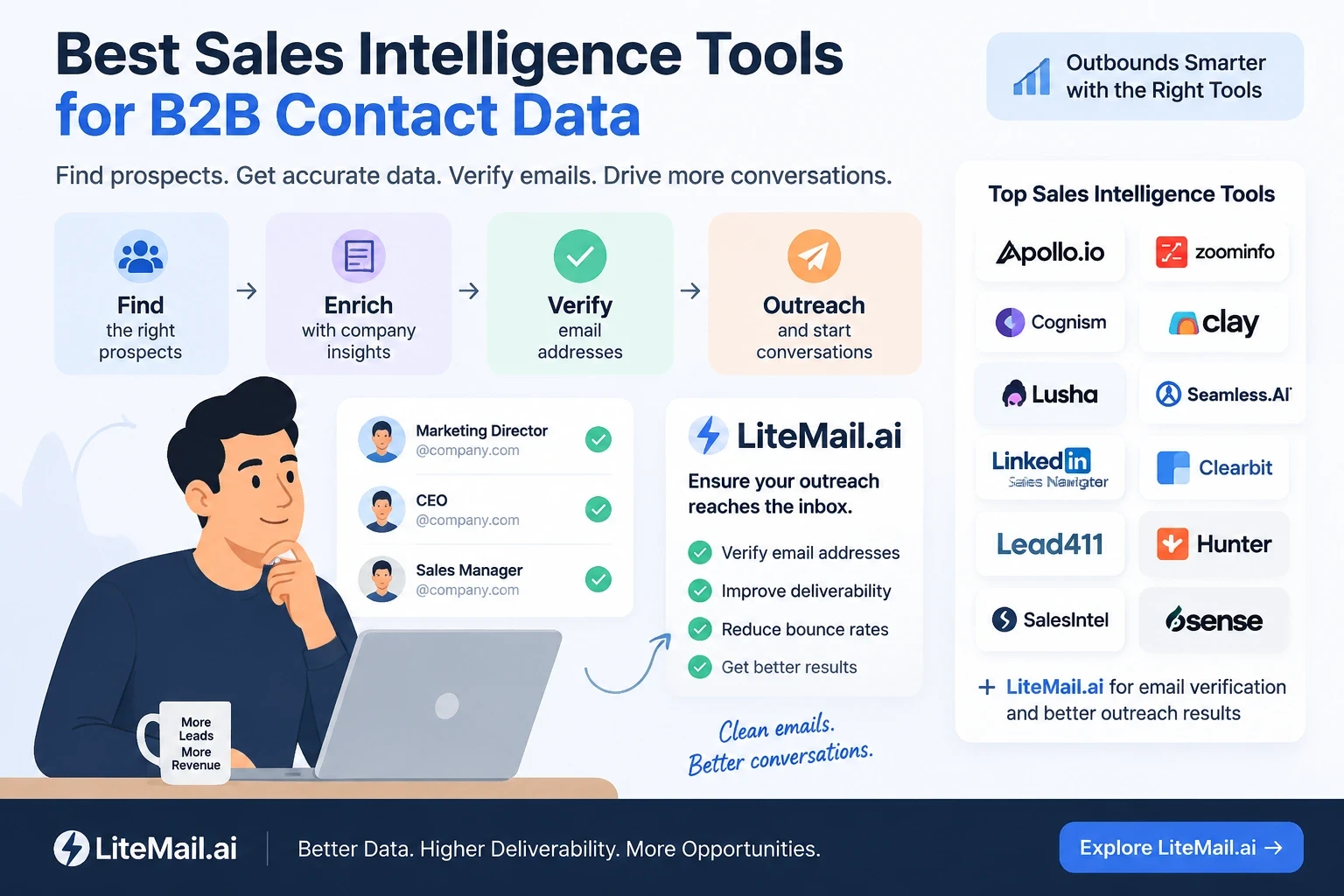
Finding the right prospects is one of the biggest challenges for modern B2B sales teams. A company may have a great product, a skilled sales team, and a strong marketing strategy, but without accurate contact data, reaching the right decision-makers becomes difficult.
Outdated databases, incorrect email addresses, missing phone numbers, and incomplete company information can waste valuable sales time. This is why businesses are investing in sales intelligence tools for B2B contact data to discover prospects, verify information, understand buying signals, and improve outbound campaigns.
Sales intelligence platforms have evolved beyond simple contact databases. Today, they combine business information, email verification, data enrichment, automation, intent signals, and CRM integrations to help sales teams create more targeted outreach strategies.
In this guide, we will compare the best sales intelligence tools for B2B contact data in 2026, including platforms for prospect discovery, outbound prospecting, email finding, enrichment, and enterprise sales teams.
What Are Sales Intelligence Tools?
Sales intelligence tools are software platforms that help businesses collect, analyze, and use sales-related information to identify potential customers.
Unlike traditional contact databases that only provide names and company details, modern sales intelligence platforms provide deeper insights such as:
Verified business emails
Direct phone numbers
Company information
Job roles and decision-makers
Industry data
Buying signals
Technology usage
Account activity
The goal is simple: help sales teams spend less time searching for prospects and more time having meaningful conversations.
For example, instead of manually searching LinkedIn, company websites, and directories, a sales representative can use a sales intelligence platform to find:
A company's decision-maker
Their professional email address
Their role in the buying process
Relevant company information
This makes outbound prospecting faster and more personalized.
Why B2B Contact Data Matters for Outbound Prospecting
Successful outbound sales depends heavily on reaching the right person at the right company.
However, many sales teams face common problems:
Inaccurate Contact Information
People change jobs, companies update their teams, and databases become outdated. Sending emails to incorrect addresses can increase bounce rates and reduce campaign performance.
Finding Decision-Makers
A company may have hundreds or thousands of employees, but only a few people influence purchasing decisions.
Sales intelligence tools help identify:
CEOs
Marketing directors
Sales leaders
Operations managers
Procurement teams
Better Personalization
Generic sales messages often perform poorly. Modern buyers expect relevant communication.
With detailed prospect data, sales teams can personalize outreach based on:
Industry
Company size
Job responsibility
Business challenges
Recent activity
Improving Sales Efficiency
Without reliable data, sales representatives spend hours researching prospects manually.
Sales intelligence platforms automate much of this process by providing ready-to-use prospect information.
How Sales Intelligence Tools Work
Most sales intelligence platforms follow a similar process:
1. Data Collection
Platforms gather information from multiple sources, including:
Public business information
Company websites
Professional networks
Data partnerships
User contributions
2. Data Verification
Good platforms verify information to improve accuracy.
Common verification methods include:
Email validation
Phone verification
Domain checks
Database updates
3. Data Enrichment
Enrichment adds additional information to existing records.
For example:
A basic contact record:
John Smith
Marketing Manager
ABC Company
can become:
John Smith
Marketing Director
ABC Company
500 employees
Uses HubSpot
Recently expanded marketing team
4. Integration With Sales Tools
Most sales intelligence platforms connect with:
CRM systems
Email automation tools
Sales engagement platforms
Marketing platforms
This allows teams to move prospects from research to outreach quickly.
How We Evaluated the Best Sales Intelligence Tools
Choosing a sales intelligence platform depends on more than database size. A large database does not always mean better results.
For this comparison, important factors include:
Data Accuracy
The quality of contact information is one of the most important factors.
A smaller database with accurate contacts can often outperform a larger database with outdated information.
Contact Coverage
A good platform should provide access to:
Companies
Decision-makers
Industries
Geographic markets
Email Verification
Email accuracy directly affects outbound campaign performance.
Important features include:
Email validation
Bounce reduction
Domain verification
Data Enrichment Features
Enrichment helps sales teams understand prospects better before contacting them.
CRM Integration
The best tools connect easily with existing workflows, including:
Salesforce
HubSpot
Pipedrive
Other CRM systems
Compliance and Data Privacy
Businesses should consider data regulations, especially when targeting international markets.
Best Sales Intelligence Tools for B2B Contact Data in 2026
The right sales intelligence platform depends on your business goals, sales process, target market, and budget. Some companies need a large enterprise database, while others need affordable prospecting tools with email verification and outreach features.
Below are some of the leading sales intelligence tools for finding B2B contact data and improving outbound prospecting.
1. Apollo.io — Best Overall Sales Intelligence Tool for B2B Prospecting
Apollo.io is one of the most popular sales intelligence platforms because it combines a large B2B contact database with sales engagement features.
Instead of using separate tools for finding contacts and sending outreach campaigns, Apollo provides prospect discovery, email sequences, and sales automation in one platform.
Key Features
B2B contact database
Verified business emails
Phone numbers
Prospect filtering
Email sequences
CRM integrations
Sales automation
Apollo is especially useful for:
Startups
Small and medium-sized businesses
Sales teams building outbound campaigns
Why Choose Apollo.io?
Many sales teams prefer Apollo because it combines data collection and outreach workflows. Users can search for prospects based on:
Industry
Company size
Location
Job title
Technology used
This makes it easier to create targeted prospect lists.
2. ZoomInfo — Best Enterprise B2B Contact Database
ZoomInfo is one of the most recognized names in the sales intelligence industry, especially among large organizations that need extensive company and contact information.
The platform focuses on providing detailed B2B intelligence, including company profiles, professional contacts, and buying signals.
Key Features
Large business database
Company intelligence
Decision-maker information
Intent data
Sales automation integrations
Market insights
ZoomInfo is commonly used by:
Enterprise sales teams
Large B2B organizations
Account-based marketing teams
Why Choose ZoomInfo?
Companies that need broad market coverage often choose ZoomInfo because of its depth of company information.
It helps sales teams answer questions like:
Which companies match our ideal customer profile?
Who are the key decision-makers?
Which accounts are showing buying interest?
For organizations running large-scale sales operations, ZoomInfo provides a strong research foundation.
3. Cognism — Best for International and Compliance-Focused Prospecting
Cognism is a sales intelligence platform known for its focus on accurate contact data and international markets.
It is especially popular among companies targeting European markets where data privacy and compliance are important considerations.
Key Features
Verified phone numbers
Business emails
International contact data
GDPR-focused approach
Company information
Sales integrations
Cognism is useful for:
Global sales teams
European B2B companies
Organizations requiring compliant data sources
Why Choose Cognism?
Finding reliable international contact information can be challenging. Cognism focuses on helping businesses reach verified prospects while considering regional data requirements.
4. Clay — Best AI-Powered Data Enrichment Platform
Clay has become popular among modern revenue teams because it focuses on data enrichment and personalization.
Instead of relying on only one database, Clay can connect multiple data sources to build detailed prospect profiles.
Key Features
Data enrichment workflows
AI-powered personalization
Multiple data sources
Automated research
Custom prospecting workflows
Clay is ideal for:
RevOps teams
Growth teams
Companies running personalized outbound campaigns
Why Choose Clay?
Traditional prospecting often follows a simple process:
Find contact → Send email → Follow up
Clay allows teams to create more advanced workflows:
Find company → Research business → Analyze signals → Create personalized message
This makes it valuable for companies focused on highly targeted outreach.
5. Lusha — Best for Quick Contact Discovery
Lusha is designed for sales professionals who need quick access to contact information.
Its browser extension allows users to find business contact details while researching companies and professionals online.
Key Features
Email finder
Phone number discovery
Browser extension
LinkedIn prospecting
Contact management
Lusha works well for:
Individual sales representatives
Small sales teams
Quick prospect research
Why Choose Lusha?
Salespeople often need contact information while researching prospects. Lusha simplifies this process by providing contact details without requiring extensive database searches.
6. Seamless.AI — Best for Real-Time Contact Discovery
Seamless.AI focuses on helping sales teams discover new prospects using AI-powered contact search.
The platform is built around finding business emails and phone numbers for outbound sales.
Key Features
Contact search
Email discovery
Data enrichment
Sales prospecting
CRM integrations
Seamless.AI is useful for:
Outbound sales teams
Lead generation campaigns
Businesses needing fresh contact lists
Why Choose Seamless.AI?
For companies running frequent outbound campaigns, access to updated contact information is important. Seamless.AI focuses on helping teams quickly build prospect lists.
7. LinkedIn Sales Navigator — Best for Relationship-Based Prospecting
LinkedIn Sales Navigator is a powerful prospecting solution for sales professionals who want to identify and connect with decision-makers directly through the LinkedIn network.
Unlike traditional contact databases, LinkedIn Sales Navigator focuses heavily on professional relationships, account research, and real-time job information.
Key Features
Advanced lead search filters
Company and account tracking
Decision-maker identification
Lead recommendations
Real-time job updates
CRM integration
LinkedIn Sales Navigator is useful for:
Enterprise sales teams
Account executives
Relationship-driven selling
Account-based marketing campaigns
Why Choose LinkedIn Sales Navigator?
One major advantage is access to professional information that changes frequently, such as:
New job positions
Company changes
Team growth
Leadership updates
For sales teams that rely on personalized outreach, LinkedIn Sales Navigator can provide valuable research before starting a conversation.
8. Clearbit — Best for B2B Data Enrichment
Clearbit focuses more on enriching existing customer and prospect data rather than being only a contact database.
It helps businesses understand more about companies and users by adding additional information to existing records.
Key Features
Company enrichment
API-based data solutions
Firmographic information
Marketing automation support
Customer intelligence
Clearbit is useful for:
SaaS companies
Marketing teams
Revenue operations teams
Why Choose Clearbit?
Many businesses already have customer or prospect information but need additional context.
Clearbit helps answer questions like:
What industry does this company belong to?
How large is the organization?
Which technology does it use?
Is it a good fit for our product?
This makes it valuable for improving lead qualification.
9. Lead411 — Best Affordable B2B Sales Intelligence Platform
Lead411 provides B2B contact information combined with sales intelligence features designed for businesses that need affordable prospecting solutions.
It focuses on helping sales teams find relevant contacts and identify potential opportunities.
Key Features
Business emails
Direct phone numbers
Company information
Intent signals
Prospect lists
Lead411 is suitable for:
Small businesses
Growing sales teams
Budget-conscious companies
Why Choose Lead411?
Not every business needs an enterprise-level platform. Lead411 provides sales intelligence features for teams that want reliable contact data without investing in expensive solutions.
10. Hunter — Best Email Finding and Verification Tool
Hunter is widely used by businesses that need to find and verify professional email addresses.
While it is not a complete sales intelligence platform like ZoomInfo or Apollo, it is valuable for email-focused prospecting.
Key Features
Email finder
Domain search
Email verification
Bulk email checking
Campaign support
Hunter is useful for:
Outreach campaigns
Link building
Email-based prospecting
Small sales teams
Why Choose Hunter?
Email accuracy is critical for outbound campaigns. Sending emails to invalid addresses can damage sender reputation and reduce campaign performance.
Hunter helps teams improve email quality before launching campaigns.
11. SalesIntel — Best for Human-Verified Contact Data
SalesIntel focuses on providing verified B2B contact information for sales and marketing teams.
The platform combines database access with data verification processes.
Key Features
Human-verified contacts
Company intelligence
B2B database
Buyer information
CRM integration
SalesIntel is useful for:
Marketing teams
Demand generation teams
B2B sales organizations
Why Choose SalesIntel?
Data quality is one of the biggest challenges in B2B prospecting. SalesIntel focuses on improving confidence in contact information through verification.
12. 6sense — Best for Enterprise Intent Intelligence
6sense is focused on account-based marketing and predictive sales intelligence.
Instead of only showing contact details, it helps businesses understand which companies may be ready to buy.
Key Features
Account intelligence
Buyer intent signals
Predictive analytics
Account scoring
ABM support
6sense is ideal for:
Enterprise B2B companies
Account-based sales teams
Marketing and sales alignment
Why Choose 6sense?
For companies selling high-value products, knowing who is interested can be as important as knowing who to contact.
6sense helps teams prioritize accounts that show stronger buying signals.
Sales Intelligence Tools Comparison Table
Tool | Best For | Main Strength |
|---|---|---|
Apollo.io | B2B outbound prospecting | Database + outreach automation |
ZoomInfo | Enterprise sales teams | Large business database |
Cognism | Global prospecting | Verified international data |
Clay | Advanced enrichment | AI-powered workflows |
Lusha | Quick contact discovery | Simple prospect lookup |
Seamless.AI | Contact generation | Real-time data discovery |
LinkedIn Sales Navigator | Relationship selling | Professional network data |
Clearbit | Data enrichment | Company intelligence |
Lead411 | Affordable prospecting | Budget-friendly data |
Hunter | Email verification | Email accuracy |
SalesIntel | Verified contacts | Data quality |
6sense | Enterprise intent data | Buyer intelligence |
Sales Intelligence Tools vs B2B Contact Databases: What Is the Difference?
Many people use the terms sales intelligence tools and B2B contact databases interchangeably, but they are slightly different.
A B2B contact database mainly provides information such as:
Names
Email addresses
Phone numbers
Company details
Job titles
A sales intelligence platform goes further by adding:
Buying signals
Company insights
Data enrichment
Account tracking
Workflow automation
For example:
A contact database may tell you:
Sarah is the Marketing Director at Company X.
A sales intelligence platform may provide:
Sarah is the Marketing Director at Company X, the company recently expanded its marketing team, uses specific software, and may be a potential buyer.
This additional context helps sales teams create more relevant outreach.
Why Email Verification Matters After Finding B2B Contact Data
Finding the right prospects is only the first step in a successful outbound sales process. Even when sales intelligence tools provide accurate contact information, email quality can directly affect campaign performance.
Invalid email addresses, outdated contacts, and poor email hygiene can increase bounce rates and reduce sender reputation. This is why many sales teams combine sales intelligence platforms with email verification and deliverability solutions.
Platforms like LiteMail.ai help businesses improve email quality by focusing on verification, inbox reach, and better email performance. By ensuring that prospect emails are accurate and deliverable, companies can get more value from their B2B contact data and outbound campaigns.
How to Choose the Right Sales Intelligence Tool
Choosing the right platform depends on your sales goals and workflow.
1. Consider Your Target Market
Some tools perform better in specific regions.
For example:
Global companies may need international coverage.
European companies may prioritize compliance.
US-focused companies may need extensive business databases.
2. Check Data Accuracy
A large database is not useful if the information is outdated.
Look for:
Verified emails
Updated company records
Bounce protection
Data refresh frequency
3. Evaluate Integration Options
A good tool should work with your existing systems:
CRM
Email platforms
Sales automation software
4. Compare Pricing Models
Different platforms use different pricing approaches:
Monthly subscriptions
User-based pricing
Credit systems
Enterprise contracts
Choose based on your sales volume and requirements.
Common Mistakes When Choosing Sales Intelligence Software
Choosing Database Size Over Accuracy
A large database does not guarantee better results.
Accurate and relevant contacts usually matter more than millions of outdated records.
Ignoring Email Verification
Poor email quality can increase bounce rates and negatively affect campaigns.
Buying Too Many Similar Tools
Many companies waste money by purchasing multiple platforms with overlapping features.
Evaluate your actual needs first.
Forgetting Compliance Requirements
Businesses targeting international customers should consider privacy regulations and responsible data usage.
Final Takeaways
The best sales intelligence tools help businesses find accurate B2B contact data and improve outbound prospecting.
Database size is important, but data accuracy and verification are often more valuable.
Apollo.io, ZoomInfo, Cognism, Clay, and other platforms serve different business needs.
Companies should choose tools based on their market, budget, workflow, and sales goals.
Combining reliable contact data with personalization can improve sales outreach results.
Frequently Asked Questions
What are the best sales intelligence tools for B2B contact data?
Some popular sales intelligence tools include Apollo.io, ZoomInfo, Cognism, Clay, Lusha, Seamless.AI, and LinkedIn Sales Navigator. The right option depends on your sales process and business requirements.
Which sales intelligence tool is best for outbound prospecting?
Apollo.io, Clay, ZoomInfo, and Seamless.AI are commonly used for outbound prospecting because they provide contact discovery, enrichment, and sales workflow features.
Are sales intelligence tools worth the investment?
For many B2B companies, these tools can save research time, improve prospect targeting, and help sales teams create more effective outreach campaigns.
What is the difference between sales intelligence and CRM software?
A CRM manages customer relationships and sales activities, while sales intelligence tools provide additional prospect information, insights, and data for finding new opportunities.
Why is B2B contact data accuracy important?
Accurate contact data reduces failed outreach, improves email deliverability, and helps sales teams reach the correct decision-makers.
Conclusion
The success of B2B sales depends heavily on having reliable information about potential customers. The best sales intelligence tools for B2B contact data do more than provide names and emails — they help sales teams understand prospects, identify opportunities, and create more personalized conversations.
Whether you need enterprise-level intelligence, affordable prospecting, AI-powered enrichment, or simple email verification, there is a platform designed for your specific needs.
Before choosing a tool, focus on data accuracy, workflow compatibility, and your sales objectives. The right sales intelligence platform can become a valuable foundation for building stronger outbound campaigns and generating better business opportunities.
However, accurate prospect data must be supported by reliable email practices. Combining sales intelligence with tools that improve email accuracy and deliverability can help businesses create stronger outbound campaigns.






