
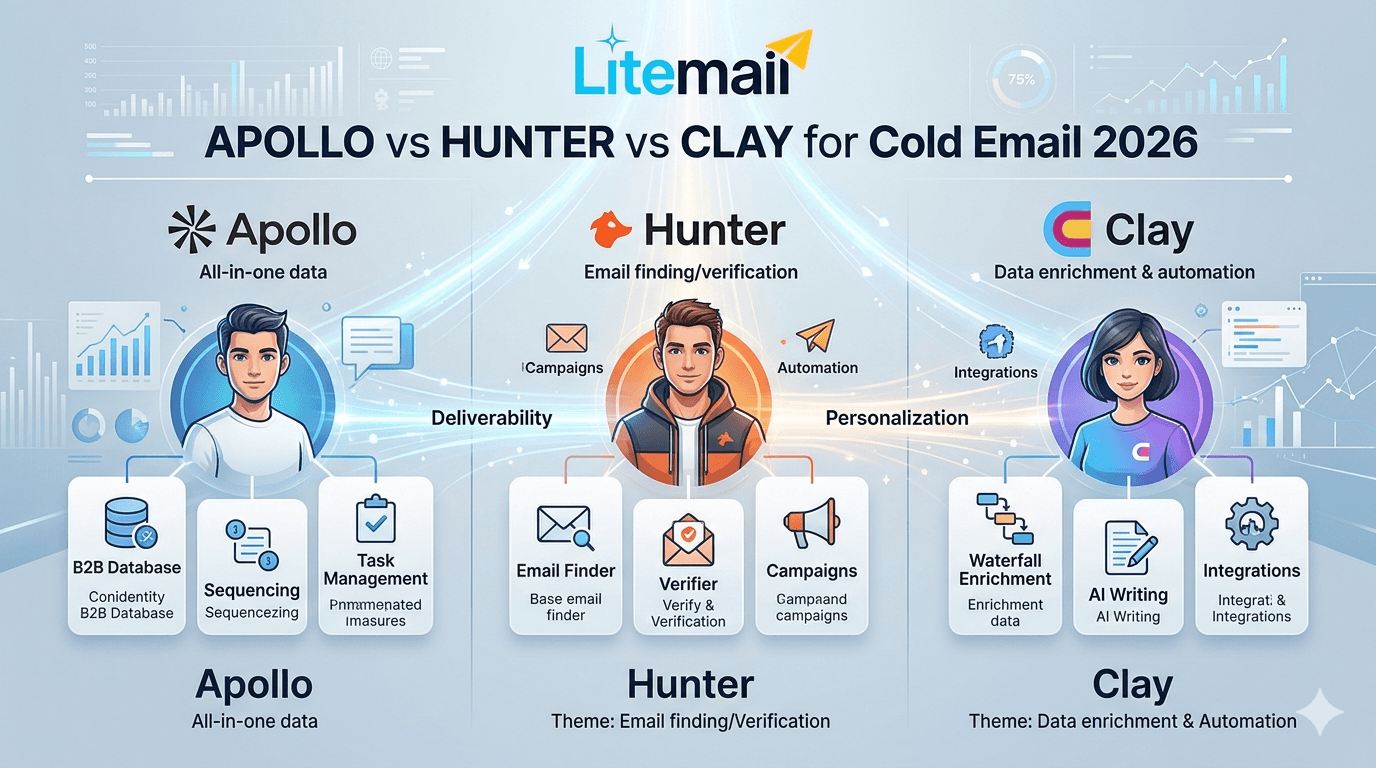
Three tools dominate cold email prospecting in 2026: Apollo, Hunter, and Clay. They're not interchangeable. Apollo is a contact database. Hunter is a domain-specific email finder. Clay is an enrichment and workflow orchestration layer. Choosing the wrong one — or using them in the wrong order — produces either bloated costs or data gaps that limit campaign performance. Here's the direct comparison.
What Each Tool Actually Does
Tool | Core Function | Best At | Not Built For |
|---|---|---|---|
Apollo.io | B2B contact database with built-in prospecting filters and sequences | Finding contacts by ICP filters (title, industry, headcount, tech stack); bulk list building | Deep enrichment of contacts you already have; link building or content outreach |
Hunter.io | Domain-based email discovery — finds emails associated with a specific company domain | Finding specific person's email when you know their name and company; domain-targeted outreach | Building prospecting lists from ICP filters; enrichment at scale |
Clay.com | Multi-source enrichment and AI workflow orchestration — pulls data from 50+ sources and structures it | Deep enrichment on existing lists; AI-generated personalisation at scale; waterfall enrichment | Initial contact discovery — Clay enriches lists, it doesn't build them from scratch |
Apollo.io for Cold Email in 2026
Apollo is the right starting point for most B2B cold email programs. Large verified database, strong ICP filtering, and a built-in sequencing tool that covers prospecting through send for teams that want simplicity.
What works well: ICP filtering by job title, industry, company size, employee count, funding stage, and technology stack. Export contacts to any sending platform or use Apollo Sequences directly. Free tier covers early discovery. Paid plans ($49–$149/month) unlock bulk export and enrichment credits.
Data quality reality: Apollo's database is large but not always current — job titles and emails lag behind LinkedIn by 3–6 months for fast-moving industries. Verification before sending is non-negotiable regardless of Apollo's built-in verification scores. Run every Apollo export through ZeroBounce before campaign launch.
Where Apollo falls short: Enrichment depth beyond the standard fields (title, email, company) is limited compared to Clay. Personalisation workflows require manual setup or integration with a dedicated enrichment layer. For teams doing AI-generated first lines or complex multi-signal personalisation, Apollo alone isn't enough.
Hunter.io for Cold Email in 2026
Hunter is purpose-built for one use case: finding the email address of a specific person at a specific company. That narrow focus makes it the best tool for its use case and a poor tool for anything outside it.
What works well: Domain search to find all known emails at a company domain. Email finder to find a specific person's email by name and domain. Email verification — Hunter's verification scores are reliable for determining deliverability risk. Integration with most cold email platforms via API or Zapier.
Pricing: Free tier (25 searches/month), $34–$104/month for higher volume. Significantly cheaper than Apollo for teams doing targeted account-based prospecting rather than bulk list building.
Where Hunter falls short: No ICP filtering — you need to know which companies to target before Hunter can help you find contacts there. No enrichment beyond basic contact data. Not a prospecting tool in the discovery sense — it's a finder tool once you know the target.
Clay.com for Cold Email in 2026
Clay is the most powerful tool in this comparison — and the most complex. It's an enrichment and automation layer that pulls data from 50+ sources (including Apollo, Hunter, LinkedIn, Clearbit, and others) and structures it into usable contact records with AI-generated personalisation.
What works well: Waterfall enrichment — try Source A for an email, if not found try Source B, then Source C. This improves contact match rate significantly over single-source tools. AI-generated first lines based on LinkedIn activity, recent news, or job posting signals. Automated workflows that build, enrich, and verify contacts without manual intervention.
Pricing: $149–$800+/month depending on credit volume. High for small teams; justified at 10+ inbox scale where AI personalisation converts at significantly higher reply rates.
Where Clay falls short: Steep learning curve — Clay's table interface is powerful but not intuitive. Requires 4–8 hours to set up a functional workflow. Not the starting point for teams new to cold email infrastructure; it's a scale tool that adds value on top of an established Apollo or Hunter foundation.
Which Tool for Which Cold Email Use Case
Use Case | Best Tool | Why |
|---|---|---|
Building a 500-contact ICP list from scratch | Apollo | ICP filters pull the right contacts efficiently; no other setup needed |
Finding the email of the CMO at a specific company | Hunter | Domain + name = email; fastest and cheapest for single-target discovery |
Adding AI personalisation to an existing 2,000-contact list | Clay | Multi-source enrichment + AI first lines at scale — no other tool competes here |
Building and sending a campaign without separate tools | Apollo (with Sequences) | Apollo's built-in sequencer works for simple campaigns; pair with Litemail inboxes for deliverability |
Verifying a list before sending | Hunter or ZeroBounce | Hunter's verifier is good; ZeroBounce is more comprehensive for catch-all handling |
Agency building lists for 10+ clients | Clay + Apollo | Apollo for discovery, Clay for enrichment and personalisation across all clients |
The Stack That Works Together
The optimal cold email prospecting stack in 2026 isn't one tool — it's a sequence:
Apollo: Build the ICP-filtered contact list. Export with title, company, LinkedIn URL, email (where available).
Hunter or ZeroBounce: Verify every email before import. Remove Invalid results; test Catch-All in small batches.
Clay (optional, scale): Enrich with multi-source data, generate AI personalisation, add trigger signals (funding, job postings).
Litemail pre-warmed inboxes: The infrastructure layer that ensures the list quality translates to primary inbox placement. 94–96% placement from Good/High Postmaster reputation means every data-quality investment in the prospecting stack compounds on clean delivery.
The Infrastructure Layer Under Every Prospecting Stack — Litemail
Apollo finds the contacts. Clay enriches them. Litemail pre-warmed inboxes ensure they actually reach the primary inbox. $4.99/inbox — the deliverability foundation that makes prospecting tool investment worthwhile.
Get Pre-Warmed Inboxes from $4.99 →
94–96% placement · Verified Good/High reputation · Dedicated US and EU IPs · No minimum order
About Litemail — Litemail provides pre-warmed Google Workspace and Microsoft 365 inboxes for cold email outreach. From $4.99/inbox with automated DNS, dedicated US and EU IPs, and full admin access. View pre-warmed inbox plans →
Related reading:
Clay.com Review 2026 · Email Verification Tools 2026 · Cold Email Prospecting Guide 2026 · How to Build a Cold Email List 2026 · B2B Cold Email Lead Generation Guide
Key Takeaways
Apollo, Hunter, and Clay serve different functions — not interchangeable alternatives. Apollo discovers contacts by ICP filter. Hunter finds emails for specific known targets. Clay enriches existing lists with multi-source data and AI personalisation.
Apollo is the right starting point for most teams — ICP filters, large database, free tier, built-in sequencing option. Add Hunter for targeted account-based discovery and ZeroBounce for verification before every send.
Clay adds the most value for teams sending 500+ emails per day where AI personalisation and multi-source enrichment meaningfully improve reply rates. The $149+/month price is justified at that scale; it's overkill for small programs.
Verify every Apollo export before sending — Apollo's database lags LinkedIn by 3–6 months. Run through ZeroBounce targeting under 2% bounce rate before campaign launch.
The prospecting stack investment compounds on clean infrastructure. 94–96% primary inbox placement from Litemail pre-warmed inboxes ensures Apollo and Clay's data quality translates to primary inbox delivery — not spam folder non-reads.
Frequently Asked Questions
Is Apollo or Hunter better for cold email in 2026?
Different use cases. Apollo is better for building ICP-filtered prospecting lists from scratch — filter by title, industry, company size, tech stack, and export at scale. Hunter is better for finding the email of a specific person at a specific company when you already know who you want to reach. Most B2B cold email programs use Apollo for list building and Hunter (or ZeroBounce) for verification rather than treating them as alternatives.
Is Clay worth it for cold email in 2026?
At 500+ emails per day with AI personalisation: yes. Clay's waterfall enrichment and AI first-line generation at scale produces meaningfully higher reply rates when the personalisation is genuinely relevant — not generic token substitution. At under 200 emails per day: the $149+/month price is likely overkill — Apollo's built-in enrichment plus manual personalisation achieves comparable results at lower cost.
What is the best cold email prospecting stack in 2026?
Apollo (ICP list building) → ZeroBounce or Hunter (verification) → Clay (optional: multi-source enrichment and AI personalisation at scale) → Litemail pre-warmed inboxes (delivery infrastructure) → Instantly or Smartlead (campaign execution). Each layer serves a distinct function. The infrastructure layer — Litemail at $4.99/inbox — determines whether the data quality in the upper layers translates to primary inbox placement or ends in spam.
How accurate is Apollo's data in 2026?
Good but not current — Apollo's database lags LinkedIn by approximately 3–6 months for job title and email changes. Always verify Apollo exports with ZeroBounce before sending campaigns. Target under 2% bounce rate on any verified Apollo list. Apollo's own email verification scores help but don't replace an independent verification step — catch-all domains in Apollo's output need separate testing before inclusion in campaigns.
Can Clay replace Apollo for cold email prospecting?
No — Clay enriches contacts, it doesn't discover them by ICP filter. Clay requires a seed list to work from — either from Apollo, LinkedIn Sales Navigator, or another discovery source. Think of it as a layer that runs after Apollo, not instead of it. For agencies building lists across multiple clients, the workflow is: Apollo for discovery → Clay for enrichment and personalisation → ZeroBounce for verification → Litemail inboxes for delivery.
How does Hunter.io compare to Apollo for email finding?
Hunter is more accurate for finding a specific person's email given their name and domain — it's built for that exact use case. Apollo is better for finding multiple contacts across many companies via ICP filters. For account-based outreach to a known target list: Hunter. For broad ICP prospecting: Apollo. Many teams use both — Apollo to identify which companies and roles to target, Hunter to find the specific email when Apollo's database doesn't have it.
Apollo vs Hunter vs Clay | Litemail Infrastructure
Whichever prospecting stack you choose, the inbox layer determines delivery. $4.99/inbox — 94–96% placement from verified Good/High reputation.
View Plans & Pricing →
Related reading:
Clay.com Review 2026 · Verification Tools · Prospecting Guide · Build a Cold Email List · B2B Lead Gen Guide






