
Private equity-backed lower-middle-market companies operate under a different set of growth pressures than the normal B2B business.
The objective is not simply to generate more leads.
It is to consistently identify the right accounts, reach the right choice-makers, identify genuine buying intent, and move qualified opportunities into the sales pipeline fast sufficient to support the company's growth plan.
That makes the B2B lead qualification process for PE-backed lower-middle-market companies especially important.
A high volume of contacts can make a CRM look healthy while producing little commercial value. Conversely, a smaller pool of highly relevant prospects can create substantially more useful sales conversations.
For PE-backed businesses, qualification should therefore connect four things:
ICP fit + buying signals + decision-maker access + commercial opportunity This guide explains how to build that system, where old-style requirement outlines fit, how AI and automation can improve the process, and how the same values can be practical to private-equity deal sourcing and M&A lead generation.
What Is B2B Lead Qualification?
B2B lead qualification is the process of determining whether a prospect or account is sufficiently aligned with your ideal customer profile and buying conditions to justify sales attention.
A basic qualification process might ask:
Does the company fit our target market?
Does it have the problem we solve?
Are we speaking with the right person?
Is there a reason to act now?
Is there a realistic commercial opportunity?
What is the next step?
But PE-backed lower-middle-market companies generally need more precision.
The qualification system should connect marketing activity to revenue, sales velocity, customer value, retention, and ultimately the growth objectives of the portfolio company.
Research on B2B lead management similarly emphasizes that lead generation, nurturing, qualification, sales handoff, and opportunity management need to operate as one connected process rather than separate activities.
Why Lead Qualification Is Different for PE-Backed LMM Companies
Lower-middle-market businesses often have:
Narrower addressable markets
More concentrated account lists
Higher-value opportunities
Complex buying committees
Limited sales capacity
Aggressive growth targets
Greater pressure to improve operational efficiency
A defined investment horizon
That changes the economics of qualification.
If your sales team spends hours researching accounts that have little chance of becoming customers, the cost is not simply the SDR's time.
You are also losing:
AE capacity
Follow-up opportunities
Sales velocity
Marketing efficiency
Pipeline visibility
Revenue opportunities
This is why a PE-backed company should not measure qualification success purely by the number of leads produced.
The more useful question is:
How efficiently are we converting target accounts into qualified commercial conversations and opportunities?
The PE-Backed LMM Lead Qualification Framework
A useful framework combines strategic fit with buying intent.
Think about every prospect across two dimensions:
Low Intent | High Intent | |
|---|---|---|
High ICP Fit | Strategic nurture / ABM | Priority sales opportunity |
Low ICP Fit | Disqualify / automated nurture | Selective fast-track |
This prevents a common mistake: treating every active prospect as equally valuable.
A company can have extremely high buying intent and still be a poor customer if it does not fit your ICP.
Likewise, a perfect-fit account may not be ready to buy today.
The qualification system needs to distinguish between those two situations.
Define Your Ideal Customer Profile Before Qualifying Leads
Lead qualification cannot be better than the ICP behind it.
For a PE-backed company, your ICP should be specific enough that a salesperson can look at an account and determine whether it deserves attention.
Define the account-level criteria
Depending on your business, this may include:
Industry
Revenue range
Employee count
Geography
Business model
Technology environment
Customer type
Growth stage
Existing solutions
Operational characteristics
Typical use case
Potential contract value
Then define the buyer-level criteria:
Job title
Functional responsibility
Decision-making authority
Influence over the purchase
Buying committee role
The supplied B2B lead-generation research similarly recommends defining ICP around the companies you can serve effectively and the problems those companies are willing to pay to solve.
Build a qualification matrix
For example:
Qualification dimension | Example |
|---|---|
Industry | Industrial services |
Revenue | $25M–$150M |
Geography | United States |
Business model | Recurring B2B |
Buyer | CEO / CRO / COO |
Problem | Inefficient customer acquisition |
ACV potential | Meets minimum threshold |
Growth signal | Expanding sales organization |
Technology | Compatible stack |
The exact thresholds should come from your own historical customer and opportunity data.
Separate ICP Fit From Buying Intent
One of the biggest improvements a PE-backed company can make is separating fit from behavior.
ICP fit asks:
“Should this company be a customer?”
Intent asks:
“Is this company showing evidence that it may want to act?”
These are different questions.
A company might have:
High fit + low intent
That account may deserve ABM, education, or long-term nurture.
Another company might have:
High fit + high intent
That account should generally receive faster sales attention.
The supplied B2B research recommends keeping fit and behavioral signals distinct so that high activity from a poor-fit account does not automatically outrank a strategically valuable account.
Capture and Enrich the Lead
Once a lead enters your system, enrich it before asking sales representatives to spend significant time on it.
Useful enrichment can include:
Company information
Revenue estimates
Employee count
Industry
Location
Technology
Current leadership
Contact role
Ownership information
Relevant company events
Website activity
Previous CRM history
For M&A-related workflows, ownership verification becomes especially important because the person running a company is not necessarily the person who controls a transaction.
Recent sourcing guidance distinguishes between legal ownership, beneficial control, and operating control, emphasizing that these roles can belong to different people.
For ordinary B2B sales, this translates into a broader principle:
Do not confuse a contact with a qualified decision-maker.
Establish MQL Criteria
A Marketing Qualified Lead (MQL) should not simply mean "someone filled out a form."
A useful MQL definition combines:
Firmographic fit + meaningful engagement
For example:
A company enters the MQL stage when it:
Matches the target industry
Falls within the appropriate company-size range
Has an appropriate buyer
Engages with high-intent content
Visits commercial pages
Requests information
Attends a relevant event
Shows another agreed buying signal
The supplied B2B lead-management research similarly defines MQLs using both firmographic fit and behavioral engagement.
Avoid the "form-fill = MQL" problem
Someone downloading a generic guide does not necessarily deserve an SDR's time.
Compare:
Low signal
Downloads a general industry report.
Higher signal
ICP-fit company visits pricing, reviews implementation information, and requests a consultation.
The second lead contains substantially more evidence for a sales conversation.
Add a Sales Acceptance Stage
Many companies move directly from MQL to SQL.
A better system can introduce Sales Accepted Lead (SAL) as an explicit checkpoint.
The process becomes:
Lead → MQL → SAL → SQL → Opportunity
The SAL stage answers:
“Does sales agree that this lead is worth pursuing?”
That creates an important feedback loop between marketing and sales.
If marketing generates 1,000 MQLs but sales accepts only a small percentage, the problem may be:
ICP definition
scoring
targeting
messaging
data quality
qualification thresholds
The supplied research specifically identifies SAL as a quality checkpoint between marketing qualification and sales qualification.
Conduct the Sales Qualification Conversation
Once sales accepts the lead, qualification should move beyond database information.
Now you need to understand the commercial situation.
A good discovery conversation explores:
Need
What problem exists?
Impact
What does the problem cost the business?
Authority
Who participates in the decision?
Urgency
Why solve it now?
Economics
Is the commercial opportunity viable?
Timing
What does the buying timeline look like?
Next step
What specific action will happen after the conversation?
The objective is not to interrogate the prospect.
It is to determine whether a genuine business opportunity exists.
BANT vs. MEDDPICC vs. ANUM for PE-Backed Companies
Different qualification frameworks solve different problems.
HubSpot's current methodology documentation, for example, includes BANT for quick qualification and MEDDIC/MEDDPIC for complex, high-value B2B sales.
BANT
Budget → Authority → Need → Timeline
Useful for fast initial screening.
Its limitation is that budget is often unclear early in a complex buying process.
ANUM
Authority → Need → Urgency → Money
This can be useful when reaching decision-makers and determining whether an immediate business problem exists.
MEDDPICC
Metrics → Economic Buyer → Decision Criteria → Decision Process → Paper Process → Identify Pain → Champion → Competition
More appropriate when opportunities involve multiple stakeholders, complex procurement, and significant commercial risk.
A practical approach
Don't force the entire sales organization into one framework.
Use qualification layers.
Early stage: fit + authority + need + intent
Discovery: pain + urgency + stakeholders + commercial potential
Complex opportunity: deeper MEDDPICC-style qualification
This gives sales enough structure without turning every first conversation into a 45-question interrogation.
Create a Speed-to-Lead SLA
Qualification quality is only useful if qualified prospects receive timely follow-up.
For high-intent inbound leads, establish a documented SLA.
For example:
Tier 1 lead → immediate routing → SDR response within the agreed target
Tier 2 lead → same-business-day follow-up
Nurture lead → automated or scheduled follow-up
The exact SLA should be based on your sales capacity and buying motion.
The supplied B2B research highlights speed-to-lead as an important operational factor and reports that delayed follow-up can contribute to lead loss.
The key is not choosing an arbitrary number.
The key is having a defined expectation that marketing, SDRs, and AEs all understand.
Score Accounts Using Fit and Intent
A simple scoring system can make qualification easier to operationalize.
For example:
ICP Fit Score
Industry match: +20
Revenue range: +20
Geography: +10
Company size: +10
Target buyer: +15
Intent Score
Pricing page visit: +15
Demo request: +30
Product evaluation: +20
Relevant webinar: +10
High-intent reply: +25
Negative signals
Outside geography: -20
Wrong industry: -30
No relevant use case: -25
Existing disqualifying relationship: -20
But don't blindly copy these numbers.
The weights should be calibrated against your own historical opportunities.
The supplied research recommends measuring fit and behavior separately and using the combined information to determine treatment rather than allowing one dimension to hide the other.
Use Trigger Signals to Improve Qualification
Static firmographics tell you who the company is.
Trigger signals can help indicate why now.
Examples include:
New executive appointment
Expansion into a new market
New facility
Acquisition
Hiring surge
Technology migration
Leadership change
New product launch
Funding or recapitalization
Strategic expansion
Recent B2B prospecting research similarly emphasizes that company events can provide more useful timing signals than firmographics alone.
For PE-backed portfolio companies, these signals can be particularly useful because growth initiatives often create new commercial requirements.
Build a Qualification Process for Outbound Leads
Outbound qualification begins before the first message.
Step 1: Build the account universe
Start with companies that fit the ICP.
Step 2: Enrich the accounts
Identify relevant contacts and account information.
Step 3: Verify contact quality
Confirm that the person still holds the role and is relevant to the buying process.
Step 4: Identify the business hypothesis
Why might this company care about your offering?
Step 5: Launch relevant outreach
Personalize around the business context rather than simply inserting the prospect's name.
Step 6: Qualify responses
Separate:
Interested
Not now
Wrong person
No fit
Already solving it
Curious but unqualified
Qualified opportunity
Step 7: Route and nurture
Qualified opportunities go to sales.
Potential future opportunities remain in structured nurture.
The supplied research recommends verifying account fit, operational fit, buying-group relevance, and contact quality before an account enters outbound execution.
The Role of an AI B2B Lead Qualification Agent
An AI B2B lead qualification agent for PE-backed lower-middle-market companies can automate much of the repetitive work surrounding qualification.
Instead of asking salespeople to manually research every prospect, an AI-assisted workflow can help:
Identify accounts matching the ICP
Enrich company information
Research relevant contacts
Detect buying signals
Score prospects
Summarize account context
Classify inbound responses
Route qualified leads
Trigger follow-up
Update CRM records
But AI should not replace commercial judgment.
The strongest model is:
AI handles scale and repetitive research → humans handle judgment, relationships, and complex qualification.
Research on PE/M&A sourcing similarly describes AI as useful for target identification, research, personalization, and prioritization while retaining human judgment for investment-thesis refinement and owner relationships.
B2B Lead Qualification for PE Portfolio Companies vs. PE Deal Sourcing
These two workflows are related but should not be confused.
Portfolio company lead generation
The objective is:
Find companies that could become customers.
Qualification focuses on:
ICP fit
Need
Intent
Authority
Commercial potential
Timing
Private equity deal sourcing
The objective is:
Find businesses that could become acquisition targets.
Qualification focuses on:
Sector fit
Revenue
EBITDA
Geography
Ownership
Business model
Growth
Strategic fit
Owner authority
Transaction readiness
Timing
Recent PE sourcing research makes the same distinction: a general B2B lead is not equivalent to a qualified acquisition target.
This distinction matters when evaluating lead generation services for private equity firms.
A provider that can generate thousands of generic business contacts is not necessarily capable of generating qualified proprietary deal conversations.
How to Qualify M&A Leads
For M&A deal sourcing, qualification should go beyond:
“Does this company fit our industry?”
A stronger process evaluates at least four dimensions.
1. Company fit
Does the company match the investment thesis?
2. Ownership
Are we speaking with someone who has meaningful authority over a transaction?
3. Strategic fit
Does the company satisfy the financial and strategic characteristics required by the investment thesis?
4. Transaction readiness
Is there genuine openness to exploring a transaction?
That fourth dimension is critical.
A perfect-fit company with no interest in a transaction is not equivalent to a company that fits the thesis and is willing to have a confidential conversation.
Solutions for Finding and Qualifying M&A Leads
A PE firm can build deal flow through several channels.
Referral networks
Investment bankers, brokers, lawyers, accountants, executives, and existing relationships.
Industry events
Conferences and sector-specific networking can create relationships and market intelligence.
Inbound thought leadership
Research, content, and investment perspectives can create awareness among potential sellers.
Direct outbound sourcing
Identify thesis-fit businesses and approach owners directly.
Deal databases
Use databases for market mapping and target identification, followed by deeper verification.
The supplied PE/M&A research identifies these five broad approaches and notes that each has different trade-offs around scalability, predictability, cost, and time to results.
The practical answer is usually not choosing one channel forever.
A PE firm can combine relationship-driven sourcing with systematic outbound and data-driven research.
How to Find Reliable M&A Lead Generation Partners
If you are considering outsourcing your sourcing operation, don't evaluate providers purely on the number of contacts they can deliver.
Ask:
Can they understand your investment thesis?
A provider should be able to translate your criteria into an operational targeting system.
Can they verify ownership?
A CEO title alone does not prove transaction authority.
How do they qualify opportunities?
Ask what must happen before a meeting is considered qualified.
Do they provide conversation context?
A calendar invitation without context is much less useful than a meeting accompanied by research and qualification notes.
Can they maintain a pipeline?
M&A conversations can take months or years to mature.
Can they integrate with your CRM?
Data should flow into the firm's existing sourcing workflow.
What happens to unready owners?
Strong sourcing programs should have a way to maintain appropriate relationships rather than simply discarding every prospect who says "not yet."
How to Evaluate Lead Generation Services for Private Equity Firms
Before choosing among top lead generation services for private equity, evaluate providers across these dimensions:
Evaluation area | Questions to ask |
|---|---|
Thesis alignment | Can they target your exact investment criteria? |
Data quality | How is target and contact information verified? |
Ownership | Can they identify actual owners/controllers? |
Outreach | Is messaging customized to your thesis? |
Qualification | What makes a conversation qualified? |
Reporting | What information accompanies each opportunity? |
CRM | Can they integrate with your workflow? |
Follow-up | How are long-term prospects nurtured? |
Compliance | How are opt-outs and data requirements handled? |
Measurement | Do they measure qualified conversations and downstream outcomes? |
This framework is more useful than comparing providers based on raw lead volume.
What the Best Lead Generation Service for Private Equity Deal Sourcing Should Deliver
For private equity deal sourcing, the output should be closer to a qualified sourcing pipeline than a lead list.
A useful output might contain:
Target company
→ Why it fits the thesis
→ Verified ownership
→ Relevant decision-maker
→ Business context
→ Reason for outreach
→ Conversation status
→ Transaction interest
→ Timing
→ Next step
That gives the deal team something it can actually work with.
Common Lead Qualification Mistakes in PE-Backed Companies
1. Optimizing for lead volume
More leads do not automatically mean more revenue.
A company can increase lead volume while simultaneously decreasing sales productivity.
2. Treating every ICP-fit account as sales-ready
ICP fit establishes potential value.
It does not prove intent.
3. Over-qualifying on budget too early
A prospect may not have a formally approved budget before understanding the business case.
Budget should therefore be considered in context rather than used as an automatic early-stage disqualifier.
4. Ignoring expansion potential
For a PE-backed portfolio company, the value of an account may extend beyond the initial contract.
Consider:
Expansion
Cross-sell
Upsell
Retention
Multi-location potential
Additional business units
5. Chasing large logos outside the ICP
A large enterprise can look attractive on paper but create:
Long procurement cycles
Heavy customization
Implementation complexity
High service requirements
A smaller account that fits the business model may create a more predictable commercial motion.
6. Sending unverified data into outbound campaigns
Bad contact data creates wasted sales activity and can damage outreach performance.
For PE sourcing, incorrect ownership information can be even more problematic because approaching the wrong person can undermine the conversation before it starts.
7. Abandoning "not now" prospects
A prospect who is not ready today may become valuable later.
This is particularly important in M&A, where transaction readiness can change over time.
The supplied PE research specifically highlights the importance of systematic follow-up for long-cycle M&A opportunities.
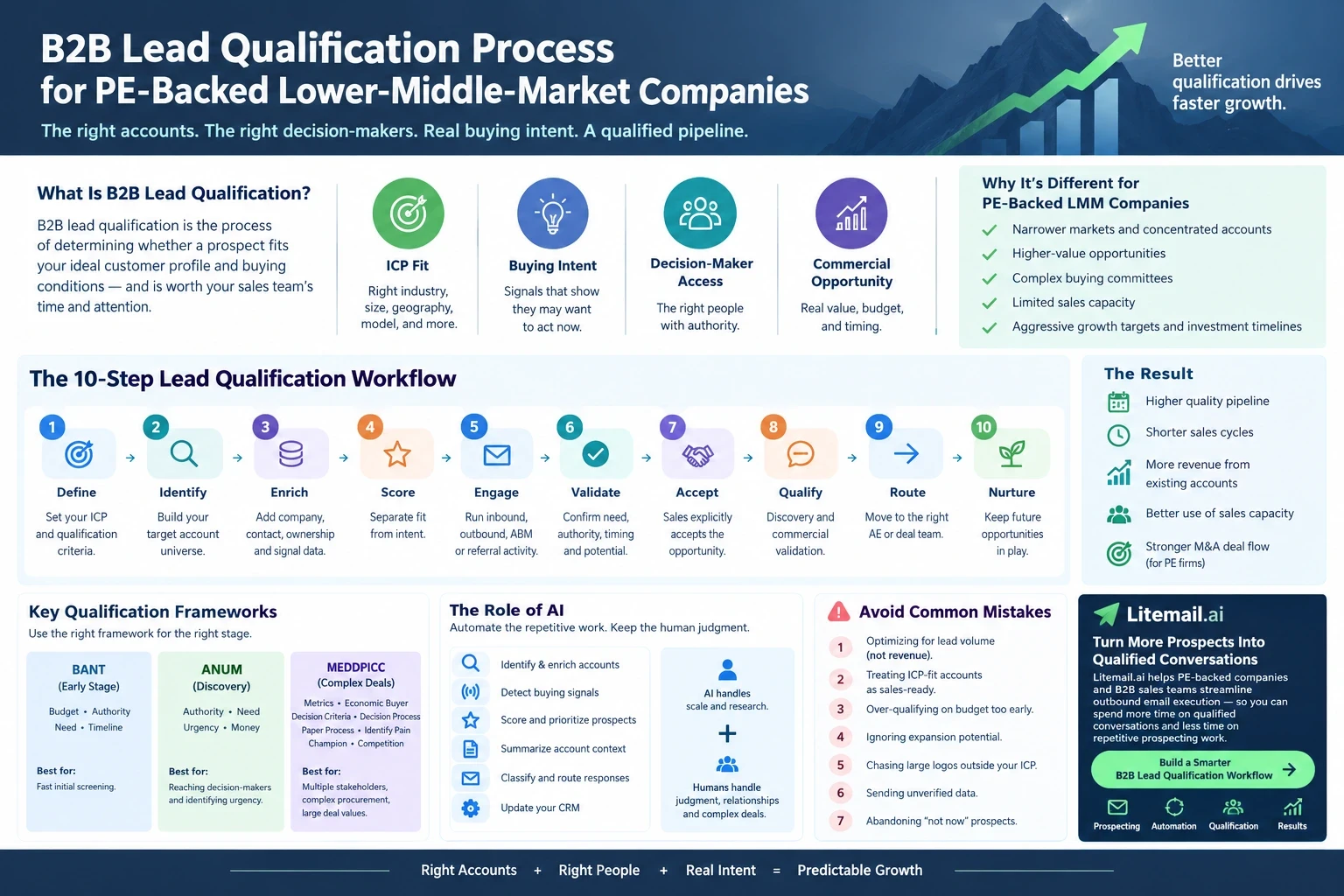
A Practical PE-Backed LMM Lead Qualification Workflow
Here is a simple operating model you can implement:
Stage 1 — Define
Create the ICP and qualification criteria.
↓
Stage 2 — Identify
Build the target account universe.
↓
Stage 3 — Enrich
Add company, contact, ownership, and relevant signal data.
↓
Stage 4 — Score
Separate fit from intent.
↓
Stage 5 — Engage
Run relevant inbound, outbound, ABM, or referral activity.
↓
Stage 6 — Validate
Confirm need, authority, timing, and commercial potential.
↓
Stage 7 — Accept
Sales explicitly accepts the opportunity.
↓
Stage 8 — Qualify
Conduct discovery and determine whether a genuine opportunity exists.
↓
Stage 9 — Route
Move qualified opportunities to the appropriate AE or deal team.
↓
Stage 10 — Nurture
Keep viable future opportunities in structured follow-up.
The Lead Qualification Dashboard PE-Backed Companies Should Track
Don't stop at leads generated.
Track the entire funnel.
Acquisition metrics
Target accounts identified
Contacts verified
Response rate
Engagement rate
Qualification metrics
MQL rate
MQL → SAL
SAL → SQL
SQL → Opportunity
Disqualification rate
Sales metrics
Time to first response
Sales cycle
Opportunity value
Win rate
Pipeline generated
Economic metrics
Customer acquisition cost
Cost per qualified opportunity
Revenue generated
Payback
Expansion revenue
For M&A:
Thesis-fit targets
Verified owners
Owner conversations
Qualified opportunities
Active transaction discussions
LOIs
Closed acquisitions
The central principle is simple:
Measure progression, not activity.
How Litemail.ai Fits Into the Qualification Process
For teams using outbound email as part of their B2B pipeline, Litemail.ai can become part of the execution layer connecting prospecting, outreach, follow-up, and qualification.
The important distinction is that email automation should not be treated as the qualification process itself.
Instead:
Targeting → Enrichment → Outreach → Response → Qualification → Routing → Follow-up
Email is one component of the system.
The real advantage comes from connecting the activity to qualification criteria and CRM outcomes.
For PE-backed companies and M&A teams, that means the objective is not simply to send more emails.
It is to create more relevant conversations with the right accounts and decision-makers.
Frequently Asked Questions
What is a B2B lead qualification process?
A B2B lead qualification process is a structured method for determining whether a prospect fits the company's ICP, has a relevant business need, shows meaningful intent, has appropriate decision-making access, and represents a commercially viable opportunity.
Why is lead qualification important for PE-backed companies?
PE-backed companies often have aggressive growth objectives and limited sales resources. A structured qualification process helps sales teams focus time on accounts with stronger fit and commercial potential instead of processing every lead equally.
What is a B2B lead qualification agent?
A B2B lead qualification agent is an AI-assisted system that can research prospects, enrich account information, analyze signals, score leads, classify responses, and route potential opportunities according to predefined qualification rules.
Human sales judgment remains important for complex conversations and high-value opportunities.
What are the best lead generation services for small private equity firms?
The right service depends on the firm's investment thesis, target sectors, geography, sourcing capacity, and desired level of execution support.
When comparing lead generation services for private equity firms, evaluate thesis alignment, target-data quality, ownership verification, qualification methodology, outreach execution, CRM integration, reporting, and long-term follow-up.
How do private equity firms find M&A leads?
PE firms can source acquisition opportunities through intermediary relationships, referrals, industry networks, inbound positioning, databases, and direct proprietary outreach.
A strong sourcing process then qualifies those targets against the firm's investment thesis.
What makes an M&A lead qualified?
A qualified M&A lead generally requires more than company-level fit.
The target should align with the investment thesis, the relevant owner or decision-maker should be identified, and there should be meaningful openness or potential readiness for a transaction.
Is outbound lead generation useful for private equity deal sourcing?
Outbound sourcing can help PE firms proactively identify and approach thesis-fit companies rather than relying exclusively on opportunities that arrive through intermediaries.
The supplied PE/M&A research identifies systematic outbound prospecting as one approach for proactively identifying and engaging companies that fit defined investment criteria.
Should PE firms use AI for lead qualification?
AI can assist with research, enrichment, target identification, signal detection, scoring, personalization, and workflow automation.
Human judgment remains important for investment-thesis decisions, relationship building, transaction discussions, and final opportunity assessment.
What is the difference between MQL, SAL, and SQL?
An MQL meets marketing-defined fit and engagement criteria.
A SAL has been reviewed and accepted by sales.
An SQL has progressed far enough through sales qualification to represent a credible sales opportunity.
Defining these stages explicitly helps marketing and sales share the same understanding of what "qualified" means.
Final Takeaway: Build a Qualification System, Not Just a Lead List
For PE-backed lower-middle-market companies, lead qualification should be treated as an operating system for growth.
The goal isn't to create the largest possible database.
It is to create a repeatable process that answers:
Who should we target?
Why do they fit?
Why might they act now?
Who can make the decision?
What evidence supports the opportunity?
What should happen next?
For portfolio companies, that process can turn outbound and inbound activity into more predictable sales pipeline.
For private equity firms, the same principles can be adapted to identify thesis-fit companies, verify ownership, qualify owner conversations, and build a more systematic M&A sourcing engine.
And with AI-assisted research, enrichment, scoring, and outreach, much of the repetitive qualification work can be automated—while your sales or deal team stays focused on the conversations that actually matter.
Turn More Prospects Into Qualified Conversations With Litemail.ai
Your sales team shouldn't have to spend its day manually researching every account, writing every follow-up, and sorting through unqualified responses.
Litemail.ai helps teams streamline outbound email execution so they can spend more time on qualified conversations and less time on repetitive prospecting work.
If your PE-backed portfolio company is ready to build a more systematic outbound pipeline, start by defining your ICP, qualification criteria, and follow-up workflow—and then use automation to execute that process consistently at scale.
Build a smarter B2B lead qualification workflow with Litemail.ai.






