
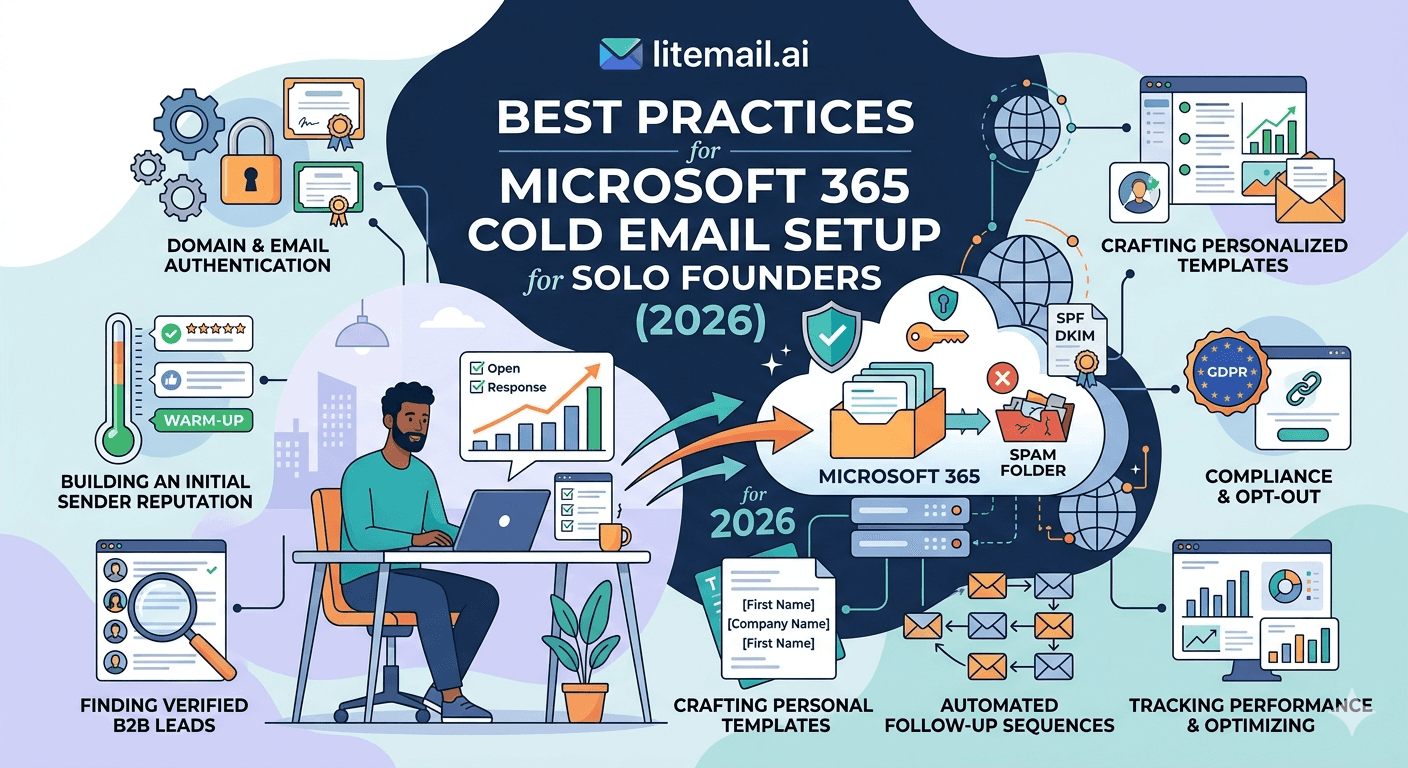
Getting a Microsoft 365 cold email setup working is one thing; keeping it working while running everything else in your business is another. Once the inboxes are live and authenticated, the game shifts from configuration to operation — the daily and weekly habits that keep outreach landing without becoming a second full-time job. These best practices are about running cold email as a solo founder: the volume discipline, targeting, cadence, and monitoring rhythms that sustain results on the limited time you can spare. Not how to set it up — that's a separate job you've done — but how to operate it well once it's running, without it consuming you.
Operating Cold Email, Not Setting It Up
A quick distinction, because it shapes everything here. Setting up cold email — domains, authentication, warm-up — is a one-time job with a clear end. Operating it is ongoing: the choices you make every week about volume, targeting, and monitoring that determine whether the running system stays healthy.
Solo founders often nail the setup and then neglect the operation, treating cold email as set-and-forget. It isn't. An operating cold email system needs regular, lightweight attention, or it degrades — reputation slips, lists go stale, results quietly decline. The good news: done as habits, this attention is minutes a week, not hours a day.
💡 The solo founder's operating principle
Cold email is a system you operate, not a machine you switch on. But for a solo founder, the operation has to fit into a busy week — so the goal is a small set of high-leverage habits, not constant tinkering. The practices below are chosen for exactly that: maximum effect on results, minimum ongoing time. If you've already fixed your setup, this is what comes next.
If your setup itself needs work first, our solo founder setup guide covers that repair job; this picks up after.
Practice 1: Volume Discipline and Cadence
The first operating practice is holding steady, sustainable volume rather than sending in bursts. This is where solo founders most often self-sabotage — sending hard when they have time, then nothing for a week.
Mailbox providers reward consistency. A steady 30 to 50 emails a day per warmed inbox, on a regular schedule, builds and maintains reputation. Erratic sending — a burst of 200 one day, silence the next — looks abnormal and hurts you. For a solo founder, this actually simplifies things: set a consistent daily volume your inboxes can sustain and your calendar can support, and hold it.
Steady daily volume beats sporadic bursts for reputation.
Send on weekdays, business hours so email arrives when people read it.
Match volume to inbox count — don't exceed 30 to 50 per warmed inbox to hit a number.
Automate the sending schedule so consistency doesn't depend on you remembering.
Automating the send schedule is the key solo-founder move here — it makes consistency automatic instead of dependent on your attention. For the volume fundamentals, see our Microsoft 365 daily volume guide.
Practice 2: Targeting Over Volume
The second practice is the one that most improves a solo founder's results per hour: tight targeting. A founder can't out-volume a big sales team, but can out-target them — and precise targeting protects deliverability while lifting replies.
Here's the leverage. A tightly targeted list of prospects who plausibly want to hear from you produces higher replies and — critically — lower spam complaints. Complaints are both a deliverability killer and a suspension risk, and irrelevant outreach is what generates them. So targeting isn't just a reply-rate tactic; it's a deliverability practice.
🚩 The volume-chasing trap
Solo founders under pressure often widen their list to send more, reasoning that more emails means more replies. It usually backfires — a broader, less relevant list draws more complaints, hurts deliverability, and lowers reply rates. For a solo founder, narrowing the list and improving relevance beats expanding it almost every time. Quality of targeting is your competitive edge, not quantity of sends.
For a solo founder, this is liberating: you don't need huge volume, you need a sharp list. That's far more achievable on limited time. For B2B lead-gen fundamentals, see our B2B lead generation guide.
Practice 3: Lightweight Monitoring
The third practice keeps small problems from becoming disasters: a light monitoring rhythm. Solo founders can't monitor obsessively, and don't need to — a few minutes weekly catches what matters.
Here's a realistic solo-founder monitoring cadence:
Check | How often | Act if |
|---|---|---|
Bounce rate | Weekly glance | Above 2% — clean the list |
Reply/positive rate | Weekly glance | Drops sharply — check targeting |
Postmaster reputation | Monthly | Falls to Medium/Low — ease off |
Spam complaints | Monthly | Nears 0.3% — tighten targeting |
The point isn't comprehensive analytics — it's catching a problem before it kills your outreach. A weekly glance at bounces and replies plus a monthly reputation check is enough for a solo founder to stay ahead of trouble. Set a recurring reminder so it actually happens. For what these metrics mean, see our inbox health metrics guide.
Practice 4: Make It Sustainable
The final and most important practice for a solo founder: build the operation so it survives your busy weeks. The best cold email system is one you can actually keep running when everything else demands your attention.
Sustainability comes from removing dependencies on your constant involvement. Automate the sending schedule so it runs without you. Keep the monitoring light enough that you'll actually do it. And — the biggest lever — start with infrastructure that doesn't need ongoing maintenance, so your limited time goes to targeting and replies rather than inbox upkeep.
This is where the setup foundation pays operational dividends. Pre-warmed inboxes that arrived authenticated and warmed don't need you managing warm-up cycles or fixing configuration drift. They stay healthy with the light-touch operation above, freeing your scarce time for the practices that actually drive results — targeting and responding to replies.
Litemail pre-warmed Microsoft 365 inboxes give solo founders that low-maintenance foundation: SPF/DKIM/DMARC pre-configured, genuine warm-up history, dedicated US and EU IPs, and full admin access from $4.99/inbox — infrastructure that stays healthy on minimal attention, so operating cold email fits a founder's week instead of taking it over. For fixing the underlying setup if needed, see our setup improvement guide.
Infrastructure that stays healthy on minimal attention. Litemail pre-warmed Microsoft 365 inboxes give solo founders SPF/DKIM/DMARC pre-configured, genuine warm-up history, dedicated US and EU IPs, and full admin access — a low-maintenance foundation so operating cold email fits your week, from $4.99/inbox. Verified Good or High in Postmaster within 48 hours. Get Pre-Warmed Inboxes from $4.99 →
About Litemail — Litemail provides pre-warmed Google Workspace and Microsoft 365 inboxes for cold email outreach. From $4.99/inbox with automated DNS, dedicated US and EU IPs, and full admin access. View pre-warmed inbox plans →
Related reading: Solo Founder Setup Guide · Microsoft 365 Daily Volume · B2B Lead Generation · Inbox Health Metrics · Common Setup Mistakes · Litemail Pre-Warmed Inboxes — Plans and Pricing
The Bottom Line
Cold email is a system you operate, not switch on — but for a solo founder, operation should be minutes a week, not hours a day.
Send steady daily volume on a regular schedule; erratic bursts hurt reputation more than they help.
Tight targeting beats high volume — it lifts replies and lowers the complaints that kill deliverability.
Widening your list to send more usually backfires; relevance is a solo founder's competitive edge.
Monitor lightly — a weekly glance at bounces and replies, a monthly reputation check — and act on what you see.
Build for sustainability: automate the schedule and use low-maintenance infrastructure so it survives busy weeks.
Frequently Asked Questions
What are the best practices for running Microsoft 365 cold email as a solo founder?
Send steady daily volume on a regular schedule rather than bursts, prioritize tight targeting over high volume, monitor lightly (a weekly glance at bounces and replies plus a monthly reputation check), and build for sustainability by automating the schedule and using low-maintenance infrastructure. These are operating habits for a running system — distinct from the one-time setup job of domains, authentication, and warm-up.
How much time does operating cold email take a solo founder?
Done as habits, minutes a week — not hours a day. The sending schedule can be automated so consistency doesn't depend on you, monitoring is a weekly glance at bounces and replies plus a monthly reputation check, and low-maintenance infrastructure removes upkeep. The aim is a small set of high-leverage habits that keep the system healthy without becoming a second job.
Should a solo founder send more emails or target better?
Target better. A solo founder can't out-volume a sales team but can out-target one, and precise targeting lifts replies while lowering the spam complaints that kill deliverability and risk suspension. Widening a list to send more usually backfires — a broader, less relevant list draws more complaints and lower reply rates. Relevance is a solo founder's real competitive edge.
Why does consistent sending volume matter?
Mailbox providers reward consistency. A steady 30 to 50 emails a day per warmed inbox on a regular schedule builds and maintains reputation, while erratic sending — a burst of 200 one day then silence — looks abnormal and hurts you. For a solo founder, automating the send schedule makes this consistency automatic instead of dependent on remembering to send.
How often should a solo founder monitor cold email?
A weekly glance at bounce rate and reply rate, and a monthly check of Postmaster reputation and spam complaints. That's enough to catch a problem before it kills your outreach without consuming time you don't have. Act when bounces exceed 2%, replies drop sharply, reputation falls to Medium, or complaints near 0.3%. Set a recurring reminder so it actually happens.
How does Litemail help a solo founder operate cold email?
Litemail pre-warmed Microsoft 365 inboxes provide a low-maintenance foundation — SPF/DKIM/DMARC pre-configured, genuine warm-up history, dedicated US and EU IPs, and full admin access from $4.99/inbox. Because they arrive authenticated and warmed, there are no warm-up cycles or configuration drift to manage, so a founder's limited time goes to targeting and replies rather than inbox upkeep.
Buy Pre-Warmed Email Inboxes & Domains | Litemail
Buy pre-warmed email accounts, inboxes and domains from $4.99/inbox. Google Workspace & Microsoft 365. Low-maintenance, US & EU IPs, warm-up built in, setup in 5 minutes.
No minimum order · Low-maintenance · Fits a founder's week
Related reading: Solo Founder Setup Guide · Microsoft 365 Daily Volume · B2B Lead Generation · Inbox Health Metrics · Litemail Pre-Warmed Inboxes — Plans and Pricing






