The best time to send cold emails depends on who you're contacting, where they work, and when they're most likely to review business communications. Sending a relevant email during a prospect's working hours is a sensible starting point, but no specific time guarantees a reply.
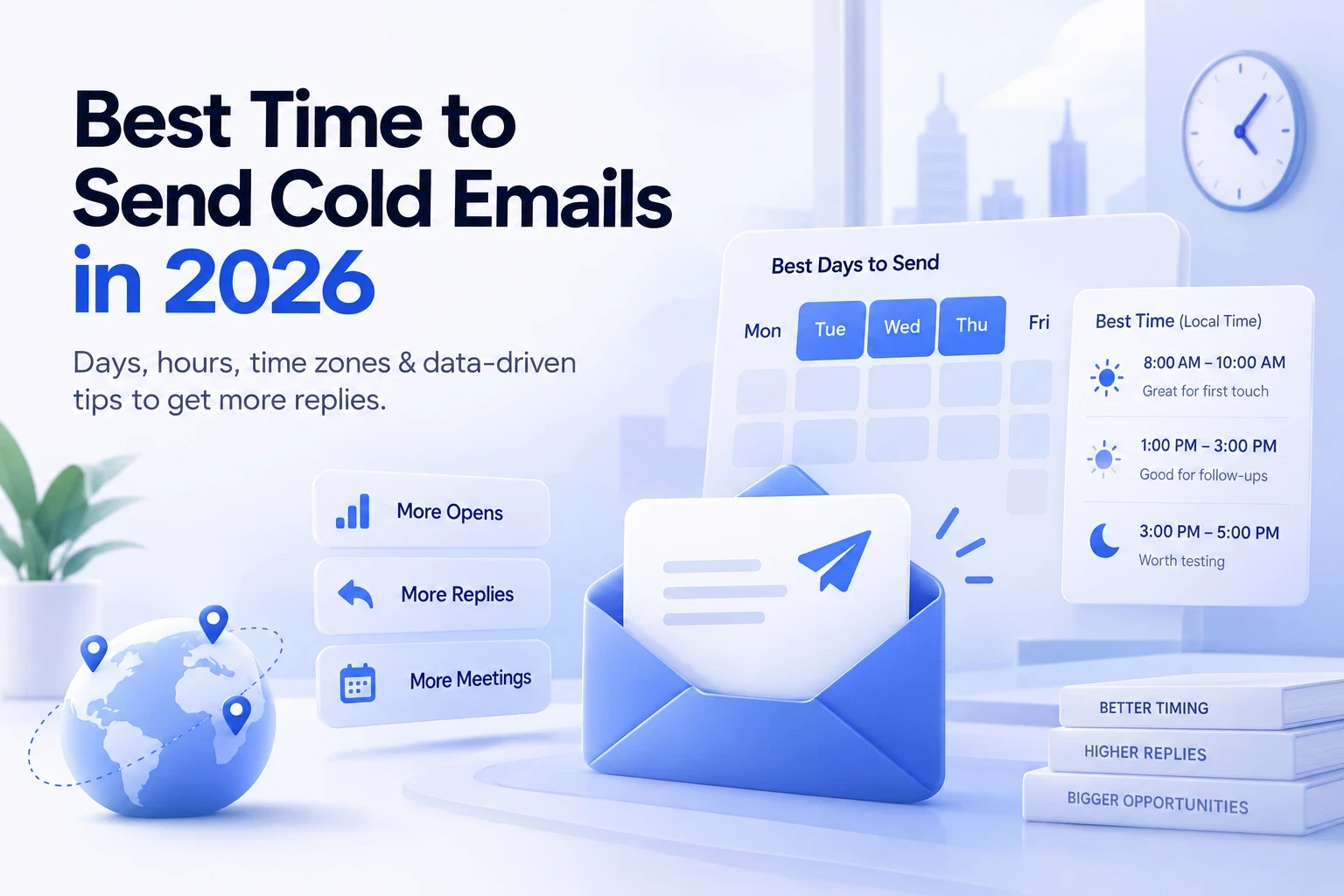
For B2B cold outreach, Tuesday through Thursday mornings are a useful starting point to test. Early afternoons can also work, particularly for prospects whose mornings are filled with meetings. The right schedule ultimately depends on your audience, industry, time zone, offer, and email quality.
In this guide, you'll learn the best time to send cold emails, which days to prioritize, how to schedule follow-ups, and how to test different sending windows. We'll also explain why timing alone cannot fix poor targeting, invalid email addresses, or deliverability problems.
What Is the Best Time to Send Cold Emails?
For B2B outreach, start by testing Tuesday through Thursday between 8:00 AM and 10:00 AM in the recipient's local time zone. Compare that window with an early-afternoon slot, such as 1:00 PM to 3:00 PM.
These are starting hypotheses, not universal benchmarks. Different audiences behave differently, and published studies don't agree on one perfect sending window.
For example, Siege Media reported that its analysis of more than 85,000 personalized outreach emails favored Monday mornings between 6:00 AM and 9:00 AM Pacific Time. Its research focused on personalized outreach rather than every type of cold email campaign. Other industry guidance favors midweek mornings.
The practical lesson is to start with a reasonable schedule, then use your own campaign results to determine which time produces more meaningful replies.
What Is the Best Day to Send Cold Emails?
The best day depends on your audience and the metric you're trying to improve. Use the following schedule as a starting point for testing.
Day | Recommendation | Why test it? |
|---|---|---|
Monday | Test morning sends | Prospects may be planning their week, although some inboxes have accumulated weekend email |
Tuesday | High-priority test day | A useful starting point for reaching prospects during a normal workweek |
Wednesday | High-priority test day | Provides a midweek comparison against Tuesday |
Thursday | High-priority test day | Useful for testing morning and early-afternoon engagement |
Friday | Test selectively | Some prospects remain responsive, but availability and priorities vary |
Saturday–Sunday | Usually deprioritize for B2B | Many business recipients follow weekday schedules |
Recommended starting point: Test Tuesday, Wednesday, and Thursday before expanding your schedule.
Don't assume Monday or Friday is automatically ineffective. If you sell to founders, consultants, or professionals with flexible schedules, those days may perform well. Your audience's actual behavior matters more than a generic calendar rule.
What Is the Best Time of Day to Send a Cold Email?
1. Early morning: 7:00 AM–9:00 AM
Early-morning sends may reach prospects before their calendars fill up. Some decision-makers review email before their first meeting, making this window worth testing.
However, an early send is only useful if it reaches the recipient at a reasonable local hour. A 7:00 AM send in New York is not a 7:00 AM send in California.
Best for testing: Executives, founders, consultants, and professionals who manage their own schedules.
2. Mid-morning: 9:00 AM–11:00 AM
Mid-morning is another practical starting window. Recipients may have begun their workday and started processing business communications.
Test this period against earlier morning sends rather than assuming that everyone checks email at the same time.
Best for testing: Sales leaders, marketing managers, operations professionals, and other office-based B2B audiences.
3. Early afternoon: 1:00 PM–3:00 PM
Early afternoon offers a second opportunity to reach people who spend their mornings in meetings or focused work.
It can also provide a useful alternative if morning sends generate opens but few replies. Compare actual response rates before deciding whether to shift more volume into this period.
Best for testing: Managers, sales teams, and professionals with meeting-heavy mornings.
4. Late afternoon: 3:00 PM–5:00 PM
Some prospects review email as they finish their day's work or prepare for the following day. Late afternoon is worth testing for audiences that are less responsive in the morning.
It may be less suitable for people who finish early, work shifts, or rarely respond outside a fixed schedule.
Best for testing: Sales professionals, consultants, and audiences whose workday includes late-afternoon email review.
Recommended starting schedule
Test group | Sending window | Purpose |
|---|---|---|
A | Tuesday, 8:00–10:00 AM | Test morning engagement |
B | Wednesday, 1:00–3:00 PM | Test early-afternoon engagement |
C | Thursday, 3:00–5:00 PM | Test late-afternoon engagement |
Use the recipient's local time for all three groups. Keep the audience, offer, email copy, and follow-up sequence as similar as possible so that you can make a meaningful comparison.
Does the Best Time to Send Cold Email Depend on Your Industry?
Yes. The right sending window can vary according to the recipient's responsibilities, working hours, and communication habits.
SaaS and technology companies
Start by testing midweek mornings and early afternoons. Product teams, engineers, and technology leaders may have meeting-heavy schedules, so compare different roles rather than treating the entire industry as one audience.
Sales and marketing teams
Test morning sends before calendars become crowded, then compare them with afternoon windows. Sales and marketing professionals often have varied schedules, making role-based testing particularly useful.
Finance and professional services
Consider the recipient's business calendar, client meetings, and reporting periods. A financial decision-maker may have different availability during month-end or quarter-end than during a normal week.
Manufacturing and logistics
Look beyond conventional office hours. Operations leaders may begin work earlier than other B2B audiences, and shift-based teams may not follow a standard 9-to-5 schedule.
Founders and executives
Test early morning and late afternoon as well as conventional business hours. Some executives review email outside normal working hours, but that doesn't mean sending at night is automatically better.
These are practical hypotheses to test, not verified industry-wide rankings. Use your own reply data to determine which windows work for your target market.
How Time Zones Affect Cold Email Timing
Time zones are one of the easiest details to overlook when building an international outreach campaign.
Suppose you're sending to prospects in New York, London, and Sydney. Scheduling every message for 9:00 AM in your own time zone could cause some recipients to receive emails overnight or outside their normal workday.
Instead, schedule messages around each recipient's local business hours.
How to schedule emails across time zones
Identify the prospect's country and, where possible, their city or time zone.
Segment your list by recipient location.
Set sending windows for each segment.
Account for daylight saving time where applicable.
Check your campaign reports to see whether different regions respond differently.
If your outreach platform supports recipient-local-time scheduling, use it and confirm how the platform determines each contact's time zone.
If location data is incomplete, don't guess that every contact in a country shares the same working hours. Start with the most reliable location information available and refine your segments over time.
What Is the Best Time to Send Cold Email Follow-Ups?
Follow-up timing should be planned separately from the timing of your first email. A follow-up gives a prospect another opportunity to respond, but sending too frequently can create a poor experience.
A reasonable starting sequence for B2B outreach is:
Suggested timing | Purpose | |
|---|---|---|
First email | Tuesday–Thursday morning | Introduce a relevant problem or opportunity |
Follow-up 1 | 3 business days later | Briefly clarify the original value proposition |
Follow-up 2 | 4–5 business days later | Share a useful detail or different angle |
Final follow-up | 5–7 business days later | Politely close the conversation |
These intervals are a starting framework, not a proven optimal cadence for every audience. Adjust them to your sales cycle, prospect expectations, and applicable outreach rules.
For each follow-up:
Keep the message relevant to the original conversation.
Add context or value instead of repeating the same request.
Stop contacting recipients who reply, opt out, or otherwise indicate they don't want further messages.
Avoid sending multiple follow-ups in a short period simply because the recipient hasn't responded.
The best follow-up schedule is one that gives prospects a reasonable opportunity to engage without overwhelming them.
How to Find the Best Time to Send Cold Emails for Your Audience
Generic recommendations can help you choose a starting point, but your campaign data should determine your long-term schedule.
Step 1: Establish a baseline
Review your recent campaigns and record the sending day, sending window, audience segment, number of messages sent, positive replies, negative replies, and bounces.
Use the same definitions across campaigns so that your comparisons remain consistent.
Step 2: Test one variable at a time
If you want to compare morning and afternoon sends, keep the audience and message as similar as possible.
For example, divide a comparable prospect list into two groups:
Group A receives the email between 8:00 AM and 10:00 AM.
Group B receives the email between 1:00 PM and 3:00 PM.
Both groups should receive messages in their recipients' local time zones.
Avoid changing the subject line, offer, targeting, and sending time simultaneously. Otherwise, you won't know which change contributed to the result.
Step 3: Measure replies, not just opens
Open tracking can be unreliable because of privacy features and automated image loading. Treat open rate as a secondary diagnostic metric rather than the sole measure of success.
Track:
Reply rate: How many recipients reply.
Positive reply rate: How many replies indicate genuine interest.
Meeting-booking rate: How many recipients book a meeting.
Bounce rate: How many emails fail to reach their intended recipients.
Opt-out and complaint signals: Whether your outreach is creating unwanted engagement.
A time slot that produces more opens but fewer positive replies may not be the better choice.
Step 4: Allow enough time for replies
Don't compare one group's immediate results with another group's results several days later. Give each cohort a comparable response window, such as seven business days after the initial send.
For smaller campaigns, results can fluctuate substantially. A difference of one or two replies may not be enough to establish that a time slot is consistently better.
Step 5: Repeat the test
Repeat your comparison across additional campaigns and similar audience segments. If the same time window continues to produce stronger results, increase its allocation gradually.
If the differences are negligible, stop over-optimizing the clock and focus on targeting, offer quality, messaging, and deliverability.
Does Sending Time Affect Cold Email Deliverability?
Sending time can affect when a message appears in a recipient's inbox and how likely someone is to notice it. However, there is no reliable basis for claiming that a specific hour guarantees inbox placement.
Deliverability depends on a wider set of factors, including sender authentication, domain and IP reputation, recipient validity, complaint rates, sending behavior, and the receiving provider's filtering decisions.
To maintain a healthier outreach process:
Configure SPF, DKIM, and DMARC appropriately.
Verify recipient addresses before sending.
Remove addresses that have hard-bounced.
Monitor server rejections and bounce trends.
Respect opt-outs and applicable email laws.
Avoid sudden, unexplained increases in sending volume.
Timing is an optimization layer, not a replacement for good email infrastructure.
How Pre-Warmed Inboxes Fit Into Your Sending Schedule
Pre-warmed inboxes can be one part of an outbound email setup, but they do not make every sending schedule safe or guarantee that messages will reach the inbox.
When evaluating mailbox infrastructure, consider authentication, reputation, account configuration, sending limits, monitoring, and how the inboxes fit into your existing outreach platform.
Litemail provides pre-warmed Google Workspace and Microsoft 365 inboxes for cold email teams. If you're planning outreach across multiple time zones, combine an appropriate mailbox setup with recipient-local scheduling, verified contact lists, and ongoing performance monitoring.
Explore Litemail if you need mailbox infrastructure for your cold email workflow.
Common Cold Email Timing Mistakes to Avoid
Sending every email at the same time
A rigid schedule isn't inherently wrong, but concentrating all sends into a narrow burst can create operational problems and reduce your flexibility. Use a controlled sending schedule that fits your campaign volume and mailbox configuration.
Don't assume that randomizing timestamps alone will improve deliverability.
Using your own time zone
Scheduling around the sender's time zone can result in messages reaching international prospects at inconvenient hours. Segment contacts by recipient location whenever reliable data is available.
Optimizing for opens instead of replies
An open doesn't mean the prospect is interested. Compare positive replies and meetings booked before deciding that one time slot is better.
Changing too many variables
If you change your copy, offer, list, and schedule at once, your results become difficult to interpret. Test timing separately whenever possible.
Ignoring list quality and deliverability
Sending at an ideal time won't fix invalid addresses or poor targeting. If your bounce rate rises or your messages begin receiving server rejections, investigate those issues before increasing campaign volume.
Key Takeaways
Start by testing Tuesday through Thursday mornings in the recipient's local time zone.
Compare morning sends with early-afternoon and late-afternoon windows.
Adjust your schedule to the recipient's industry, role, location, and working hours.
Use a consistent follow-up cadence and stop when recipients respond or opt out.
Measure positive replies and meetings rather than relying on open rates alone.
Treat timing as one part of a broader process that includes list verification, authentication, and responsible sending.
Frequently Asked Questions
What is the best time to send cold emails?
Tuesday through Thursday between 8:00 AM and 10:00 AM in the recipient's local time is a reasonable starting point to test. Compare it with afternoon windows and use your own reply data to identify the best schedule.
What is the best day to send a cold email?
Tuesday, Wednesday, and Thursday are useful starting days for B2B testing. However, Monday or Friday may work better for certain audiences, so compare results instead of assuming one universal winner.
Is it better to send cold emails in the morning or afternoon?
Neither is universally better. Morning sends may reach recipients during early inbox review, while afternoon sends may work for people whose mornings are filled with meetings. Test both windows with comparable audiences.
Should I send cold emails on weekends?
For conventional B2B outreach, start with weekdays unless your audience has different working patterns. Test weekend sends only when they make sense for the recipients and your outreach practices.
What is the best time to send cold email follow-ups?
A practical starting point is three business days after the first email, followed by a few additional business days between subsequent messages. Adjust the cadence to your audience and stop contacting recipients who opt out or respond.
Does cold email send time affect reply rates?
It can influence when a message is seen, but reply rates also depend on targeting, relevance, the offer, and message quality. Measure your own results to determine whether a particular time window makes a meaningful difference.
How many cold emails should I send per day?
There is no single daily volume appropriate for every mailbox or domain. Consider the provider's limits, account history, infrastructure, recipient quality, and observed delivery outcomes. Increase volume cautiously rather than relying on a universal quota.
Should I schedule cold emails in the recipient's time zone?
Yes, when reliable location data and scheduling tools are available. Recipient-local scheduling helps align messages with normal working hours and avoids sending at inconvenient times because of differences between countries.
Does sending at the best time guarantee inbox placement?
No. Sending time cannot guarantee inbox placement. Authentication, sender reputation, recipient validity, complaint rates, message content, and receiving-provider filtering all influence delivery.
Find the Sending Schedule That Works for Your Audience
The best time to send cold emails is not a universal hour that works for every business. Start with reasonable weekday windows, schedule around the recipient's local time, and test your results with consistent measurement.
Once you've established a baseline, focus on the time slots that produce meaningful replies and qualified meetings. Combine that schedule with relevant messaging, clean contact data, sound authentication, and reliable mailbox infrastructure to build a more effective cold outreach process.