
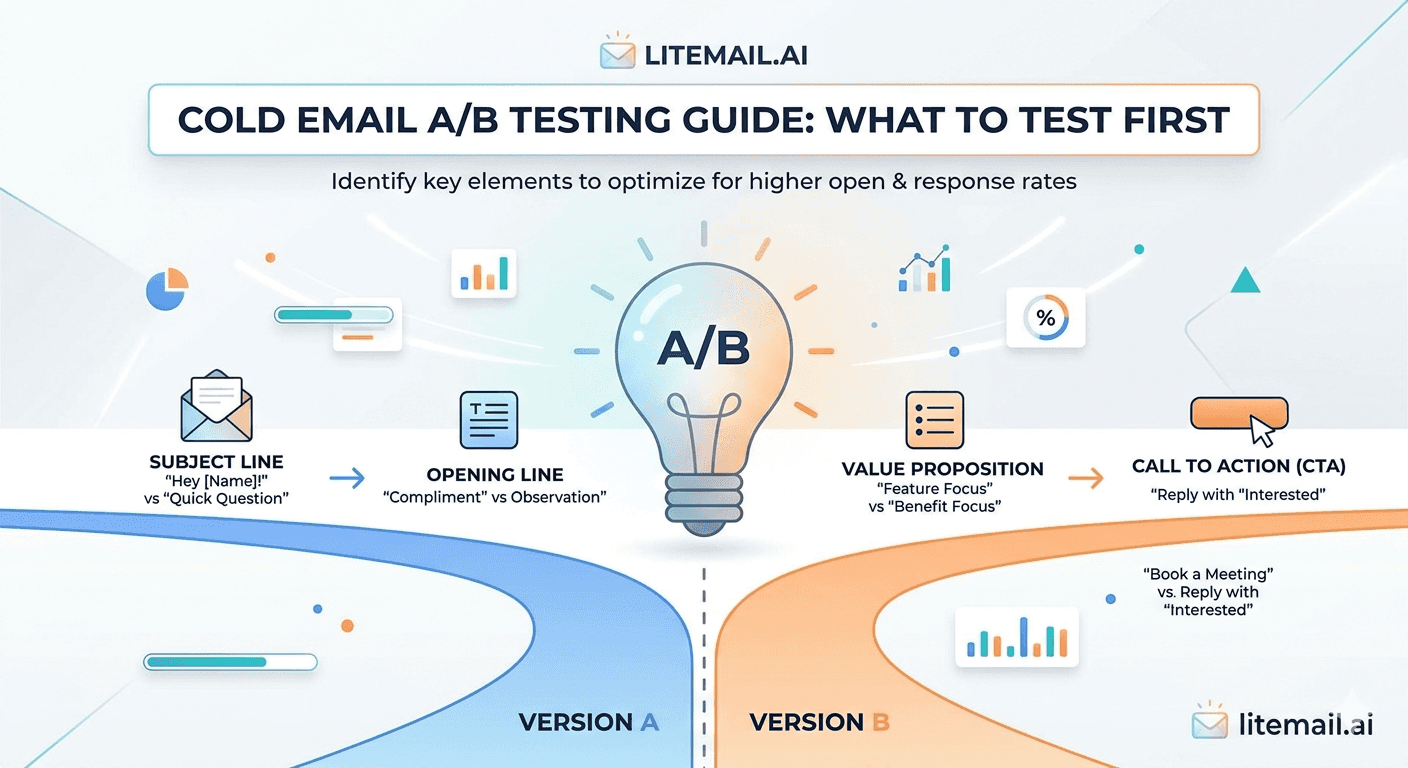
The average B2B cold email reply rate in 2026 is 3.43%. Teams that run disciplined, sequential A/B tests consistently push past 8%. That gap — 3.43% to 8%+ — isn't copy talent. It's systematic testing. But most cold email A/B testing is done wrong: changing two variables at once, testing on lists too small to generate meaningful data, or testing the wrong elements in the wrong order. This guide fixes that.
The 3 A/B Testing Mistakes That Waste Every Test You Run
Before we get to what to test, let's clear out the practices that make testing meaningless regardless of what you're testing.
Mistake 1 — Testing Two Variables at Once
If you change the subject line and the opening line in the same test, you cannot know which change moved the metric. Both might be improvements. One might be helping while the other hurts. You'll never know. Test one element. Lock everything else.
Mistake 2 — Sample Size Too Small
A minimum of 200 emails per variant is required for statistically meaningful cold email results. Under 200 and individual responses — one person having a bad day, one company blocking your email — skew the entire result. For detecting improvements under 15% relative lift, aim for 500+ per variant. Most teams test on 50–100 recipients and call a winner based on results that are statistically noise.
Mistake 3 — Calling a Winner Too Early
Cold email replies come over 5–7 business days — not 24 hours. A test called after 1 day misses most replies. Wait the full cycle. Many teams call winners on day 2 based on a difference that doesn't hold after day 5. Let the test run its full duration before touching anything.
💡 TL;DR
Test one element at a time. Start with subject lines (most impact on opens). Then opening line (most impact on reads-to-replies). Then CTA format. Then sequence length. Minimum 200 emails per variant, wait 5–7 business days for results. A winning variant should show at least 15% relative improvement to count. Four sequential wins of 20% each can roughly double your baseline reply rate.
Test This First, Then This: The Correct Sequence
Testing order matters. Each winning test builds on the last. If you start testing your CTA before you've optimized what gets the email opened, you're optimizing a small fraction of possible impact. Here's the order that compounds results.
Test Priority | Element | Metric It Moves | Time to Results | Expected Lift Range |
|---|---|---|---|---|
1st | Subject line | Open rate | 5–7 business days | 10–30% relative lift |
2nd | Opening line | Open-to-reply rate | 5–7 business days | 15–40% relative lift |
3rd | Call to action format | Reply rate | 5–7 business days | 10–25% relative lift |
4th | Email body length | Reply rate | 5–7 business days | 5–20% relative lift |
5th+ | Sender name, timing, follow-up gaps | Mixed | 7–14 business days | 2–15% relative lift |
Start with subject lines because they control whether anyone reads anything else. A 20% improvement in open rate means 20% more people see your opening line — compounding all downstream improvements. Lock in a winning subject line before testing anything else.
Testing Subject Lines: What the Data Shows for Cold Email
Subject lines in cold email follow different rules than marketing email. Marketing email open rates are inflated by Apple Mail Privacy Protection. Cold email open rates are more reliable because they're measured on direct reply threads, not pixel tracking.
According to Instantly's 2026 Benchmark Report analysis, personalized subject lines that reference a specific pain point outperform generic curiosity lines in cold email — the opposite of what many marketing email tests find. Cold prospects are skeptical, not curious. They respond to specificity.
The specific elements worth testing on subject lines:
Length — Under 6 words vs. 8–12 words. Short lines work well on mobile (most email is read on mobile). Longer lines can communicate more specific value but risk getting cut off.
Personalization — [First name] or [Company] in subject line vs. no personalization. In B2B cold email, personalized subjects consistently show 10–22% higher open rates depending on the segment.
Format — Question vs. statement. "Quick question about [X]" vs. "[X] for [Company]". Questions tend to outperform statements in B2B cold email, but this varies by industry.
Capitalization — Sentence case vs. Title Case. Sentence case reads more like a personal email. Title Case reads more like a marketing email. For cold outreach, sentence case typically wins.
Pain point framing — "Struggling with [X]?" vs. benefit framing "How [Company] solved [X]". Pain framing outperforms benefit framing by 20–25% in most B2B cold email segments tested.
Testing Opening Lines: The Highest-ROI Test in Cold Email
Opening lines are where most cold email lives or dies — and they're the most under-tested element. Once someone opens your email, the opening line determines whether they read on. A 40% improvement in open-to-reply conversion is more valuable than a 40% improvement in open rate, because opens don't pay anything.
The opening lines worth testing in cold B2B email:
Compliment vs. No Compliment
"I loved your recent post on [topic]" vs. leading directly with a problem or question. In our testing at Litemail with cold email campaigns for B2B clients, compliment openers test well for warm-ish audiences (LinkedIn connections) and poorly for fully cold outreach. The more genuinely cold the prospect, the worse the compliment performs — it reads as flattery, not research.
Observation vs. Question
"Most [role] at [company size] companies deal with [X]" vs. "Are you dealing with [X]?" Observation openers demonstrate knowledge. Question openers invite dialogue. Both work — test to find which resonates with your specific segment.
Specific vs. Generic Pain
"I noticed [Company] is still hiring for [specific role]" vs. "Most companies in [industry] struggle with [vague problem]" — specific almost always wins. The specificity signals that the email is written for this recipient, not blasted to thousands.
Testing CTAs: One Ask That Actually Works
The most common CTA mistake in cold email is asking for too much. "Would you have 30 minutes this week for a call?" in email number one is asking a stranger for significant commitment before establishing any value.
Test these three CTA formats against each other:
Open question — "Is [specific problem] something you're actively working on, or not a priority right now?" — This gets a reply even from people who aren't interested ("not a priority") and maintains the relationship for future follow-up.
Binary choice — "Would it make sense to connect, or is there someone better to talk to about this?" — Two options reduces decision paralysis. Works well for senior buyers.
Direct calendar ask — "Would Tuesday or Wednesday work for a 15-minute call?" — Performs better in sequences step 3+ after establishing some relevance, not in step 1.
The open question CTA typically outperforms the calendar ask in first emails by 30–50% in B2B cold email reply rate, according to data from Unify's analysis of disciplined A/B testing programs. Save the calendar link for follow-up emails to people who've already replied positively.
Why Infrastructure Quality Affects Your Test Results
Here's a testing mistake nobody talks about: if your inbox placement rate is inconsistent, your A/B tests are measuring noise. If variant A lands in inbox for 80% of sends and variant B lands in spam for 40%, you're not testing copy — you're testing the lottery of inbox placement.
Clean A/B test results require consistent inbox placement across both variants. That means pre-warmed inboxes with verified domain reputation, not fresh inboxes in the middle of their warmup cycle. In our testing at Litemail, campaigns run from pre-warmed inboxes (94–96% inbox placement) produce test results that are stable and actionable. The same tests run from fresh inboxes during warmup show 15–25% variance in results that has nothing to do with the copy being tested.
You can't reliably test copy on broken infrastructure. Fix the infrastructure first, then test.
Test Copy on Infrastructure That Doesn't Introduce Noise
A/B tests on fresh or inconsistently placed emails produce unreliable data. Litemail pre-warmed inboxes deliver 94–96% inbox placement from day one — your test results reflect copy differences, not inbox lottery. $4.99/inbox, Good/High Postmaster verification, automated DNS.
Get Pre-Warmed Inboxes from $4.99 →
Consistent 94–96% inbox placement · Full admin access · No minimum order · Works with all sending platforms
About Litemail — Litemail provides pre-warmed Google Workspace and Microsoft 365 inboxes for cold email outreach. From $4.99/inbox with automated DNS, dedicated US and EU IPs, and full admin access. View pre-warmed inbox plans →
Related reading: Cold Email Open Rate Benchmarks 2026 · Improve Cold Email Open Rate Tactics 2026 · Cold Email Ultimate Guide 2026 · Best Pre-Warmed Inbox Providers 2026 (Ranked) · Cold Email Deliverability Guide 2026 · Litemail Pre-Warmed Inboxes — Plans and Pricing
Key Takeaways
The average cold email reply rate is 3.43% in 2026. Disciplined sequential A/B testing routinely pushes teams past 8%.
Test one element at a time — changing two variables simultaneously makes results uninterpretable.
Minimum 200 emails per variant for statistically meaningful results. Under 200 and individual outliers skew everything.
Wait 5–7 business days before calling a winner — cold email replies come in slowly and early results are misleading.
Test subject lines first (controls opens), then opening lines (highest ROI test), then CTA format, then body length.
A winning variant should show at least 15% relative improvement to count as a real win, not statistical noise.
Inconsistent inbox placement invalidates A/B test results — pre-warmed inboxes with 94–96% placement rate give you clean data to test against.
Frequently Asked Questions
How many emails do I need to A/B test cold email?
Minimum 200 emails per variant for reliable results. For detecting improvements under 15% relative lift, aim for 500 per variant. Most cold email lists are small enough that hitting 200 per variant requires either a larger list or running the test over a longer period — which is fine as long as both variants run simultaneously to avoid timing bias.
What should I test first in a cold email campaign?
Subject line first, always. The subject line controls whether anyone reads anything else in your campaign. A 20% improvement in open rate compounds across every downstream metric. Once you have a winning subject line, test opening lines next — that's where the highest absolute reply rate improvements are typically found. CTA format, body length, and timing tests come later.
How long should I run a cold email A/B test?
5–7 business days minimum from the last send date. Cold email reply cycles are longer than marketing email — many replies come on day 3 through 5. Calling a winner at 24 or 48 hours almost always produces false results. Wait the full cycle. If you're testing follow-up step timing, extend to 14 days to capture the full reply window including late responders.
Does personalization in the subject line improve cold email open rates?
Yes, consistently. Research from Moosend found personalized subject lines increase opens by approximately 10%. In B2B cold email specifically, personalization that references the prospect's company, role, or a specific relevant detail shows 10–22% higher open rates across most tested segments. First name alone is the lowest-impact personalization. Company name + specific context is more effective. Job title is neutral — everyone targeting that title uses it.
Should I use a question or a statement for cold email CTAs?
For first emails to cold prospects: open question outperforms direct calendar ask by 30–50% in reply rate. Questions like "Is [problem] something you're actively working on?" generate replies even from prospects who aren't interested — which maintains the relationship for future follow-up and gives you useful list segmentation. Direct calendar asks perform better in follow-up steps 3+ after you've already established relevance through prior replies.
How do I know if my A/B test result is statistically significant?
A winning variant should show at least 15% relative improvement over the control to count as a real win. For example: control reply rate 3%, winner must show at least 3.45% to count. Anything smaller could be noise. Use a statistical significance calculator (many are free online) with your sample size and conversion rates. Calling a winner without checking significance is one of the most common testing mistakes in cold email.
Run Tests on Infrastructure That Doesn't Lie | Litemail
A/B test copy, not deliverability luck. Litemail pre-warmed inboxes deliver 94–96% inbox placement consistently — so your test results reflect the copy variable you're testing, not spam filter noise. $4.99/inbox. Good/High Postmaster reputation. Works with all platforms.
Get Pre-Warmed Inboxes from $4.99 →
Consistent 94–96% placement · No minimum order · Works with all platforms · Delivered in 24 hours
Related reading: Cold Email Open Rate Benchmarks 2026 · Improve Cold Email Open Rate Tactics 2026 · Cold Email Deliverability Guide 2026 · Best Pre-Warmed Inbox Providers 2026 (Ranked) · Cold Email Metrics Before and After Pre-Warmed Inboxes · Litemail Pre-Warmed Inboxes — Plans and Pricing
📺 Recommended video: Cold Email A/B Testing: What to Test and When — Full Guide — search on YouTube: cold email A/B testing guide 2026