
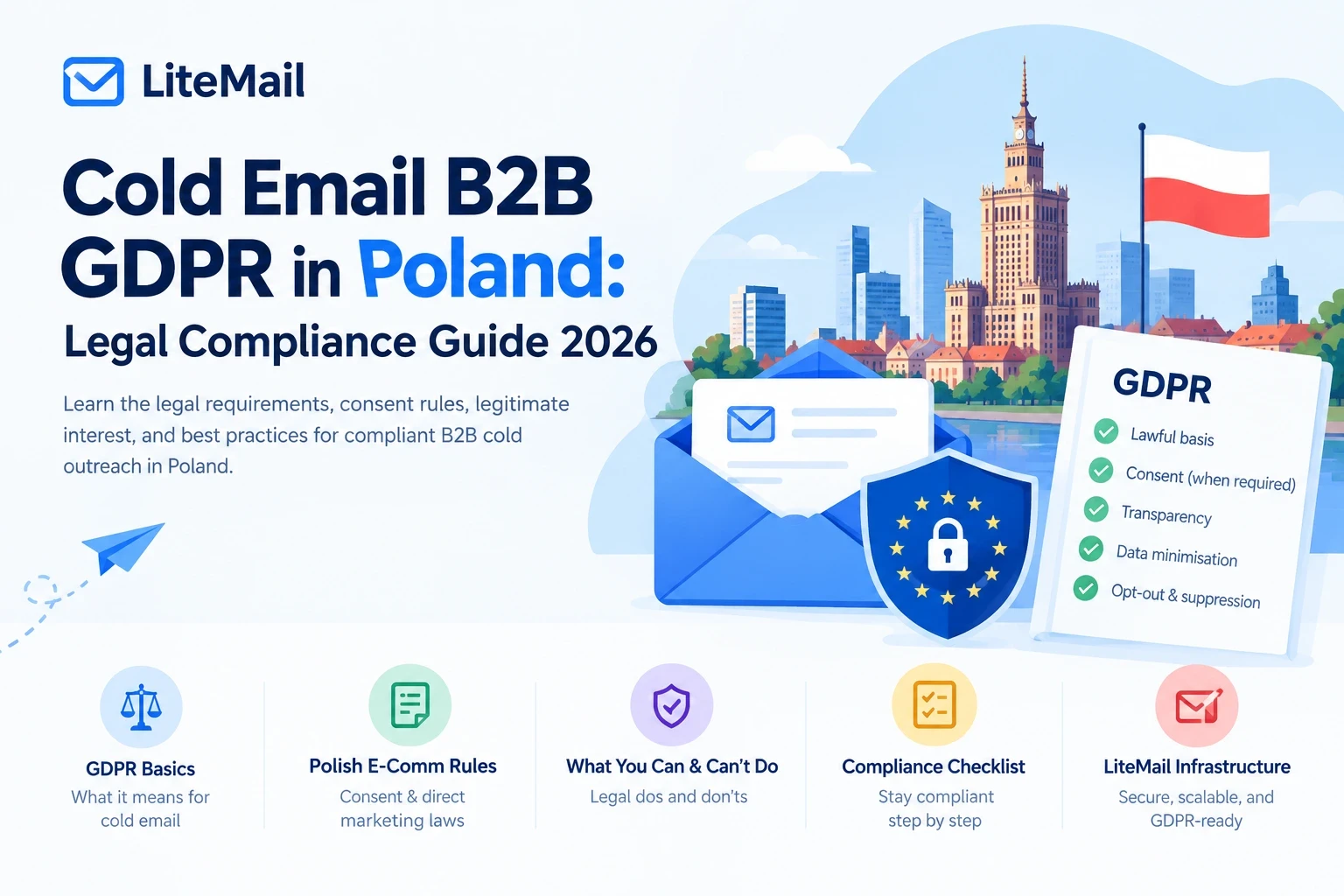
an you send B2B cold email to prospects in Poland?
The short answer is: you need to look at more than GDPR.
GDPR governs how you process personal data, including the personal data contained in many professional email addresses. But electronic direct marketing is also affected by separate electronic-communications rules, including Polish national law.
That distinction matters.
A company can have a legitimate-interest analysis for processing a prospect's data and still need to satisfy separate rules governing whether a commercial message can be sent electronically.
This guide explains the main compliance considerations for B2B cold email targeting Poland in 2026, including GDPR, lawful bases, consent, transparency, opt-outs, data minimisation, Polish electronic-communications rules, and the technical infrastructure behind compliant outreach.
Important: This article is an educational guide, not legal advice. Polish and EU marketing rules can depend on the recipient, communication method, data source, and exact campaign. If you are launching a large-scale campaign or have a specific legal question, consult qualified Polish/EU counsel.
TL;DR
If you're planning B2B cold email campaigns targeting Poland, don't treat GDPR as the only rule.
Your compliance workflow should cover:
The lawful basis for processing personal data
The rules governing electronic direct marketing
Whether consent is required for the specific communication
Why the recipient is being contacted
Data minimisation
Transparent privacy information
A clear way to object or unsubscribe where applicable
Immediate suppression of opted-out contacts
Reliable records of consent or other legal basis
Responsible data sourcing
Proper email authentication and sending infrastructure
The key distinction is simple:
GDPR answers how you may process personal data. Other electronic-communications rules can determine whether and how you may send direct-marketing messages.
Is Cold Email Legal in Poland?
There is no simple “GDPR allows it” answer.
GDPR itself does not create a blanket ban on B2B outreach. The European Data Protection Board notes that direct marketing may, in some circumstances, constitute a legitimate interest, but legitimate interest is not automatic: the controller still needs to satisfy the applicable conditions and balance the rights and interests involved.
At the same time, EU electronic-communications rules address unsolicited electronic direct marketing separately.
Poland has implemented its own electronic-communications framework. The current Polish Electronic Communications Law includes a prior-consent requirement for using covered electronic communications to transmit commercial information, including direct marketing.
That means businesses targeting Polish recipients should evaluate both layers rather than relying on a generic statement such as “GDPR allows B2B cold email.”
GDPR vs Polish Electronic Communications Rules
This is the most important distinction in the entire topic.
Think about compliance as two connected questions.
Question 1: Can I process this person's data?
This is the GDPR question.
For example, you may be processing:
Name
Professional email address
Job title
Company
Industry
Business contact information
GDPR requires a lawful basis for processing personal data and imposes additional obligations around transparency, minimisation, security, retention, and individual rights.
Question 2: Can I send this commercial message?
This is where electronic-communications and direct-marketing rules become important.
The EU ePrivacy framework addresses unsolicited electronic communications for direct marketing, and national legislation determines how those rules operate in individual countries.
For Poland, the current Electronic Communications Law is therefore an important part of any B2B cold-email compliance review.
Don't collapse these two questions into one.
A legitimate-interest analysis under GDPR does not automatically answer every question about whether a particular marketing email may be sent.
What Does GDPR Have to Do With Cold Email?
A professional email address can still be personal data when it identifies an individual.
For example:
can identify a specific person.
By contrast, a generic address such as:
may not be personal data in the same way, depending on the circumstances.
The European Commission explains that GDPR applies to processing personal data and specifically identifies sending promotional emails as an example of processing. It also notes that direct marketing emails must comply with applicable marketing rules under the ePrivacy framework.
That means your compliance process needs to consider both data protection and electronic marketing requirements.
Legitimate Interest Under GDPR
One of the most misunderstood parts of cold email compliance is legitimate interest.
Article 6(1)(f) GDPR provides a legal basis for processing personal data when legitimate interests apply and the required balancing conditions are satisfied.
For direct marketing, the European Data Protection Board explains that direct marketing may constitute a legitimate interest, but that does not mean every direct-marketing activity automatically qualifies.
A legitimate-interest assessment generally asks three questions.
1. Is there a legitimate purpose?
You need a genuine business purpose for the processing.
For example:
A B2B software company wants to contact sales leaders at companies that match its target customer profile.
That's a specific commercial purpose.
Compare that with:
We collected as many email addresses as possible and might contact them about something eventually.
The second approach is much harder to justify.
2. Is the processing necessary?
Ask whether the data you're using is actually necessary for the purpose.
If you need:
Name
Professional email
Company
Job title
you should question whether additional personal information is actually necessary.
3. Do the recipient's rights override the interest?
This is the balancing stage.
Consider:
What would the recipient reasonably expect?
How relevant is the offer?
How was the data obtained?
Is the contact professional or personal?
How intrusive is the campaign?
How frequently are you contacting the person?
Can the recipient easily object?
A legitimate-interest assessment should be specific to the campaign rather than a generic paragraph copied between campaigns.
But Legitimate Interest Does Not Automatically Mean “Send the Email”
This is where many cold-email guides become misleading.
You may see statements such as:
“GDPR allows B2B cold email under legitimate interest.”
That is incomplete.
GDPR lawful basis and electronic-marketing rules are related but separate issues.
The European Data Protection Board specifically notes that legitimate interest does not automatically make all direct marketing lawful and that another legal basis, such as consent, may be required in some circumstances.
For Poland, this distinction is especially important because national electronic-communications rules need to be considered when sending commercial communications electronically.
Your compliance checklist should therefore ask both questions before a campaign launches.
What Does Polish Law Require for Commercial Email?
Poland's current Electronic Communications Law is particularly important for cold-email operators.
Article 398 addresses the use of electronic communications for transmitting commercial information, including direct marketing, and provides for prior consent from the subscriber or end user.
The law also specifies that consent can be expressed through providing an identifying electronic address for the purpose of receiving commercial information.
This is why a Poland-specific cold-email strategy should not simply copy a general “EU GDPR cold email” playbook.
The exact legal analysis can depend on:
Who the recipient is
What type of address is being used
What the message contains
How the address was obtained
Whether consent exists
Whether the communication is direct marketing
Whether another legal exception applies
Which communication channel is being used
For campaigns at scale, get the specific workflow reviewed by Polish counsel before relying on a particular interpretation.
B2B Does Not Automatically Mean “No Consent”
Another common mistake is assuming:
“It's B2B, so consent isn't required.”
That is too broad.
B2B status can matter to the analysis, but it does not automatically override electronic-marketing rules.
You should distinguish between:
Business context
and
legal permission to send a particular commercial communication.
A recipient may work for a company, but that alone does not answer every question about whether you can send unsolicited marketing to that person's electronic address.
Work Email vs Personal Email
Your data strategy should also distinguish professional addresses from personal addresses.
Example
Professional:
jane@acme.com
Personal:
jane.smith@gmail.com
The first address may be relevant to a professional B2B campaign.
The second is much more problematic for a B2B campaign because it is a personal address and may create additional privacy and marketing concerns.
For EU campaigns, a strong operational rule is:
Build campaigns around professional relevance and minimise unnecessary personal data.
Don't enrich a B2B prospect simply because more personal information is available
What Data Should You Collect?
Use data minimisation as a campaign design principle.
A typical B2B prospect record may need:
Data | Typical purpose |
|---|---|
First name | Personalisation |
Last name | Identification |
Professional email | Business communication |
Company | Business relevance |
Job title | Role relevance |
Company website | Company context |
Industry | Segmentation |
Be cautious about collecting unnecessary information such as:
Home address
Personal phone number
Personal social accounts
Family information
Health information
Political information
Religious information
Other sensitive personal information
If a field isn't necessary for the campaign, ask why you're storing it.
How Should You Source B2B Contact Data?
Data sourcing is part of compliance.
Don't assume that because an email address is visible online, you can automatically use it for any marketing purpose.
Before using a data provider, ask:
Where did the provider obtain the data?
What categories of data are collected?
What legal basis does the provider rely on?
How is transparency handled?
How are deletion requests handled?
How are opt-outs handled?
Can the provider explain its data provenance?
If the provider cannot clearly explain its data practices, that's a warning sign.
Transparency Matters
GDPR isn't only about having a lawful basis.
People also have information rights.
Your privacy information should explain relevant matters such as:
Who is processing the data
Why the data is being processed
What categories of data are involved
The applicable legal basis
Relevant data retention information
Individual rights
How to contact the organisation
Don't hide your identity behind a generic sender.
A professional outbound email should make it reasonably clear who is contacting the recipient and why.
Give Recipients a Clear Way to Object
Your outbound system should have a reliable suppression process.
If someone says:
“Please don't contact me again.”
that request needs to reach the systems responsible for sending future campaigns.
A good suppression workflow should prevent the contact from being re-added through:
Another campaign
Another salesperson
Another CSV import
Another enrichment provider
Another sending account
This is where automation becomes important.
A suppression list should be treated as infrastructure, not as a spreadsheet someone remembers to update manually.
What Should Your Cold Email Include?
For a compliant-conscious B2B campaign, your email should make the sender and purpose clear.
A practical structure is:
Sender identity
Who are you?
Company identity
What organisation are you representing?
Relevant reason
Why is this person receiving the message?
Clear next step
What are you asking?
Opt-out / objection mechanism
How can the recipient stop future outreach?
The exact legal requirements can vary by jurisdiction and campaign, so treat this as an operational framework rather than a substitute for legal review.
Poland Cold Email Compliance Checklist
Before launching a campaign targeting Polish prospects, work through this checklist.
Legal
Identify the jurisdictions you're targeting
Determine whether the communication is direct marketing
Determine the applicable Polish electronic-communications rules
Identify the GDPR lawful basis for processing personal data
Document the reasoning behind your legal basis
Check whether consent is required
Keep evidence of consent where applicable
Data
Use relevant professional contact data
Avoid unnecessary personal information
Review your data provider
Document data sources
Maintain accurate contact records
Have a process for data-subject requests
Identify the sender
Identify the company
Make the business relevance clear
Provide the required contact information
Provide an appropriate opt-out mechanism
Process objections promptly
Infrastructure
Use dedicated sending domains
Configure SPF
Configure DKIM
Configure DMARC
Separate outreach from critical transactional email
Monitor sending reputation
Use responsible sending volumes
Monitor spam complaints and bounces
GDPR Compliance Is Not the Same as Deliverability
This is an important distinction for cold email teams.
You can have a legally reviewed campaign that still lands in spam.
And you can have technically excellent email infrastructure that doesn't make an unlawful campaign lawful.
These are separate layers.
Legal layer
GDPR
Polish electronic-communications rules
Consent
Lawful basis
Transparency
Data minimisation
Recipient rights
Technical layer
SPF
DKIM
DMARC
Sending domains
Mailboxes
IP reputation
Bounce handling
Complaint monitoring
Campaign layer
Targeting
Relevance
Copy
Sending frequency
List hygiene
Opt-out management
A serious outbound operation needs to manage all three.
Build the Technical Layer With LiteMail
Once the legal and campaign requirements are understood, the next step is making sure your sending infrastructure is configured correctly.
This is where LiteMail fits into the stack.
LiteMail provides cold-email infrastructure built around:
Google Workspace inboxes
Microsoft 365 inboxes
Sending domains
Automated DNS
SPF
DKIM
DMARC
US/EU IP infrastructure
Pre-warmed options
Mailbox scaling
OAuth export to outreach platforms
The infrastructure can be connected to platforms such as Instantly and Smartlead, allowing the sending infrastructure and campaign-management layer to remain separate.
That distinction is useful.
Compliance determines what you're allowed to do.
Infrastructure helps you operate the campaign correctly.
LiteMail does not replace your legal compliance process, but it can handle much of the technical infrastructure required by a cold-email operation.
Why Separate Cold Email Infrastructure From Your Main Domain?
Your primary business domain may handle:
Customer communication
Transactional email
Password resets
Invoices
Support
Employee communication
Cold outreach is a different email stream.
For that reason, many outbound teams separate campaign infrastructure from critical business email.
A simplified architecture looks like:
Primary Business Domain
→ Customer + transactional communication
Dedicated Outreach Domains
→ Cold email campaigns
Mailboxes
→ Google Workspace / Microsoft 365
Authentication
→ SPF + DKIM + DMARC
Sending Platform
→ Campaigns + sequences + reply management
This separation gives the team clearer operational boundaries.
LiteMail for Poland-Focused Outreach
If your team sends campaigns into Poland, you can build the infrastructure separately from your legal workflow.
For example:
Step 1 — Define the audience
Polish B2B decision-makers relevant to your offer.
↓
Step 2 — Review the legal basis
Determine the applicable GDPR and electronic-marketing requirements.
↓
Step 3 — Verify the data
Use relevant professional contact information and document the source.
↓
Step 4 — Prepare your infrastructure
Set up domains, Google Workspace or Microsoft 365 inboxes, SPF, DKIM and DMARC.
↓
Step 5 — Connect your sending platform
Connect the mailboxes to your outreach platform.
↓
Step 6 — Build suppression controls
Make sure objections and opt-outs prevent future sends.
↓
Step 7 — Launch conservatively
Monitor bounces, complaints, replies and reputation.
↓
Step 8 — Audit regularly
Review both the legal process and the technical infrastructure.
A Simple Poland Cold Email Compliance Workflow
Here's the complete process in one view:
Targeting
→ Is this genuinely relevant to the recipient's professional role?
↓
Data
→ Do we know where the contact information came from?
↓
Legal
→ What GDPR basis applies?
↓
Marketing rules
→ Does Polish electronic-communications law require consent for this communication?
↓
Transparency
→ Can the recipient understand who we are and why we're contacting them?
↓
Objection
→ Can the recipient easily stop future outreach?
↓
Suppression
→ Will that objection block future campaigns?
↓
Infrastructure
→ Are SPF, DKIM and DMARC configured?
↓
Monitoring
→ Are bounces, complaints and sending reputation being monitored?
This is much safer than thinking:
“It's B2B, so we can send it.”
Common Poland Cold Email Mistakes
Mistake 1: Treating GDPR as the only law
GDPR is only one part of the compliance picture.
Better approach: Evaluate GDPR together with applicable electronic-communications and direct-marketing rules.
Mistake 2: Assuming B2B automatically means consent isn't required
Business recipients aren't automatically exempt from every marketing restriction.
Better approach: Check the rules applicable to the communication and recipient.
Mistake 3: Buying a huge list without checking provenance
A list size doesn't tell you whether the data was obtained or processed appropriately.
Better approach: Ask your provider about data sources, legal basis and privacy processes.
Mistake 4: Using personal email addresses
A personal Gmail address isn't equivalent to a professional business address.
Better approach: Keep B2B campaigns focused on relevant professional contacts.
Mistake 5: Treating unsubscribe as a manual task
A spreadsheet isn't enough when multiple campaigns and senders are involved.
Better approach: Maintain a central suppression process.
Mistake 6: Thinking SPF/DKIM/DMARC makes a campaign legal
Authentication is technical infrastructure.
It doesn't create a legal basis for marketing.
Better approach: Keep legal compliance and deliverability as separate layers.
Mistake 7: Using the same domain for everything
Cold outreach, transactional email and core business communication have different risk profiles.
Better approach: Separate outbound infrastructure from critical business email where appropriate.
Frequently Asked Questions
Is cold email legal in Poland in 2026?
There is no simple yes/no answer based on GDPR alone. GDPR governs personal-data processing, while Polish electronic-communications rules also regulate commercial communications. The current Polish Electronic Communications Law contains a prior-consent requirement for covered electronic communications used to transmit commercial information, including direct marketing. The exact application depends on the recipient, message, data and communication method.
Does GDPR allow B2B cold email?
GDPR does not categorically ban B2B direct marketing. Legitimate interest can sometimes provide a lawful basis for processing personal data, but it requires a case-specific assessment and does not automatically override separate electronic-marketing rules.
Is legitimate interest enough to send cold email in Poland?
Not necessarily. Legitimate interest is a GDPR data-processing concept. You also need to consider the Polish rules governing electronic commercial communications.
Do I need consent for B2B cold email in Poland?
You should not assume that B2B status removes the consent requirement. Poland's current Electronic Communications Law contains a prior-consent rule for covered electronic communications used for commercial information/direct marketing. The exact legal position depends on the communication and circumstances.
Can I email a Polish business email address?
A professional email address may still constitute personal data if it identifies an individual. You therefore need to consider GDPR and the applicable electronic-marketing rules before using it for outreach.
Does SPF, DKIM and DMARC make cold email GDPR compliant?
No.
SPF, DKIM and DMARC are technical email-authentication mechanisms. They help authenticate and protect email infrastructure but do not establish a lawful basis for processing personal data or permission to send marketing messages.
Does LiteMail provide GDPR compliance?
LiteMail provides email infrastructure; it does not determine whether your campaign is legally compliant.
You remain responsible for your targeting, data sources, lawful basis, consent requirements, messaging and opt-out process.
LiteMail can help with the technical layer, including mailboxes, domains, DNS, SPF, DKIM and DMARC.
Can LiteMail be used for European outreach?
LiteMail provides Google Workspace and Microsoft 365 inbox infrastructure, domains, automated DNS, SPF, DKIM, DMARC and US/EU IP options. Teams can use the infrastructure as part of a broader outbound stack.
Can I connect LiteMail to Instantly or Smartlead?
Yes. LiteMail currently advertises OAuth export/connectivity for Instantly and Smartlead, allowing teams to use LiteMail for infrastructure while managing campaigns through their existing outreach platform.
Final Takeaway
The biggest mistake in Poland-focused cold email is treating GDPR as the entire legal framework.
A responsible B2B outreach program should separate three questions:
1. Data protection
Do you have an appropriate GDPR basis for processing the prospect's personal data?
2. Electronic marketing
Are you allowed to send the specific commercial communication under the applicable Polish rules?
3. Technical delivery
Is your email infrastructure configured correctly and operated responsibly?
These are different questions.
For the legal layer, document your process and get professional advice when the circumstances require it.
For the infrastructure layer, LiteMail can provide the operational foundation: Google Workspace and Microsoft 365 inboxes, sending domains, SPF, DKIM, DMARC, US/EU infrastructure, pre-warmed options, and connections to outreach platforms.
The goal isn't simply to send more cold emails.
It's to build an outbound system where targeting, legal compliance, data handling, infrastructure and sending practices work together.