
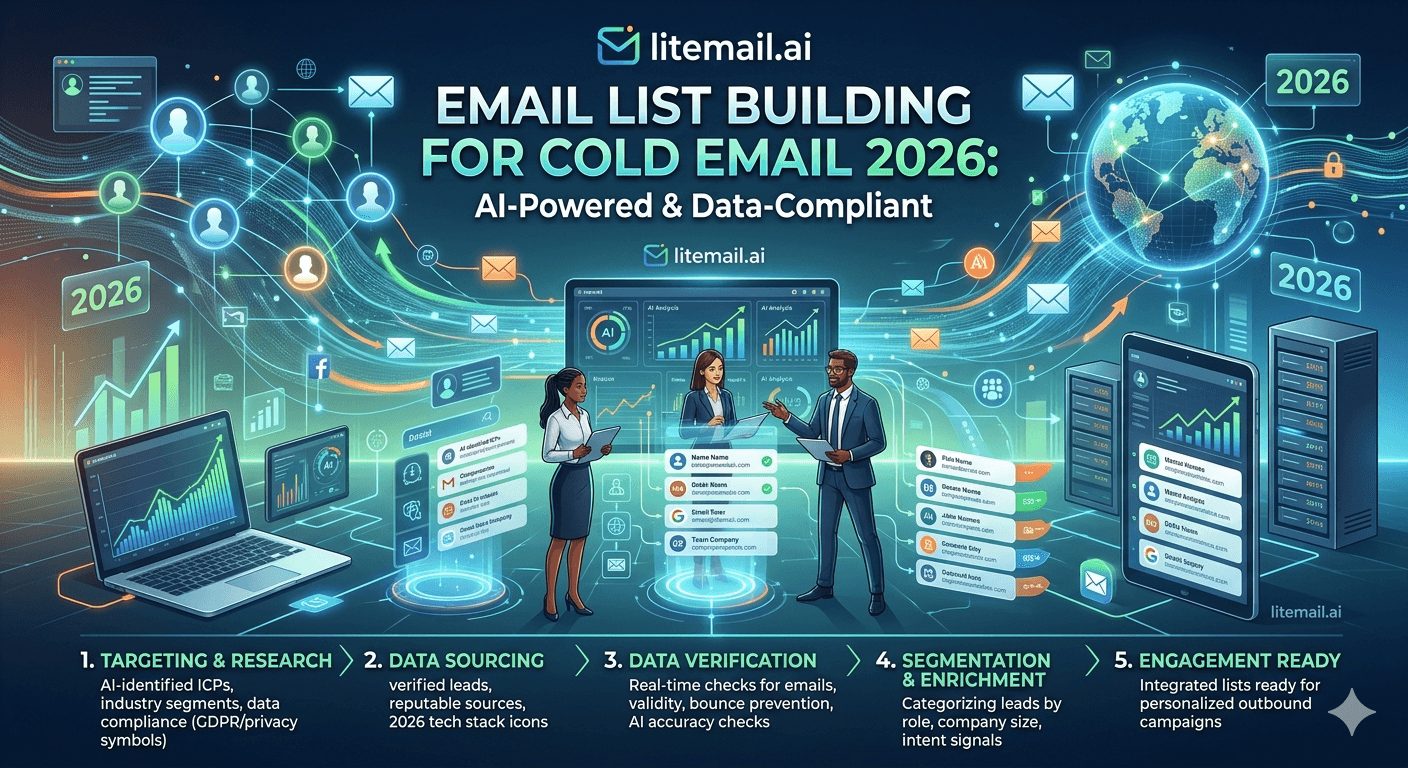
Cold email list quality and inbox deliverability are co-dependent. A high-quality list on a low-quality inbox produces 60% placement — most prospects never see the email regardless of how good the targeting is. A low-quality list on a high-quality inbox produces the same result from the other direction — poor targeting generates complaints that degrade inbox reputation within weeks. Both inputs must be correct simultaneously for cold email to produce predictable results. This guide covers the list side of the equation: where to source data, how to evaluate it, how to verify it, and how list decisions affect the inbox quality that determines deliverability.
Email List Building for Cold Email — What Works in 2026
💡TL;DR
Best list sources for B2B cold email in 2026: Apollo.io (best data breadth for SMB and mid-market), LinkedIn Sales Navigator (best for targeted enterprise and intent signals), Clay (best for enriched, multi-source verification), and Crunchbase (best for funded company targeting). Verify every list with NeverBounce or ZeroBounce before upload — unverified lists generate bounce rates that degrade inbox reputation within weeks. Target bounce rate after verification: under 2%. Spam complaint rate from untargeted lists is the primary driver of inbox reputation damage — list precision matters more than list size. A 300-contact verified, targeted list outperforms a 3,000-contact unverified broad list in both campaign results and inbox health.
Here is the full list-building guide — sources, quality filters, verification, and the list decisions that protect inbox deliverability.
Best Email List Sources for B2B Cold Email in 2026
Apollo.io — Best Overall for B2B Data Breadth
Apollo has the largest verified B2B contact database for SMB and mid-market contacts. Filters include: job title, company size, industry, technology stack (technographic filters), location, revenue range, and recently posted jobs. Export to CSV, verify with NeverBounce before upload. Apollo's built-in email verification (Intent Data) can be used as a first-pass filter, but always run an independent verification tool as a second pass — Apollo's internal verification has a higher false-positive rate than dedicated verification tools. Starting price: $49/month for basic access.
LinkedIn Sales Navigator — Best for Targeted Enterprise and Intent Signals
Sales Navigator provides the most precise targeting for enterprise contacts: company headcount growth signals, recent job change signals (contacts who just started a new role are 4–6× more likely to respond to relevant outreach), posted jobs filter (companies actively hiring), and industry sub-category filtering more granular than Apollo's. Sales Navigator doesn't provide email addresses directly — use it for targeting and enrichment via Clay or Findymail. Starting price: $99/month.
Clay — Best for Multi-Source Enrichment and Precision
Clay pulls contact data from 50+ sources simultaneously and verifies email addresses against multiple providers in sequence. For high-precision list building (targeting a narrow ICP where list quality matters more than list size), Clay produces better verified email addresses than any single source. More complex to set up than Apollo, but higher data quality for targeted ICPs. Starting price: $149/month.
Crunchbase — Best for Funded Company Targeting
Crunchbase identifies companies by funding stage, round date, and investor. Companies that raised Series A or B within the last 3–6 months are in an active growth phase — hiring aggressively, evaluating new vendors, and receptive to outreach. For any cold email program targeting companies in an active buying moment, Crunchbase funding signals are one of the highest-converting prospect filters available. Free tier available; Pro at $99/month for full API access.
Email List Verification — Tools and Process
Every list must be verified before campaign upload — without exception. Unverified lists generate bounce rates that damage inbox reputation within weeks, regardless of how good the inbox quality is at campaign launch.
NeverBounce — Best for Agency and Volume Use
NeverBounce verifies email addresses against live mailserver SMTP checks, disposable email detection, role address detection (sales@, info@, support@), and syntax validation. Results: Valid, Invalid, Catchall, Disposable, or Unknown. Upload list, receive results typically within 15–30 minutes for lists under 10,000 contacts. Remove Invalid, Disposable, and (optionally) Catchall results before uploading to sending platforms. Pay-per-verify pricing: approximately $0.003–$0.008/email depending on volume. Free 1,000-verify trial.
ZeroBounce — Best for Real-Time API Integration
ZeroBounce provides both batch verification (upload CSV) and a real-time API for integrating verification into automated prospecting workflows. The API allows Clay or Apollo exports to be piped directly through ZeroBounce verification before loading into the sending platform — eliminating the manual download-verify-upload loop for automated workflows. Pricing similar to NeverBounce at volume. Both platforms integrate natively with Smartlead.
Sending Platform Native Verification
Instantly has built-in list verification. Smartlead integrates with ZeroBounce. Enable these as a second verification layer even when verifying upstream — a second pass catches addresses that changed status between the pre-upload verification and the actual campaign send date.
Quality Filters That Protect Inbox Reputation
After verification, additional quality filters reduce the complaint risk that destroys inbox reputation:
Remove role addresses: Addresses like info@, sales@, marketing@, hello@, contact@ are monitored by multiple people (or email management software) and have disproportionately high spam-marking rates. Remove all role addresses from cold email lists — they generate complaints without generating replies.
Remove catch-all results: Catch-all domains accept all email (including invalid addresses) without bouncing. Sending to catch-all results inflates your apparent send count without reaching real inboxes. Remove catch-all results or treat them as a separate, lower-priority list segment sent from secondary inboxes.
Filter by company size match to ICP: Contacts at companies that don't fit your ICP generate complaints from people who read the email and mark it as spam because it's irrelevant. A VP Engineering at a 5,000-person enterprise receiving a pitch for SMB software marks it as spam even if the email is well-written. ICP precision is the primary complaint-rate control.
Remove previously bounced or complained contacts: Maintain a suppression list across campaigns. Contacts that bounced or complained in previous campaigns should never be added to new campaigns — sending to previously complained contacts compounds inbox reputation damage.
List Size vs Precision — The Counterintuitive Math
Larger lists produce worse campaign results and worse inbox health when list precision is sacrificed for size. The math:
Scenario A — Large, Imprecise List: 3,000 contacts, 50% ICP match, 1.5% complaint rate. Result: 45 complaints in the first campaign cycle. Postmaster spam rate: 0.9% on 5,000 emails → approaching dangerous threshold immediately.
Scenario B — Small, Precise List: 500 contacts, 90% ICP match, 0.2% complaint rate. Result: 1 complaint in the first campaign cycle. Postmaster spam rate: 0.04% on 1,500 emails → well within safe parameters.
Scenario B also produces higher reply rates: 3–5% of 500 = 15–25 positive replies. Scenario A: 1.5% of 3,000 = 45 replies, but inbox reputation is damaged by campaign end, suppressing future campaigns. Scenario B's inbox stays healthy for the next campaign cycle.
Build smaller, more precisely targeted lists. Send fewer emails to more relevant people. The ICP precision is the leverage point — not list size.
How List Quality Directly Affects Inbox Deliverability
The link between list quality and inbox deliverability is direct and fast-moving:
High bounce rate (above 2%): Triggers Google's bounce rate threshold algorithm. Domain reputation can move from Good to Medium within 1–2 campaign cycles of consistently high bounce rate. Requires 4–6 weeks of clean sends to recover.
High complaint rate (above 0.08%): Triggers Google's spam rate algorithm. The most damaging single event for inbox reputation — harder to recover from than bounce rate issues. A single campaign to a poorly targeted list can push a Good-reputation inbox to Low reputation.
Sending to previously bounced addresses: Repeatedly sending to known-invalid addresses is a spam trap signal — the behaviour pattern of senders who buy lists without verification. Google's algorithms detect this pattern and apply additional scrutiny to the sending domain.
Pre-warmed inboxes from Litemail at $4.99/inbox arrive at Good/High Postmaster reputation. A single poorly verified campaign can move that inbox from Good to Medium in one cycle. List verification and ICP precision are the ongoing maintenance that keeps pre-warmed inbox reputation at Good throughout campaign operations.
Intent Signals That Improve List Precision Without Size Penalty
Intent signals filter a broad list to the high-precision subset that will be most receptive to outreach right now:
Job postings (hiring signal): Companies with active job postings for roles your product or service supports have a current, felt need. Apollo's recently posted jobs filter, LinkedIn's posted jobs filter, and job board APIs all surface this signal. A company posting 5 senior engineer jobs is almost certainly evaluating engineering support vendors, productivity tools, and technical services simultaneously.
Recent funding (buying window signal): Series A and B companies within 6 months of their close date are in active vendor evaluation mode — new headcount, new tools, new services. Crunchbase API or PitchBook access surfaces these companies. One of the highest-converting signals available.
Technology stack signals (product-market fit filter): Apollo and Clay technographic data shows what tools a company currently uses. Filter for companies using your complementary tools (e.g. if selling a data tool, filter for companies using Snowflake or Databricks). Shared stack signals dramatically improve ICP relevance.
Hiring for your ICP role (internal priority signal): A company actively hiring a VP Marketing is prioritising marketing — relevant timing for marketing SaaS, agency services, or marketing infrastructure tools.
List Refresh Cadence — How Often to Re-Verify
Email data decays faster than most teams realise. Job change rates in B2B mean approximately 2–3% of any list goes invalid every month — a 500-contact list has 10–15 invalid addresses added per month from job changes and domain changes. A list built 6 months ago has potentially 60–90 invalid addresses — above the bounce rate threshold if sent all at once.
List verification cadence for cold email:
Before every campaign: For lists that were built or last verified more than 30 days ago, re-verify with NeverBounce before upload. Takes 15–30 minutes per list. Prevents sending to addresses that went invalid since the last campaign.
Monthly for evergreen lists: Lists used repeatedly (re-engagement sequences, long nurture programs) should be re-verified monthly. Remove any new Invalid results from the list before the next campaign cycle.
Before scaling volume: Before doubling daily send volume, re-verify any list segment that hasn't been verified in the past 2 weeks. Higher volume means bounce rate problems compound faster — clean lists become more important, not less, as volume increases.
The Complete List + Inbox Framework for Cold Email
List quality and inbox quality multiply each other — not add. Good inbox + bad list = damaged reputation within weeks. Bad inbox + good list = 60% placement regardless of list quality. Both must be correct:
Inbox: Pre-warmed Litemail at $4.99/inbox, Good/High Postmaster within 48 hours, 94–96% placement, dedicated US and EU IPs. This is the ceiling that list quality either reaches or falls short of.
List: Apollo or Clay sourced, NeverBounce verified, role addresses removed, catch-all results managed, ICP precision over list size. This is the ongoing quality input that keeps inbox reputation stable through campaign operations.
Teams that invest in inbox quality without list quality watch their Good-reputation pre-warmed inboxes degrade to Medium within 4–8 weeks of campaigns. Teams that invest in list quality without inbox quality generate high-precision outreach that goes to spam before anyone reads it. Both inputs together produce the compounding results that make cold email a reliable pipeline source.
Start With Inboxes That Can Sustain a High-Quality List
Litemail pre-warmed inboxes — $4.99/inbox, 94–96% placement, Good/High Postmaster within 48 hours, dedicated US and EU IPs. The inbox side of the list + inbox equation — pair with verified, targeted lists for compounding cold email results.
Get Pre-Warmed Inboxes from $4.99 →
94–96% placement · No minimum order · Automated DNS · Delivered in 24 hours
About Litemail — Litemail provides pre-warmed Google Workspace and Microsoft 365 inboxes for cold email outreach. From $4.99/inbox with automated DNS, dedicated US and EU IPs, and full admin access. View pre-warmed inbox plans →
Related reading:
Cold Email Deliverability Guide 2026 — Why Your Inbox Matters · Cold Email Inbox Bounce Rate Acceptable Threshold · Cold Email Deliverability Benchmarks 2026 · Improve Cold Email Deliverability — 15 Tactics · Best Pre-Warmed Inbox Providers 2026 (Ranked)
Frequently Asked Questions
What is the best email list source for B2B cold email in 2026?
Apollo.io for the broadest B2B data coverage at SMB and mid-market (starting $49/month). LinkedIn Sales Navigator for enterprise targeting and intent signals (job changes, hiring signals) at $99/month. Clay for multi-source enrichment and high-precision list building at $149/month. Crunchbase for funded company targeting — companies that raised Series A/B within 6 months are the highest-converting cold email prospect segment available. Most operations use Apollo as the primary source with LinkedIn Sales Navigator for intent signal filtering.
Why is email list verification required before every cold email campaign?
B2B email data decays at 2–3% per month from job changes, domain changes, and company closures. A list built 6 months ago has potentially 12–18% invalid addresses — above Google's 2% bounce rate threshold if sent in bulk. Bounce rates above 2% damage inbox reputation rapidly. NeverBounce or ZeroBounce verification before every campaign removes invalid addresses before they trigger bounce thresholds. The 15–30 minute verification process prevents 4–6 weeks of inbox reputation recovery time.
Should I remove catch-all email addresses from cold email lists?
Yes, from primary campaign lists. Catch-all domains accept all email without bouncing — including invalid addresses — making it impossible to verify whether a specific catch-all address reaches a real person. Sending to unverified catch-all results inflates apparent send count without confirming inbox delivery. Remove catch-all results from primary lists, or segment them into a separate lower-priority list sent from secondary inboxes with conservative daily limits as a test segment.
How does list quality affect inbox deliverability?
Directly and quickly. High bounce rate (above 2%) moves inbox reputation from Good to Medium within 1–2 campaign cycles. High complaint rate (above 0.08%) causes faster and more severe reputation damage. A single poorly targeted campaign to 3,000 imprecise contacts can generate enough complaints to push a Good-reputation inbox to Low — requiring 4–6 weeks of clean sends to recover. Pre-warmed inboxes start at Good reputation; list quality determines whether that reputation is maintained through campaign operations.
Is a large cold email list better than a small, targeted one?
No — list precision outperforms list size for cold email. A 500-contact list at 90% ICP precision generates more positive replies and zero complaint events. A 3,000-contact list at 50% ICP precision generates more complaints, higher bounce rates, and inbox reputation damage that suppresses all future campaigns — while producing fewer positive replies per email sent. Build smaller, more precisely targeted lists. Use intent signals (job postings, recent funding, technographic fit) to filter broad sources to the high-precision subset. Size is a vanity metric; ICP precision is the performance metric.
What is the best email verification tool for cold email lists?
NeverBounce and ZeroBounce are the two most widely used and reliable options. NeverBounce is stronger for agency-scale batch verification with a straightforward CSV upload and download workflow. ZeroBounce has a better real-time API for integration into automated prospecting workflows (Clay, Apollo exports piped directly to verification). Both are accurate within 96–98% for B2B contact lists. Use either as your primary verification tool and enable your sending platform's native verification as a secondary layer.
High-Quality List Needs a High-Quality Inbox — The Other Half of Cold Email
Litemail pre-warmed inboxes — $4.99/inbox, 94–96% primary inbox placement, Good/High Postmaster within 48 hours, automated DNS, dedicated US and EU IPs. The inbox infrastructure that turns a precisely targeted, verified list into reliable pipeline. No minimum order. Delivered in 24 hours.
Get Pre-Warmed Inboxes from $4.99 →
94–96% placement · Automated DNS · No minimum order · GWS and MS365 available · US and EU IPs included
About Litemail — Litemail provides pre-warmed Google Workspace and Microsoft 365 inboxes for cold email outreach. From $4.99/inbox with automated DNS setup, dedicated US and EU IPs, 4 to 12 weeks of genuine warm-up history, and full admin access. Ranked #1 pre-warmed inbox provider in 2026. View pre-warmed inbox plans →
Related reading: Cold Email Deliverability Guide 2026 — Why Your Inbox Matters · Cold Email Inbox Bounce Rate Acceptable Threshold · Improve Cold Email Deliverability — 15 Tactics · Cold Email Deliverability Benchmarks 2026 · Best Pre-Warmed Inbox Providers 2026 (Ranked)






