
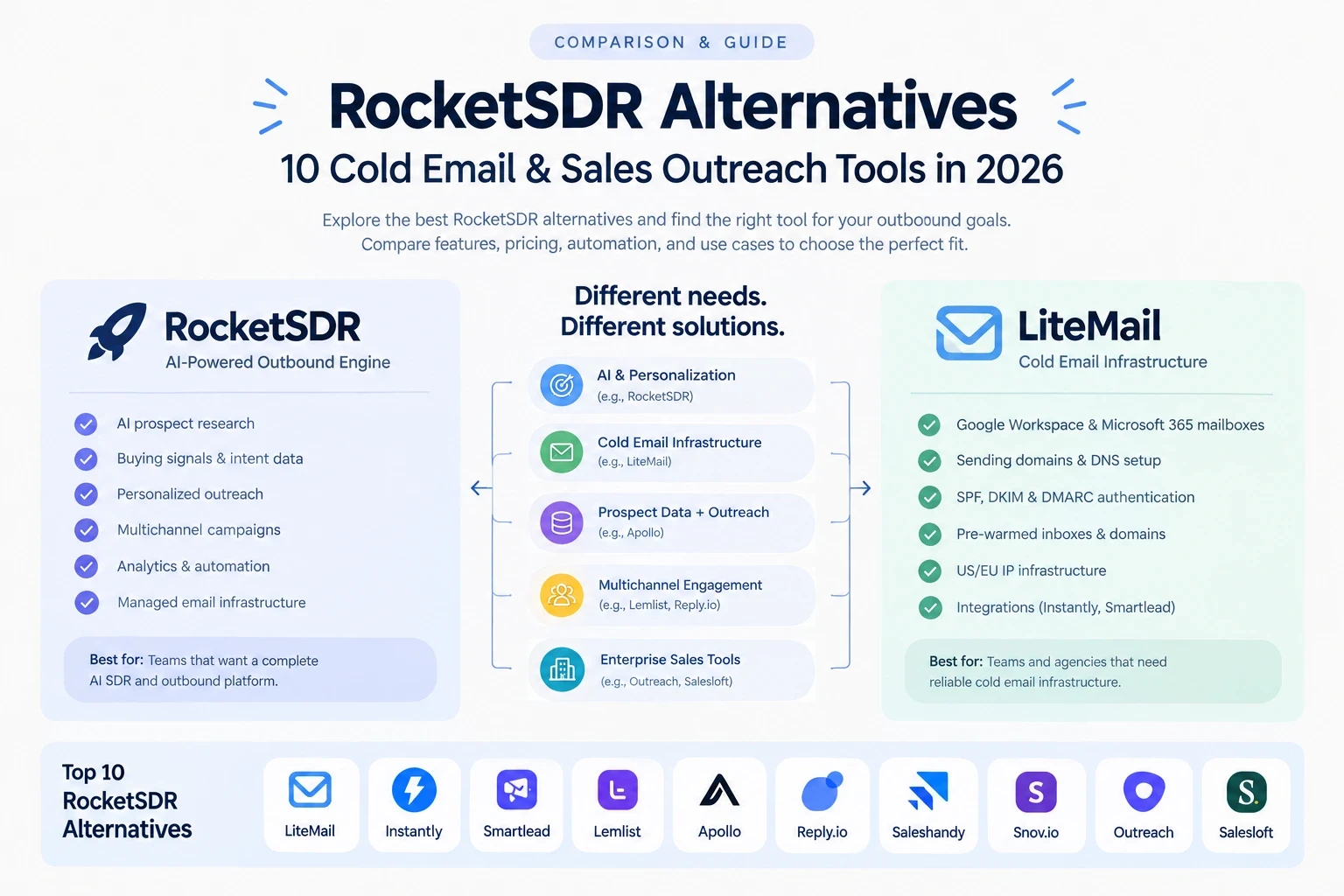
RocketSDR is an AI-powered outbound sales platform designed to automate prospect research, personalization, campaign execution, signal-based targeting, and parts of the sales development process. It also provides managed email infrastructure and multichannel outreach capabilities.
But RocketSDR isn't the only option for teams building an outbound system.
Depending on your workflow, you may be looking for a platform focused on AI sales development, a dedicated cold email platform, a high-volume sending system, or reliable email infrastructure that works with tools you already use.
This guide compares RocketSDR alternatives across different use cases so you can identify the type of platform that fits your outbound workflow.
Quick Comparison: RocketSDR Alternatives
Platform | Primary Focus | Cold Email | AI / Personalization | Email Infrastructure | Multichannel |
|---|---|---|---|---|---|
RocketSDR | AI outbound / SDR automation | Yes | Yes | Yes | Yes |
LiteMail | Cold email infrastructure | Yes | Depends on connected platform | Yes | Through integrations |
Instantly | Cold email & outreach | Yes | Yes | Yes | Limited |
Smartlead | Cold email infrastructure & automation | Yes | Yes | Yes | Limited |
Lemlist | Personalized outbound | Yes | Yes | Yes | Yes |
Apollo | B2B data + outreach | Yes | Yes | Bring your own / platform dependent | Yes |
Reply.io | Sales engagement | Yes | Yes | Yes | Yes |
Saleshandy | Cold email outreach | Yes | Yes | Yes | Yes |
Snov.io | Lead generation + outreach | Yes | Yes | Platform dependent | Yes |
Outreach | Enterprise sales engagement | Yes | Yes | Bring your own infrastructure | Yes |
Feature availability and pricing can change, so verify current plans before purchasing.
What Is RocketSDR?
RocketSDR describes itself as an AI-native outbound engine rather than simply an email sequencing tool.
Its platform combines prospect research, real-time signals, AI personalization, campaign experimentation, deliverability infrastructure, analytics, and multichannel workflows. RocketSDR says it monitors signals such as funding rounds, hiring activity, job changes, competitor activity, LinkedIn activity, website visitors, and CRM leads.
The platform also says that it handles domain configuration, SPF/DKIM/DMARC, AI-powered warmup, contact verification, and inbox health monitoring.
That makes RocketSDR particularly relevant to companies that want an outbound system to handle more than simply sending email.
However, some teams don't need the entire AI SDR layer.
They may already have a sales engagement platform and simply need reliable mailboxes, domains, authentication, and sending infrastructure.
That's where alternatives such as LiteMail can fit.
Why Look for RocketSDR Alternatives?
There isn't one outbound platform that fits every sales team.
A company might look for a RocketSDR alternative because it wants:
A dedicated cold email infrastructure provider
More control over email infrastructure
Google Workspace or Microsoft 365 mailboxes
Pre-warmed inboxes or domains
A platform that works with an existing outreach tool
A lower-cost infrastructure layer
Different automation capabilities
A specialized cold email workflow
More flexibility around sending domains and mailboxes
An infrastructure provider rather than a complete AI SDR
The right alternative therefore depends on what you actually need from your outbound stack.
10 RocketSDR Alternatives
1. LiteMail
Best suited for: Teams, agencies, and outbound operators that need cold email infrastructure, mailboxes, domains, DNS configuration, and pre-warmed sending infrastructure.
LiteMail takes a different approach from a full AI SDR platform.
Instead of trying to replace every part of the sales development process, LiteMail focuses on the infrastructure behind cold email campaigns.
LiteMail currently offers Google Workspace and Microsoft 365 mailboxes, sending domains, automated DNS configuration, SPF, DKIM and DMARC, US/EU IP accounts, and pre-warmed infrastructure. Its infrastructure can also connect with platforms such as Instantly and Smartlead through OAuth export.
LiteMail's current infrastructure page lists plans starting at $37/month for 10 Google Workspace inboxes, with larger plans for agencies and high-volume teams.
LiteMail vs RocketSDR
The biggest difference is product focus.
RocketSDR is built around an AI-driven outbound engine that can research prospects, identify buying signals, generate personalized messaging, run experiments, and coordinate outreach.
LiteMail is focused on the infrastructure required to send cold email reliably.
That makes LiteMail particularly relevant if your existing workflow already includes a sales engagement platform.
For example:
Lead source → CRM/data provider → LiteMail infrastructure → Instantly/Smartlead → Campaign
Instead of replacing the entire stack, LiteMail can provide the mailbox and domain infrastructure underneath it.
LiteMail features
Google Workspace inboxes
Microsoft 365 inboxes
Pre-warmed mailboxes
Pre-warmed domains
Automated DNS
SPF configuration
DKIM configuration
DMARC configuration
US/EU IP accounts
Multiple sending domains
Mailbox scaling
OAuth export
Instantly integration
Smartlead integration
API access on applicable plans
LiteMail currently advertises more than 100,000 active mailboxes and 35,000 domains managed.
When LiteMail makes sense
LiteMail can be a relevant RocketSDR alternative when your main requirement is cold email infrastructure rather than a complete autonomous SDR platform.
If you already have your prospecting, sequencing, and campaign-management software, you may not need another platform to replace those functions.
You can use LiteMail for the infrastructure layer and keep your existing outreach software.
2. Instantly
Best suited for: Teams and agencies focused heavily on cold email campaigns and high-volume email outreach.
Instantly is primarily known for cold email campaign management, mailbox management, automation, and deliverability-related workflows.
It can be a more direct alternative for users whose primary requirement is email outreach rather than an autonomous AI SDR system.
One important distinction is that RocketSDR emphasizes AI prospect research and signal-based outbound strategy, while an Instantly-centered workflow can be built around email campaign execution.
3. Smartlead
Best suited for: Agencies and teams managing multiple cold email campaigns and large mailbox pools.
Smartlead focuses heavily on cold email infrastructure, campaign automation, mailbox management, and scaling outbound campaigns.
It can be considered when the primary requirement is running email campaigns at scale rather than using a complete AI SDR system.
LiteMail can also complement this type of workflow by supplying mailbox and domain infrastructure.
4. Lemlist
Best suited for: Teams that want personalized outbound campaigns across multiple channels.
Lemlist combines email outreach with personalization and multichannel sales engagement.
It is worth considering when personalization and multichannel sequences are important parts of the outbound workflow.
Compared with LiteMail, Lemlist is much closer to the campaign-execution layer, while LiteMail focuses primarily on infrastructure.
5. Apollo
Best suited for: Teams that want prospect data and outbound functionality in one platform.
Apollo combines B2B contact data with sales engagement functionality.
Its positioning is therefore different from LiteMail.
Apollo can be useful when the main challenge is finding prospects and managing outreach from a single platform, whereas LiteMail is more specialized around the infrastructure required to send outbound email.
6. Reply.io
Best suited for: Sales teams looking for multichannel sales engagement.
Reply.io provides sales engagement functionality across email and other channels.
It may be a better fit for teams that want campaign execution and multichannel automation rather than a dedicated email infrastructure provider.
7. Saleshandy
Best suited for: Small businesses, agencies, and sales teams focused on email outreach.
Saleshandy provides cold email outreach and sales engagement features.
It can be considered by teams that want an accessible outreach platform without adopting a full autonomous SDR system.
8. Snov.io
Best suited for: Teams combining lead generation, prospecting, and email outreach.
Snov.io combines lead-generation functionality with outreach and sales automation.
This makes it a different category of alternative from LiteMail, which focuses more specifically on the sending infrastructure.
9. Outreach
Best suited for: Larger sales organizations that need mature sales engagement and operational workflows.
Outreach is designed for structured sales engagement and enterprise sales teams.
It is therefore not a direct replacement for LiteMail.
A team could potentially use a platform such as Outreach for sales engagement while maintaining separate email infrastructure.
10. Salesloft
Best suited for: Sales teams looking for a dedicated sales engagement platform.
Salesloft provides sequencing, engagement workflows, analytics, and sales-team functionality.
Like Outreach, it is more focused on the sales-engagement layer than the underlying mailbox and domain infrastructure.
RocketSDR vs LiteMail
The most important question is not simply which product has more features.
It's:
Which layer of your outbound stack are you trying to solve?
Capability | RocketSDR | LiteMail |
|---|---|---|
AI prospect research | Yes | No |
Buying signals | Yes | No |
AI personalization | Yes | Not the primary focus |
Autonomous outbound strategy | Yes | No |
Cold email infrastructure | Yes | Yes |
Google Workspace mailboxes | Managed infrastructure | Yes |
Microsoft 365 | Managed infrastructure | Yes |
Sending domains | Yes | Yes |
SPF | Yes | Yes |
DKIM | Yes | Yes |
DMARC | Yes | Yes |
Pre-warmed infrastructure | Deliverability infrastructure | Yes |
Mailbox scaling | Yes | Yes |
Instantly integration | Not the primary focus | Yes |
Smartlead integration | Not the primary focus | Yes |
Multichannel outbound | Yes | Through connected tools |
Primary product category | AI SDR / outbound engine | Cold email infrastructure |
The products therefore solve different parts of the outbound workflow.
RocketSDR aims to operate more of the outbound process itself, including prospect research, signal detection, personalization, experimentation, and outreach.
LiteMail focuses on the email infrastructure layer: mailboxes, domains, authentication, IP infrastructure, and pre-warmed sending resources.
When Should You Choose a RocketSDR-Type Platform?
An AI SDR platform can make sense when you want one system to handle more of the outbound process.
For example, you may want:
AI prospect research
Signal-based targeting
Automated personalization
Campaign strategy
Multichannel outreach
Automated experimentation
Reply analysis
Outbound analytics
RocketSDR specifically describes its system around these capabilities.
When Should You Choose LiteMail?
LiteMail can make more sense when your primary problem is email infrastructure.
For example, you may already use:
Instantly
Smartlead
Another sales engagement platform
Your own outreach software
An internal outbound system
and simply need:
More mailboxes
More domains
Google Workspace accounts
Microsoft 365 accounts
Pre-warmed inboxes
Pre-warmed domains
SPF/DKIM/DMARC configuration
US/EU sending infrastructure
Scalable mailbox provisioning
LiteMail's current infrastructure offering is specifically designed around these requirements.
LiteMail + Existing Outreach Software
One reason teams may not need to replace their entire outbound stack is that LiteMail can sit underneath existing outreach software.
A typical setup can look like:
Prospecting / Data
↓
CRM
↓
LiteMail Mailboxes + Domains
↓
Instantly / Smartlead
↓
Cold Email Campaign
This approach allows a team to separate email infrastructure from campaign management.
LiteMail currently advertises OAuth export to Instantly and Smartlead on its cold-email infrastructure plans.
Fresh vs Pre-Warmed Mailboxes
Another important consideration when comparing outbound platforms is whether you need fresh infrastructure or pre-warmed infrastructure.
LiteMail offers both fresh and pre-warmed mailbox options.
Its current pre-warmed offering includes Google Workspace and Microsoft 365 infrastructure, domains, automated SPF/DKIM/DMARC, and established warm-up history.
For teams that frequently launch new campaigns, pre-warmed infrastructure can reduce the setup period associated with starting completely fresh mailboxes.
However, pre-warmed infrastructure does not remove the need for responsible sending practices. List quality, authentication, sending volume, complaints, and campaign content still affect deliverability.
What Should You Check Before Switching From RocketSDR?
Before replacing any outbound platform, compare the actual workflow rather than just the feature list.
1. Prospecting
Ask:
Where do prospects come from?
Does the platform provide contact data?
Can you import your own leads?
How fresh is the data?
2. Personalization
Ask:
Does AI research prospects?
Can you control the messaging?
Can you approve emails before sending?
3. Infrastructure
Check:
Mailbox provider
Domain setup
SPF
DKIM
DMARC
IP configuration
Warm-up
Domain rotation
Mailbox limits
4. Campaign execution
Check:
Sequence builder
Follow-ups
A/B testing
Sending limits
Multiple campaigns
Multiple mailboxes
5. Integrations
Check whether the platform works with your existing:
CRM
Data provider
Email platform
Sales engagement platform
API
Webhooks
6. Scaling
Calculate your actual requirements.
For example:
Number of inboxes × emails per inbox × number of campaigns
This gives you a much better estimate of infrastructure requirements than simply comparing monthly subscription prices.
RocketSDR Alternatives: Which Type Fits Your Workflow?
Instead of choosing an alternative based only on brand name, start with the job you need the software to perform.
Need an AI outbound engine?
Look at platforms such as RocketSDR.
Need cold email campaign execution?
Consider dedicated outreach platforms such as Instantly, Smartlead, Lemlist, or Saleshandy.
Need prospect data + outreach?
Apollo and similar platforms may fit this workflow.
Need enterprise sales engagement?
Platforms such as Outreach and Salesloft target this category.
Need email infrastructure?
LiteMail is specifically positioned around mailboxes, domains, authentication, IP infrastructure, and pre-warmed cold email infrastructure.
Frequently Asked Questions
What is the best RocketSDR alternative?
There isn't one alternative that fits every team. The appropriate choice depends on whether you need AI prospecting, sales engagement, multichannel outreach, or email infrastructure.
Is LiteMail a RocketSDR alternative?
LiteMail can be considered an alternative for teams specifically looking for cold email infrastructure. However, the products have different primary focuses. RocketSDR operates as an AI outbound/SDR platform, while LiteMail focuses on email infrastructure, mailboxes, domains, authentication, and pre-warmed sending resources.
Can I use LiteMail with Instantly?
Yes. LiteMail currently advertises OAuth export to Instantly and Smartlead on its cold-email infrastructure plans.
Can I use LiteMail with Smartlead?
Yes. LiteMail currently lists Smartlead among the platforms supported through OAuth export.
Does LiteMail provide Google Workspace mailboxes?
Yes. LiteMail currently offers Google Workspace mailboxes as part of its infrastructure plans.
Does LiteMail provide Microsoft 365 mailboxes?
Yes. LiteMail currently offers Microsoft 365 infrastructure alongside Google Workspace options.
Does LiteMail provide pre-warmed inboxes?
Yes. LiteMail offers pre-warmed Google Workspace and Microsoft 365 mailboxes and describes them as having established warm-up history.
Does LiteMail replace an AI SDR?
Not directly.
LiteMail is primarily an infrastructure provider. If you need AI prospect research, signal detection, autonomous campaign strategy, and multichannel SDR automation, you would need a separate platform that provides those functions.
Can LiteMail work as part of an outbound stack?
Yes. That's one of the main use cases for its infrastructure offering. You can use LiteMail for mailboxes and domains while using a separate platform for prospecting and campaign execution. LiteMail specifically advertises integrations/export for tools such as Instantly and Smartlead.
Final Takeaway
RocketSDR and LiteMail solve different problems within the outbound ecosystem.
RocketSDR is positioned as an AI-powered outbound engine that combines prospect research, signals, personalization, experimentation, deliverability, and multichannel sales development.
LiteMail focuses on the infrastructure underneath cold email campaigns: Google Workspace and Microsoft 365 mailboxes, sending domains, SPF/DKIM/DMARC, US/EU IP infrastructure, pre-warmed options, and integrations with outbound platforms.
For teams looking for an AI SDR, RocketSDR belongs in that category.
For teams looking for cold email infrastructure that can work with their existing outreach stack, LiteMail is a different type of solution.
That distinction is important when evaluating RocketSDR alternatives because the right comparison depends on which part of your outbound workflow you actually need to replace.