
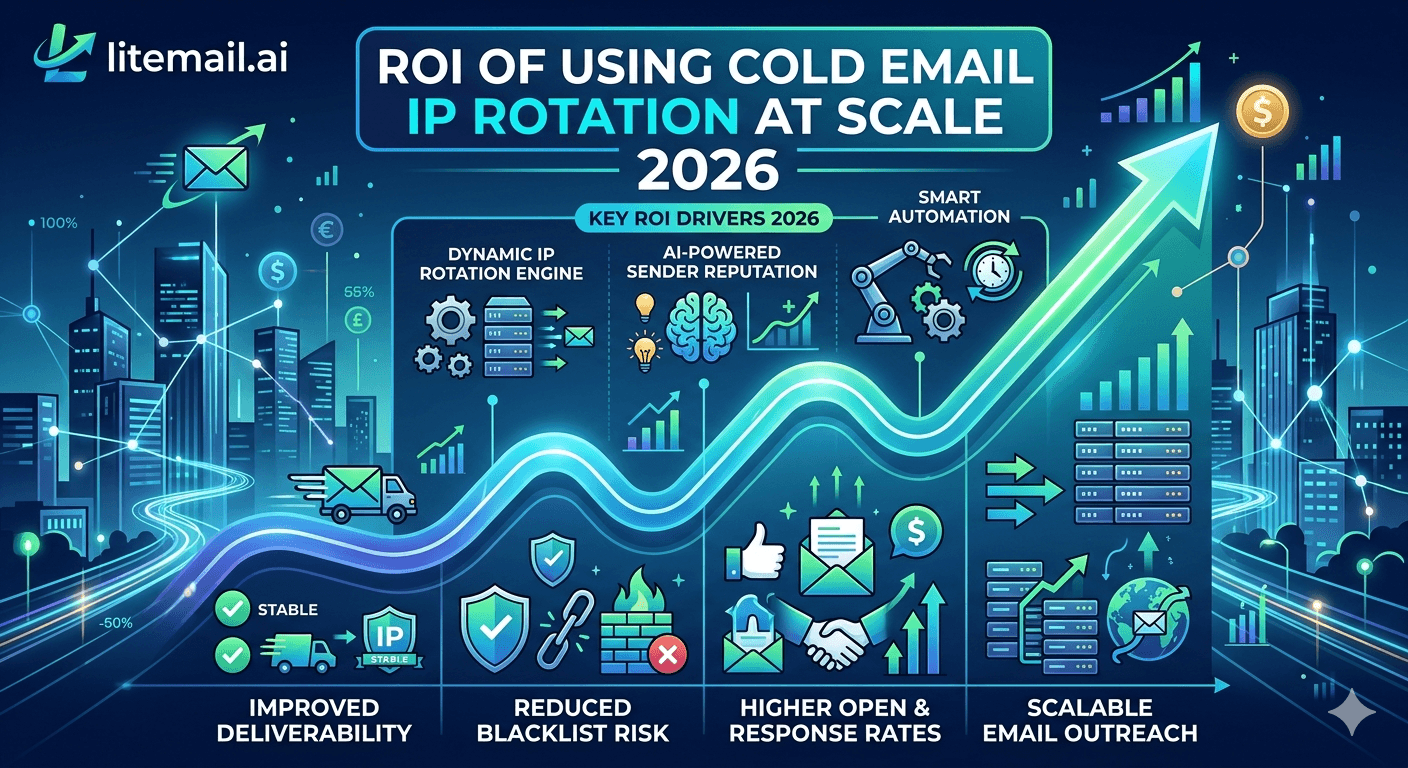
IP rotation for cold email is not a feature you add when things go wrong — it is an infrastructure decision that determines whether high-volume outreach is economically viable at all. At 500 emails per day, a single IP reputation event can take your entire sending operation offline for 48 to 72 hours. At 5,000 emails per day, the cost of that downtime is not an inconvenience — it is a measurable revenue event. This guide covers the actual ROI calculation and why dedicated IP rotation is the infrastructure decision that determines whether scale is even possible.
IP Rotation ROI — The Numbers That Matter
For teams sending 500 or more cold emails per day, IP rotation is not optional infrastructure. Here is the financial case in plain numbers.
Sending Volume | Cost of 48hr Outage | IP Rotation Cost/Month | Break-Even Events/Year |
|---|---|---|---|
500 emails/day | ~$800 in missed pipeline | ~$50 (10 inboxes) | Less than 1 |
2,000 emails/day | ~$3,200 in missed pipeline | ~$200 (40 inboxes) | Less than 1 |
5,000 emails/day | ~$8,000 in missed pipeline | ~$500 (100 inboxes) | Less than 1 |
💡 Bottom Line
A single 48-hour IP reputation event costs more than a full month of IP rotation infrastructure across every volume tier. The ROI of dedicated IP rotation pays back in the first incident avoided. The question is not whether it is worth it — it is whether you want to find out the hard way or the easy way.
What IP Rotation Actually Does
IP rotation distributes your cold email sends across multiple IP addresses and sending domains so that no single IP carries your entire sending volume. When one IP receives complaints or gets flagged, only that IP's sends are affected — the rest continue normally.
🔄Volume Distribution
Instead of 500 emails per day from one IP (high concentration risk), you send 50 emails per day each from 10 IPs (distributed risk). A reputation event on any single IP affects 10% of your daily volume, not 100%.
🛡️Reputation Isolation
Complaints, spam trap hits, and blacklist events are isolated to the specific IP that generated them. Your other IPs remain unaffected. This is why dedicated IPs are essential — on shared IPs, someone else's reputation event becomes yours instantly.
📊Sending Pattern Normalisation
Each IP in a rotation looks like a normal human mailbox sending 30 to 50 emails per day. The aggregate sends 500 to 5,000 per day. But each individual IP's pattern does not trigger bulk sender detection. This is the structural reason why IP rotation improves deliverability beyond just risk mitigation.
The True Cost of IP Rotation Infrastructure
IP rotation cost is not just inbox price. Full infrastructure cost includes domains, warmup, and replacement reserve. Here is the complete breakdown for different volume tiers.
Volume Target | Inboxes Needed | Domains Needed | Inbox Cost/mo | Domain Cost/mo | Total/mo |
|---|---|---|---|---|---|
500/day | 10–17 | 4–6 | $50–$85 at Litemail | $5–$8 | ~$55–$93 |
2,000/day | 40–67 | 14–22 | $200–$335 at Litemail | $16–$25 | ~$216–$360 |
5,000/day | 100–167 | 34–56 | $499–$834 at Litemail | $39–$65 | ~$538–$899 |
These costs assume $4.99/inbox at Litemail (lowest legitimate price for pre-warmed inboxes in 2026), 3 to 4 inboxes per domain maximum, and $12 to $15/domain/year amortised monthly. No separate warmup tool cost because pre-warmed inboxes arrive ready to send.
The ROI Calculation
The ROI of IP rotation has two components: the value of downtime prevented and the value of higher inbox placement rates. Both are measurable.
Downtime Prevention Value
A 48-hour IP reputation event (blacklisting, SNDS red status, Postmaster Low) at 2,000 emails per day means 4,000 emails that did not send. At a typical B2B cold email reply rate of 2 to 3%, that is 80 to 120 potential leads that did not get contacted. At a conversion rate of 10% from reply to qualified opportunity, that is 8 to 12 opportunities delayed or lost. At an average deal value of $5,000, that is $40,000 to $60,000 in pipeline risk from a single 48-hour event. The infrastructure that prevents it costs $200/month.
Inbox Placement Rate Value
In our testing at Litemail, inboxes sending 50 emails per day consistently achieve 94 to 96% primary inbox placement. The same volume concentrated on one inbox sending 500 per day drops to 78 to 85% placement. The 10 to 15% placement difference on 2,000 daily sends is 200 to 300 emails per day landing in spam instead of primary. At a 30% open rate on primary vs 2% on spam, that is the difference between 600 opens per day and 16 opens per day from the same list.
Shared IPs vs Dedicated IPs — The Math
Shared IP rotation is not really IP rotation. It is IP sharing. The distinction matters because shared IPs expose you to other senders' behaviour.
IP Type | Your Control | Contamination Risk | Blacklist Cause | For Cold Email |
|---|---|---|---|---|
Dedicated IPs | Full — only your sends | None | Only your behaviour | Required for scale |
Shared IPs | None — shared with unknown senders | High — any sender on the pool can blacklist the IP | Any sender on the pool | Not viable at scale |
Litemail pre-warmed inboxes use dedicated US and EU IP addresses. Every inbox in your pool has its own IP — your reputation is entirely your own. Cheaper providers use shared IP pools, which is one reason their pricing can be lower. The cost difference is the risk you absorb when another sender on your IP gets blacklisted.
Practical IP Rotation Strategy
Effective IP rotation is not just having multiple inboxes. It is the sending pattern across those inboxes that determines whether rotation actually reduces risk.
📊Equal Volume Distribution
Distribute sends equally across all inboxes in your rotation. Do not send 200 emails from one inbox and 20 from each of the others — unequal distribution concentrates risk on the high-volume inbox and wastes the reputation buffer of the low-volume ones. Your cold email platform's inbox rotation settings should split sends evenly.
🔁Tiered Rotation for Large Pools
For pools of 20 or more inboxes, use a tiered rotation: 60% of sends from your best-performing inboxes (Good or High Postmaster reputation), 30% from solid inboxes (Good but newer), and 10% from inboxes you are actively monitoring or testing. This protects your highest-reputation assets while continuing to develop the rest of the pool.
🔄GWS/MS365 Split in Rotation
Include both Google Workspace and Microsoft 365 inboxes in your rotation pool. Rotate GWS sends to prospects likely on Gmail, MS365 sends to prospects likely on Outlook. Most cold email platforms support platform-aware routing. This is the single biggest structural improvement to aggregate inbox placement for mixed B2B prospect lists.
When IP Rotation Stops Being Optional
Two thresholds where IP rotation changes from useful to essential:
500 emails per day: At this volume, a single inbox is operating near its safe capacity. One reputation event takes the entire operation offline. You need minimum 10 inboxes across 3 domains to send 500/day safely. The rotation is inherent in the infrastructure requirement.
Any campaign targeting multiple industries: Different industries have different spam complaint rates. A list of attorneys has different complaint patterns from a list of marketing directors. Mixing these in a single-inbox send contaminates your IP with the complaint rate of your most complaint-prone segment. Rotation lets you segment sends so each inbox maintains clean reputation for its specific prospect type.
✅ The Rotation Minimum for Scale
1,000 emails per day: 20 inboxes minimum, 7 domains minimum, 60/40 GWS/MS365 split, 50 sends per inbox per day maximum. Below this configuration, you are either concentrating risk on too few IPs or pushing volume per inbox beyond safe limits. At Litemail's $4.99/inbox, 20 inboxes cost $99.80/month — the infrastructure cost for a 1,000/day operation is genuinely accessible.
Enterprise IP Rotation Considerations
At enterprise scale — 10,000 or more emails per day — IP rotation takes on additional complexity. Three factors that matter at this level and are rarely covered in standard guides.
🌍Geographic IP Segmentation
At 10,000 sends per day to a global list, routing European prospect sends through EU IPs and North American sends through US IPs meaningfully improves placement. European mail servers treat US data center IPs with higher scrutiny. Dedicated EU IPs from Litemail are not an upgrade — they are the baseline for any team with meaningful European pipeline.
📈Inbox Replacement Cycle
At enterprise scale, budget for a 10 to 15% inbox replacement rate monthly. High-volume campaigns eventually damage some inboxes regardless of best practices. Build replacement into your infrastructure cost rather than treating it as an emergency expense. At $4.99/inbox, replacing 20 inboxes per month on a 200-inbox pool costs $99.80 — a maintenance budget line, not a crisis.
📊Automated Reputation Monitoring
Manual daily blacklist checks are not viable at 200 inboxes. Use HetrixTools or a custom Postmaster Tools API integration to flag any inbox dropping below Good reputation automatically. Automated monitoring at scale is the difference between catching a reputation event in 2 hours and finding out 3 days later when open rates have collapsed.
Building a Rotation Pool With Pre-Warmed Inboxes
The practical way to build an IP rotation pool without a 6-week warmup wait per batch of inboxes. This is the approach agencies and high-volume teams use when they cannot afford to wait for warmup on each infrastructure expansion.
Order pre-warmed inboxes in batches — Litemail delivers within 24 hours. Order your initial rotation pool all at once rather than staggering to avoid warmup delays.
Verify all inboxes in Postmaster Tools — Within 48 hours of delivery, every inbox should show Good or High. Flag any that show Unknown or Medium and contact the provider before adding them to your rotation.
Distribute across multiple domains — 3 to 4 inboxes per sending domain maximum. Register domains in advance if ordering large batches.
Set up rotation in your sending platform — Configure equal volume distribution across all inboxes. Most platforms (Instantly, Smartlead, Lemlist) handle this natively. Verify sends are distributing evenly after the first day of sends.
Maintain ongoing warmup activity — Keep warmup sends running at 20 per day per inbox to maintain the sending pattern of a normal mailbox alongside campaign sends.
The ROI Summary
IP rotation infrastructure at scale has a clear positive ROI when the costs are accurately compared against the risks they mitigate. Here is the one-paragraph version for anyone making this investment decision.
At $4.99/inbox, a 20-inbox rotation pool for 1,000 daily sends costs $99.80/month in inbox infrastructure. The alternatives: concentrated single-IP sending with high reputation event risk, or shared IP pools with contamination risk from other senders. A single 48-hour outage at 1,000 sends/day represents approximately 2,000 missed send slots and potentially $20,000 to $40,000 in deferred pipeline. The infrastructure that prevents it costs $99.80/month. That is not an ROI calculation — it is a straightforward risk management decision.
Frequently Asked Questions
What is cold email IP rotation and why does it matter?
IP rotation distributes cold email sends across multiple IP addresses so no single IP carries your full sending volume. It matters because a reputation event (blacklisting, spam complaints, spam trap hit) on a single IP affects only that IP's sends rather than your entire operation. At scale — 500 or more emails per day — IP rotation is not optional. It is the infrastructure that makes high-volume cold email operationally stable.
How many inboxes do I need for effective IP rotation at 1,000 emails per day?
Minimum 20 inboxes across 7 domains, sending 50 emails per inbox per day. A 60/40 split of GWS and MS365 inboxes gives you coverage across both major mail ecosystems. At $4.99/inbox at Litemail, 20 inboxes cost $99.80/month — a fully rotation-ready infrastructure for 1,000 daily sends.
Do I need dedicated IPs for cold email IP rotation?
Yes. Shared IP pools are not IP rotation — they are IP sharing. On a shared pool, another sender's reputation event affects your deliverability because you share the IP. Dedicated IPs isolate your reputation entirely to your own sending behaviour. Litemail pre-warmed inboxes include dedicated US and EU IPs — your IP reputation is entirely your own.
What is the ROI of IP rotation for cold email?
The primary ROI is downtime prevention. A single 48-hour IP reputation event at 1,000 sends per day represents approximately $20,000 to $40,000 in deferred pipeline at typical B2B conversion rates. The infrastructure that prevents it — 20 dedicated pre-warmed inboxes from Litemail — costs $99.80/month. The secondary ROI is higher inbox placement: distributed sends at 50/inbox/day consistently achieve 94 to 96% primary placement versus 78 to 85% at 500/inbox/day.
Can pre-warmed inboxes be added to an existing IP rotation pool?
Yes. Litemail pre-warmed inboxes connect via OAuth to Instantly, Smartlead, Lemlist, Saleshandy, Apollo, and all major platforms — the same way as any other inbox. Because they arrive with established reputation and automated DNS, they can be added to a rotation pool and start contributing to sends on day one without a warmup waiting period.
How do I set up inbox rotation in Instantly or Smartlead?
In Instantly: add all inboxes to your account, go to Campaigns → Settings → Sending Schedule, and enable inbox rotation. Instantly rotates sends equally across all connected inboxes by default. In Smartlead: add inboxes to a campaign under Email Accounts, then set sending limits per inbox. Smartlead rotates across all accounts in the campaign pool. Both platforms handle rotation automatically once inboxes are connected — no manual configuration per send.
What is the maximum safe daily send volume per inbox for cold email?
50 cold emails per day per inbox is the safe operational limit for long-term deliverability. At 50/day, each inbox's sending pattern looks like an active human mailbox. Above 100 per day, anti-spam heuristics at both Google and Microsoft begin applying additional scrutiny. Above 150 per day, inbox placement degradation becomes measurable. Use more inboxes rather than increasing volume per inbox — the infrastructure cost is low and the deliverability benefit is significant.
Build Your IP Rotation Pool — Pre-Warmed Inboxes from $4.99
Litemail pre-warmed inboxes include dedicated US and EU IP addresses — your IP reputation is entirely your own. No shared pool contamination. Order your full rotation pool in one batch, delivered within 24 hours, Postmaster-verified within 48 hours. $4.99/inbox, no minimum order, GWS and MS365 available.
Build Your Rotation Pool from $4.99/inbox →
Dedicated US and EU IPs · No shared pool risk · Full admin access · No minimum order · Delivered in 24 hours
About Litemail — Litemail provides pre-warmed Google Workspace and Microsoft 365 inboxes for cold email outreach. From $4.99/inbox with automated DNS setup, dedicated US and EU IPs, 4 to 12 weeks of genuine warm-up history, and full admin access. Ranked #1 pre-warmed inbox provider in 2026. View pre-warmed inbox plans →
Related reading: Pre-Warmed Inbox Rotation Strategy for High Volume · How Many Pre-Warmed Inboxes Do You Need? · Cold Email IP Rotation for Ecommerce Brands · Pre-Warmed Inbox Rotation for Digital Agencies · Pre-Warmed Inbox Sending Limits 2026 · Litemail Pre-Warmed Inboxes — Plans and Pricing