
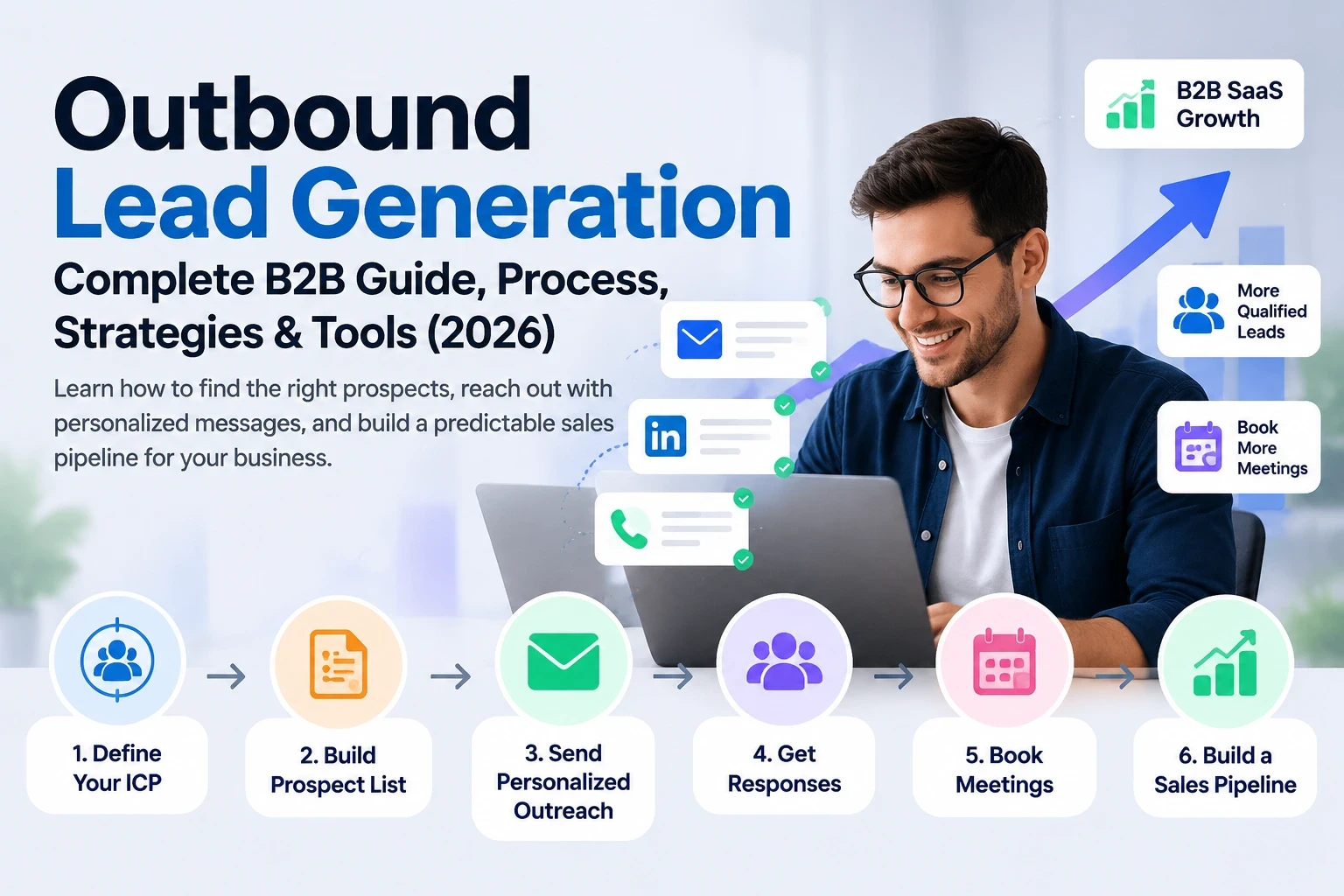
Many businesses struggle with the same problem: they need more customers, but they are waiting for people to discover them.
SEO, content marketing, and referrals can bring valuable leads, but they usually take time. If a company needs new sales conversations quickly, it needs a more proactive approach.
This is where outbound lead generation comes in.
Outbound lead generation is the process of identifying potential customers who match your ideal customer profile and reaching out to them directly through channels like cold email, LinkedIn, phone calls, and other sales methods.
Instead of waiting for prospects to find your business, outbound allows you to find the right prospects first and start conversations with them.
Modern outbound is no longer about sending thousands of random emails. Successful companies focus on accurate targeting, personalized messaging, clean data, and reliable systems
What Is Outbound Lead Generation?
Outbound lead generation is a sales and marketing approach where a company actively searches for potential buyers and contacts them before they show interest.
The process usually includes:
Identifying the right companies
Finding decision-makers
Creating targeted messaging
Sending outreach campaigns
Following up with prospects
Booking qualified sales meetings
For example, a software company selling CRM solutions may identify companies with growing sales teams, find sales managers or founders, and contact them with a message explaining how their product can solve a specific problem.
The goal of outbound is not simply sending messages.
The goal is starting relevant conversations with people who are likely to become customers.
Outbound Lead Generation vs Inbound Lead Generation
Outbound and inbound lead generation both help businesses find customers, but the approach is different.
Inbound Lead Generation
Inbound focuses on attracting customers.
Examples:
SEO content
Blog posts
Social media marketing
Paid advertising
Webinars
The prospect discovers your company when they are already searching for information.
Outbound Lead Generation
Outbound focuses on proactive outreach.
Examples:
Cold email campaigns
LinkedIn outreach
Sales calls
Account-based marketing
The company chooses the target audience and starts the conversation.
A simple way to understand the difference:
Inbound: The customer finds you.
Outbound: You find the customer.
Most successful B2B companies use both approaches together. Inbound builds long-term demand, while outbound creates direct sales opportunities.
How Does B2B Outbound Lead Generation Work?
A successful B2B outbound lead generation system follows a structured process.
Random outreach usually creates poor results. A good outbound system follows these steps:
1. Define Your Ideal Customer Profile (ICP)
The first step is deciding who you want to target.
Your Ideal Customer Profile describes the companies that are most likely to buy from you.
Important ICP details include:
Industry
Company size
Location
Revenue
Technology used
Business problems
Decision-maker roles
For example:
A SaaS company selling marketing automation software may target:
B2B companies
50–500 employees
Marketing teams
Companies already using CRM platforms
A clear ICP improves every part of outbound because your list, messaging, and offer become more relevant.
2. Build a Targeted Prospect List
After defining your audience, the next step is building a prospect list.
A good outbound list contains relevant contacts, not random email addresses.
You should collect:
Company name
Contact name
Job title
Work email
LinkedIn profile
Company information
Many outbound campaigns fail because businesses focus on quantity instead of quality.
A list of 500 relevant prospects is usually more valuable than 20,000 unrelated contacts.
3. Find Decision Makers
Reaching the correct person is critical.
A common mistake is contacting people who cannot make buying decisions.
Depending on your product, the right contacts may include:
CEOs
Founders
Marketing Directors
Sales Managers
Operations Managers
Heads of Growth
Your message should reach the person who actually experiences the problem you solve.
4. Create Personalized Outreach Messages
Generic sales emails are easy to ignore.
Messages like:
"Hi, we are a leading company helping businesses grow. Can we schedule a call?"
usually perform poorly.
Better outbound messages focus on the prospect.
A stronger approach:
Mention something specific about their company
Explain a possible challenge
Offer a useful solution
Ask for a simple conversation
Personalization does not mean writing every email manually.
It means making the message relevant.
5. Use Multi-Channel Outreach
Modern outbound campaigns rarely depend on one channel.
The most common outbound channels are:
Cold Email
Cold email remains one of the most popular B2B outreach methods because it allows companies to contact specific decision-makers directly.
However, success depends on:
Good targeting
Quality data
Strong copy
Email deliverability
Internal link suggestion: Add link on anchor text cold email deliverability → LiteMail deliverability guide.
LinkedIn Outreach
LinkedIn allows sales teams to connect with prospects, engage with their content, and build familiarity before direct outreach.
Cold Calling
Phone outreach can still work, especially for high-value products where direct conversations matter.
Social Selling
Commenting, sharing insights, and engaging with prospects can improve trust before a sales conversation.
Outbound Lead Generation Strategies That Work in 2026
Successful outbound campaigns focus on relevance instead of volume.
Here are some effective strategies:
1. Account-Based Outreach
Instead of targeting thousands of companies, businesses focus on specific high-value accounts.
This approach works well for B2B SaaS and enterprise sales.
2. Trigger-Based Outreach
Timing matters.
Useful signals include:
New funding
Hiring growth
New leadership
Product launches
Market expansion
These events create natural reasons to contact a company.
3. Personalized Cold Email Sequences
Most prospects do not reply after one message.
A proper sequence includes:
Initial email
Follow-up messages
Additional value
Final check-in
Consistency matters.
4. Combine Email With LinkedIn
Using multiple channels increases opportunities to connect.
A prospect may ignore an email but respond after seeing your LinkedIn activity.
Why Email Deliverability Matters in Outbound
A strong outbound campaign depends on reaching the inbox.
You can have:
The right audience
Great messaging
Perfect timing
But if emails go to spam, results disappear.
Important deliverability factors include:
Proper domain setup
Email authentication
Clean contact lists
Sending reputation
Gradual sending volume
Internal link suggestion: Add LiteMail link on:
"SPF, DKIM, and DMARC setup"
"email authentication"
"SMTP configuration"
Do not make this article a complete deliverability tutorial. Keep technical details inside dedicated LiteMail guides.
Outbound Lead Generation Tools
A modern outbound system usually needs several tools.
Data Tools
Used for finding prospects:
Contact databases
Email enrichment platforms
Lead research tools
Outreach Platforms
Used for:
Email sequences
Follow-ups
Campaign management
Email Infrastructure Tools
Used for:
Sending inboxes
Domain management
Deliverability protection
Pre-warmed inbox solutions can help businesses start campaigns faster without waiting weeks for new inbox reputation development.
Verification Tools
Email verification helps remove invalid contacts and reduce bounce rates.
How Much Does Outbound Lead Generation Cost?
The cost depends on your strategy and scale.
A basic outbound setup may include:
Data tools
Outreach software
Email inboxes
Verification tools
Small businesses may start with a few hundred dollars per month.
Larger companies may invest in:
Sales development representatives
Advanced automation
Multiple channels
Larger databases
The goal is not maximum spending.
The goal is creating a repeatable system that generates qualified conversations.
How To Measure Outbound Success
The right metrics help you understand what is working.
Important outbound metrics include:
Reply Rate
Shows how many people respond.
Low replies may indicate:
Weak targeting
Poor messaging
Wrong audience
Positive Reply Rate
Measures interested prospects, not just responses.
Meetings Booked
The main purpose of outbound is creating sales opportunities.
Bounce Rate
A high bounce rate usually means your list quality needs improvement.
Conversion Rate
Shows how many conversations become customers.
Common Outbound Lead Generation Mistakes
1. Sending Messages to Everyone
Broad targeting creates weak results.
Focus on specific customer groups.
2. Using Generic Templates
Prospects ignore messages that feel automated.
Make outreach relevant.
3. Ignoring Follow-Ups
Many opportunities are lost because businesses stop after one email.
4. Poor Data Quality
Incorrect contact information damages campaigns.
Always verify your lists.
5. Measuring Only Activity
Sending more emails does not always mean better results.
Focus on qualified meetings and revenue.
Frequently Asked Questions
Is outbound lead generation still effective in 2026?
Yes. Modern outbound works when companies combine accurate targeting, personalization, and strong infrastructure. Poor-quality mass outreach is what creates bad results.
What is the outbound lead generation process?
The process includes defining an ICP, building a prospect list, finding decision-makers, creating outreach campaigns, following up, and converting responses into sales meetings.
What channels are used for outbound lead generation?
Common channels include cold email, LinkedIn outreach, phone calls, and social selling.
How do companies generate outbound leads?
Companies generate outbound leads by identifying target customers, finding contact information, and reaching out with relevant messages.
Is outbound lead generation good for SaaS companies?
Yes. SaaS companies often use outbound because their target customers can be clearly defined by industry, company size, technology, and business needs.
Final Thoughts
Outbound lead generation is not about sending more messages.
It is about finding the right companies, contacting the right people, and starting meaningful conversations.
The best outbound systems combine:
Clear targeting
Accurate data
Personalized messaging
Multiple channels
Strong email infrastructure