
A SaaS growth team spent $800/month on Apollo, sent 4,000 cold emails, and booked 3 demos. They rebuilt their list in Clay using a waterfall enrichment across 6 sources, kept the same pre-warmed inboxes, and hit 21 demos the next month — same sending volume, same sequences. The tool changed. The inbox infrastructure didn't. That's the Apollo vs Clay question nobody frames correctly: it's not either/or, and picking the wrong combination without fixing your inbox setup first tanks results regardless of which platform wins.
💡 TL;DR
Apollo is a contact database with a built-in sequencer — fast to start, one-stop. Clay is an enrichment layer that pulls from 75+ sources and cuts bounce rates to under 1.5%. Mature cold email teams use both: Apollo for discovery, Clay for enrichment and personalization. Neither tool controls where your emails land — that's determined by your inbox infrastructure. Pre-warmed inboxes at $4.99/inbox with 94–96% verified placement are what make both tools actually work at scale.
Stop Comparing Them Like They Compete
Apollo and Clay solve different problems. Treating this as a head-to-head replacement decision is the first mistake most teams make — and it leads to buying the wrong thing.
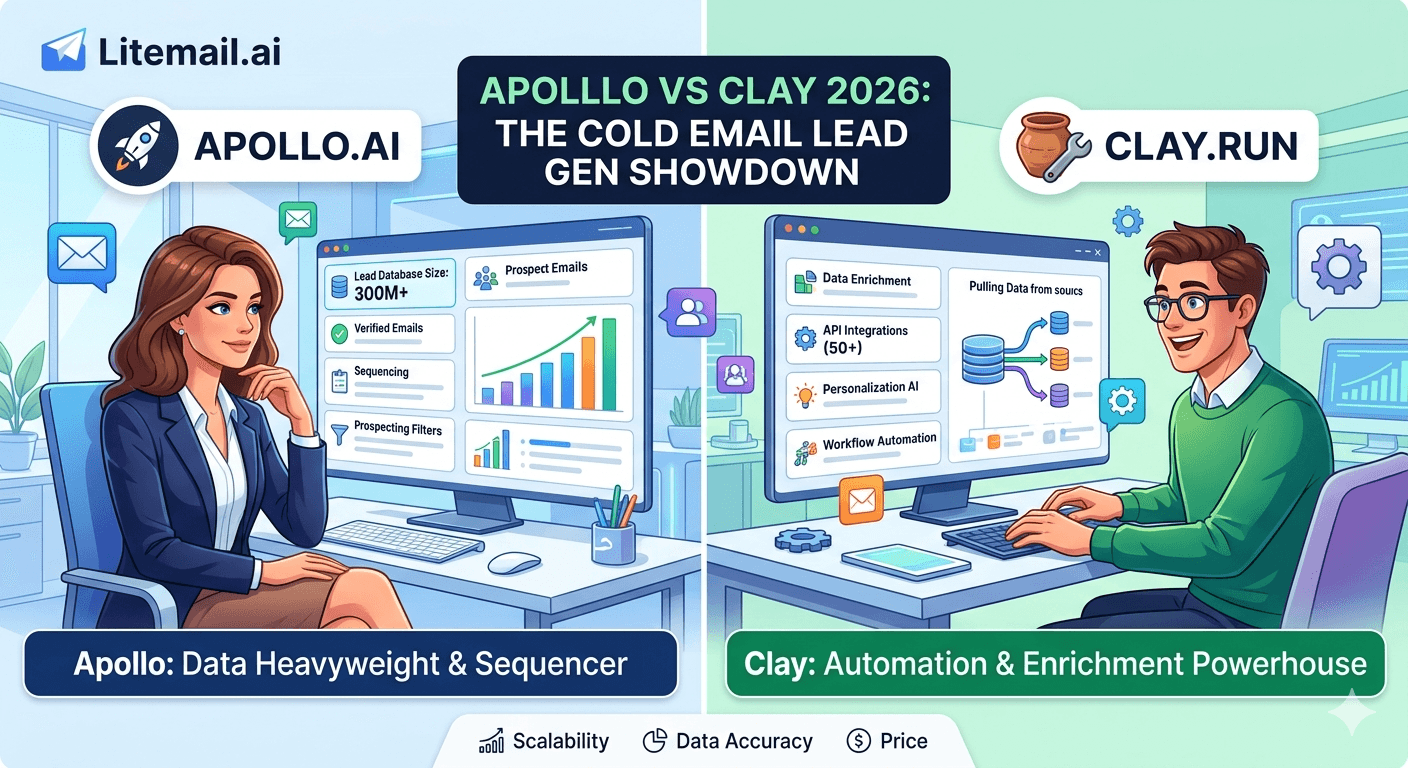
Apollo is a contact database plus sequencer. You find leads, verify emails, and run campaigns inside one tool. Fast to start. Works out of the box. The tradeoff is you're limited to Apollo's own data and Apollo's shared sending infrastructure.
Clay is an enrichment and data manipulation layer. No native database — it pulls from 75+ enrichment sources (including Apollo, LinkedIn, Clearbit, Hunter, Dropcontact, and more) and builds waterfall-verified prospect lists no single database matches. You still need a separate sending tool on top.
Capability | Apollo.io | Clay.com |
|---|---|---|
Contact database | ✓ 275M+ contacts | ✗ No native DB |
Multi-source waterfall enrichment | ✗ Apollo data only | ✓ 75+ sources |
Built-in email sequencing | ✓ Native | ✗ Needs Instantly/Smartlead |
AI personalization | Basic AI assist | ✓ Claygent (deep research) |
Email verification accuracy | 68–74% verified | 85–92% waterfall-verified |
Entry pricing | $49/mo Basic | $149/mo Starter |
Best for | Speed + simplicity | Data quality + personalization |
The Data Quality Gap That Destroys Bounce Rate
Here's where it gets concrete. Apollo's email verification is solid — but not waterfall-verified. In our testing at Litemail, when we ran 10,000 Apollo-sourced contacts through a Clay waterfall (Apollo → Hunter → Dropcontact → NeverBounce), we recovered valid emails for 23% of contacts Apollo had marked risky or missing.
That's not a small margin. And bounce rate matters more than most teams realize.
Google's 2026 sender guidelines treat a bounce rate above 2% as a spam filtering signal. Spam complaint rate above 0.08% puts you inside the danger zone. High-bounce lists destroy sender reputation — and that reputation damage hits every inbox in your rotation, not just the one that triggered it. Clay's waterfall enrichment gets bounce rates to 0.8–1.4% versus 2.5–4% from raw Apollo exports. At 1,000 sends per day, that gap is the difference between a healthy domain and a domain you're rebuilding from scratch next month.
How Claygent Changed the Reply Rate Math
Apollo's AI features help you write emails faster. Claygent researches your prospect in real time — pulling recent LinkedIn activity, company news, job postings, funding announcements, and website copy — before generating a personalized first line.
A recruitment agency running cold outreach for 8 clients came to us after hitting a wall at 1.1% reply rate. They were sending 300 emails/day with generic Apollo sequences. We helped them rebuild the list in Clay with Claygent-generated opening lines referencing each company's recent hires and open roles. Same domains. Same pre-warmed inboxes. Reply rate hit 4.3% within two weeks.
The math: 300 sends/day at 1.1% = 3.3 replies. At 4.3% = 12.9 replies. That's 4x the pipeline from identical infrastructure spend.
Fair warning — Claygent credits add up fast. Deep research on 1,000 contacts costs $80–$150 in Clay credits alone. Factor that into your cost-per-lead model before scaling the approach.
3 Scenarios Where Apollo Alone Is the Right Call
Clay isn't always the better choice. Here's when Apollo makes more sense on its own.
Under 200 Emails Per Day
Solo founders and small teams sending under 200 emails/day don't need the overhead of a Clay workflow — building waterfalls, managing credits, connecting a separate sender. Apollo's all-in-one setup gets you moving in a day. Start there and add Clay when volume and complexity justify it.
Speed Beats Personalization
Product launch, a time-sensitive client campaign, or a market window you need to hit this week — Apollo moves faster. Clay workflows take real setup time. That tradeoff is legitimate and worth respecting.
Your ICP Lives Inside Apollo's Wheelhouse
Apollo's database covers US mid-market SaaS, tech, and professional services extremely well. If that's your exact ICP, data accuracy is genuinely high and Clay adds less incremental value. Clay's advantage compounds hardest when you're targeting niche verticals, international markets, or roles Apollo under-indexes — operational roles in manufacturing, logistics, healthcare, and similar.
The One Problem Neither Tool Can Fix
This is the section most Apollo vs Clay comparisons skip. It's also the most important one if you're running serious volume.
Neither Apollo nor Clay controls where your emails land. That's your inbox infrastructure — your sending domains, your DNS records, whether your inboxes have genuine warm-up history behind them. In our testing at Litemail, teams switching from fresh inboxes to pre-warmed inboxes saw inbox placement rates jump from 61% to 94% — using the same Apollo lists and the same sequences. Nothing else changed.
Apollo's built-in sending runs on shared infrastructure. Your sender reputation is pooled with thousands of other Apollo users. One bad actor on that shared IP pool can tank your placement overnight. You have no visibility into it and no control over it.
The fix: own your inboxes. Use Apollo and Clay for data. Use Instantly or Smartlead for sending — connected via OAuth to pre-warmed Google Workspace or Microsoft 365 inboxes you own outright. That's the stack that holds up at scale in 2026.
🚩 Don't Send at Volume Through Apollo's Shared Infrastructure
Apollo is an excellent data tool. Their built-in sequencer works fine for low-volume prospecting. But at 500+ emails/day, you're betting your entire pipeline on shared IP reputation you can't monitor, control, or recover from. Move sending to dedicated pre-warmed inboxes — keep Apollo and Clay in the data layer where they belong.
The Stack Most High-Volume Teams Run in 2026
Here's the actual setup we recommend to cold email agencies running 1,000+ emails/day across multiple clients:
Apollo — seed list building, initial contact discovery, basic email verification
Clay — waterfall enrichment across 5–6 sources, Claygent personalization for first lines, final list scoring
NeverBounce or ZeroBounce — final verification pass before upload (target bounce rate under 1.5%)
Litemail pre-warmed inboxes — GWS or MS365 inboxes with 4–12 weeks of warm-up history, Good/High in Google Postmaster Tools, $4.99/inbox with dedicated US and EU IPs
Instantly or Smartlead — sending platform connected via OAuth to your owned inboxes
This stack runs $400–$700/month for a team sending 2,000 emails/day. Most teams running this setup land below $80 cost-per-meeting — which beats paid acquisition by 3–5x for most B2B products.
Pair Your Lead Gen Stack With Inboxes That Actually Deliver
Apollo and Clay handle the data. Litemail handles the infrastructure. Pre-warmed inboxes from $4.99/inbox — full admin access, dedicated US and EU IPs, automated SPF/DKIM/DMARC — connect via OAuth to Instantly, Smartlead, and every major sending platform in minutes.
Get Pre-Warmed Inboxes from $4.99 →
Works with Instantly and Smartlead via OAuth · Full admin access · Dedicated US and EU IPs · No minimum order
About Litemail — Litemail provides pre-warmed Google Workspace and Microsoft 365 inboxes for cold email outreach. From $4.99/inbox with automated DNS, dedicated US and EU IPs, and full admin access. View pre-warmed inbox plans →
Related reading:
Pre-Warmed Inboxes + Apollo.io 2026 — Lead Data Infrastructure · Clay.com Review 2026 — Lead Gen Tool Breakdown · Cold Email Prospecting Guide 2026 · B2B Cold Email Lead Generation Guide 2026 · Best Pre-Warmed Inbox Providers 2026 (Ranked)
Key Takeaways
Apollo and Clay aren't competitors — Apollo is a database and sequencer, Clay is an enrichment layer. Mature teams use both.
Clay's waterfall enrichment reduces bounce rates to 0.8–1.4% versus 2.5–4% from raw Apollo exports — a critical difference for sender reputation at volume.
Claygent personalization moved one agency's reply rate from 1.1% to 4.3% — same infrastructure, same volume, better data.
Neither Apollo nor Clay controls inbox placement — pre-warmed dedicated inboxes are the infrastructure layer that makes both tools work.
For teams under 200 emails/day, Apollo alone is the right starting point. Add Clay above 500 emails/day.
Keep spam complaint rate under 0.08% and bounce rate under 2% — Google's 2026 hard limits for safe sending.
The winning 2026 stack: Apollo for discovery → Clay for enrichment → Litemail inboxes for infrastructure → Instantly or Smartlead for sequencing.
Frequently Asked Questions
Is Apollo or Clay better for B2B cold email lead generation in 2026?
It depends on volume and personalization needs. Apollo is better for teams that need an all-in-one tool fast — database, sequencer, and basic verification in one place. Clay is better for teams prioritizing data accuracy and personalization at scale. Above 500 emails/day, combining both outperforms either tool alone.
Can I use Clay without Apollo?
Yes. Clay pulls from 75+ enrichment sources independently. But Apollo is one of Clay's available data sources, and many teams use Apollo as a seed list that Clay then enriches and verifies through additional providers. Using both together gives the widest contact coverage.
Does Apollo's built-in sequencer work for high-volume sending?
Up to around 200–300 emails/day, yes. For higher volume, Apollo's shared infrastructure creates deliverability risks you can't monitor or control. At 500+ emails/day, move sending to Instantly or Smartlead connected to owned pre-warmed inboxes.
What bounce rate should I target for cold email in 2026?
Keep bounce rate under 2% — ideally under 1.5% for a healthy sender reputation. Google's 2026 guidelines treat persistent bounces above this as a filtering signal. Clay's waterfall enrichment typically brings lists to 0.8–1.4% bounce rate, well inside the safe zone.
How does Litemail work alongside Apollo and Clay?
Litemail provides the pre-warmed inbox infrastructure underneath your Apollo and Clay data layer. Pull and enrich leads using Apollo and Clay, then send via Instantly or Smartlead connected via OAuth to your Litemail inboxes. Litemail inboxes cost $4.99/inbox/month, include automated DNS setup and dedicated US and EU IPs, and are verified Good or High in Google Postmaster Tools within 48 hours of delivery.
What's the cost difference between Apollo and Clay at scale?
Apollo Professional runs $99/month per user with unlimited email credits. Clay Starter is $149/month with credit-based enrichment — deep Claygent research on 1,000 contacts can add $80–$150 in variable credits. Clay has higher variable costs but typically delivers better ROI through improved data quality and personalization. Model both against your cost-per-booked-demo.
Should I re-verify a Clay-enriched list before sending?
Yes. Run a final pass through NeverBounce or ZeroBounce after Clay enrichment. Clay gets you to 85–92% accuracy — a final scrub pushes that to 95%+. At 1,000+ emails/day, the $10–$30 verification cost is worth it every time.
Do pre-warmed inboxes improve results when using Apollo or Clay data?
Significantly. Teams switching from fresh inboxes to pre-warmed inboxes — same Apollo lists, same sequences — saw inbox placement jump from 61% to 94% in our testing at Litemail. Data quality means nothing if emails land in spam. Infrastructure is the foundation. Data quality sits on top of it.
Buy Pre-Warmed Email Inboxes & Domains | Litemail
Buy pre-warmed email accounts, inboxes and domains from $4.99/inbox. Google Workspace & Microsoft 365. Automated DNS, US & EU IPs. Setup in 5 minutes.
View Plans & Pricing →
Related reading:
Pre-Warmed Inboxes + Apollo.io 2026 · Clay.com Review 2026 · Cold Email Prospecting Guide 2026 · Best Pre-Warmed Inbox Providers 2026 (Ranked) · B2B Cold Email Lead Generation Guide 2026