
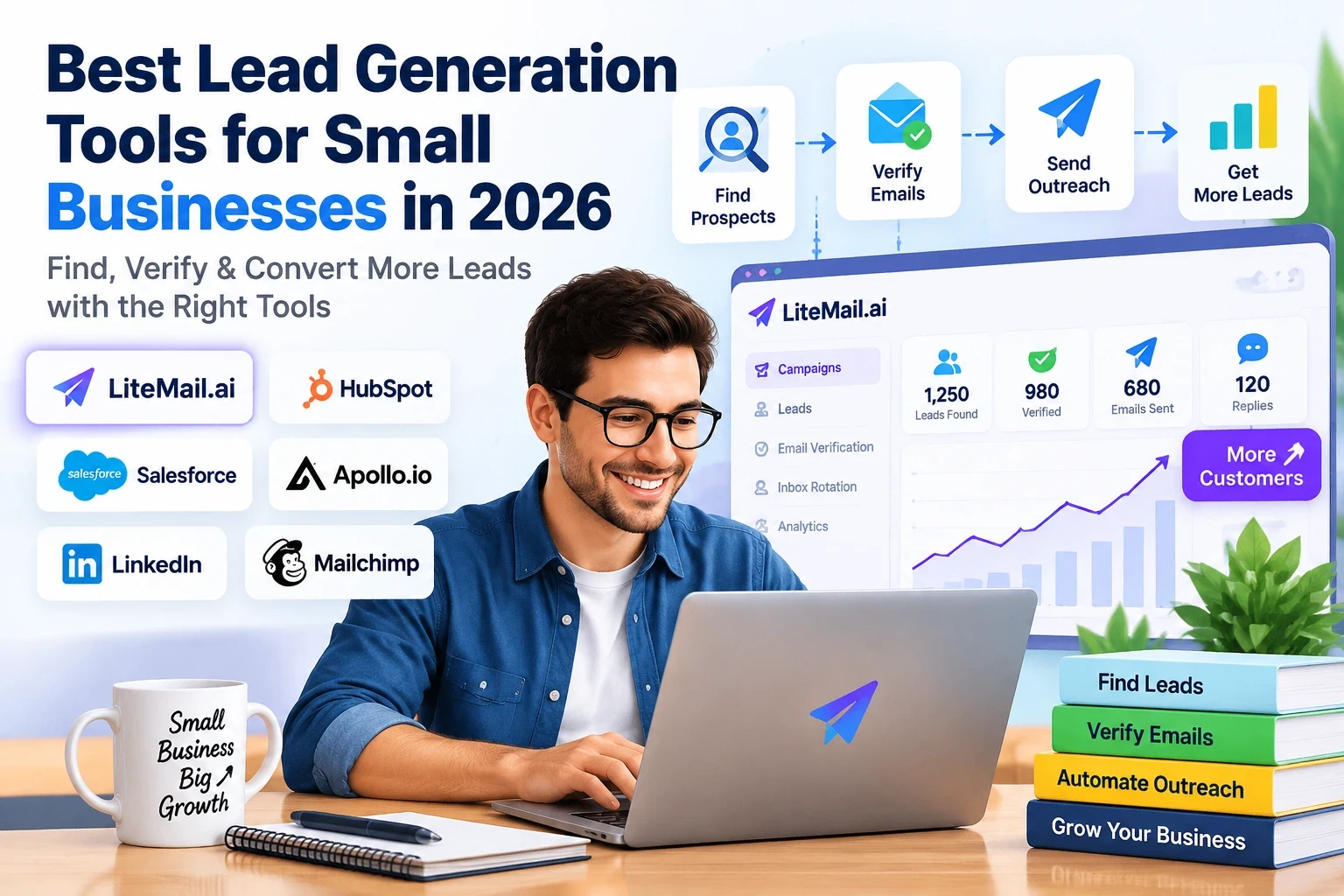
Consistent lead generation is one of the toughest issues for small businesses.
Many firms offer amazing products and services. But they might struggle with one essential question:
How can we identify the proper consumers and initiate more sales conversations?
Traditional techniques such as cold phoning, manual research, and sponsored advertising can be time-consuming and expensive. This is why many small companies are embracing lead generation solutions to identify prospects, manage client data, automate outreach and streamline their sales process.
But picking the correct tool is no simple task.
Some platforms are just for databases. Some concentrate on CRM administration, internet forms or marketing automation. What works for a giant organization may not be the best option for a small business with a limited budget and a tiny sales team.
The top lead generation tools help companies with the whole process:
Email address verification
Customized outreach
Follow-up handling
Converting prospects into customers
In this guide, we’ll review the best lead generating tools for small businesses in 2026 — what each performs well and how to choose the ideal solution for your growth strategy.
What Is a Lead Generation Tool?
A lead generation tool is software that assists businesses in identifying and attracting potential customers.
Businesses can use these tools to automate various aspects of the sales process instead of manually searching for prospects.
Lead generation tools can help you depending on the platform:
Business contacts needed
Catching website visitors
Prospect List Development
Customer information management
Sending marketing campaigns
Sales follow-ups automation
Monitoring customer interaction
For example, a local software company searching for new customers might use a lead generation tool to find marketing managers at growing companies, verify their email addresses, and send personalized outreach messages.
Different Types of Lead Generation Tools
Not all lead generation tools work the same.
Most platforms are in other categories.”
Tools for Inbound Lead Generation
Inbound tools help businesses catch leads that are already interested.
For example:
Web forms
Landing pages
Chat en vivo
Pop ups
Tools for content marketing
These are good for businesses that already get website traffic.
Tools for Generating Leads - Outbound
Businesses use outbound tools to find potential customers.
These are mostly used for:
B2B sales
Cold email campaigns
Prospecting
Outreach based on accounts
Outbound lead generation consists of:
Find companies
Locating the decision-makers
Checking contact details
Email to start conversations
For lots of small B2B businesses, outbound lead generation is a quicker way to get to potential customers.
What Should Small Businesses Look For In A Lead Generation Tool?
Choosing the right platform depends on your business goals.
A good lead generation tool should provide more than just contact lists.
1. Accurate Lead Data
The quality of your leads directly affects your results.
Poor data can create:
Invalid email addresses
High bounce rates
Wasted sales efforts
Lower campaign performance
A reliable platform should help businesses maintain clean and accurate prospect data.
2. Email Verification
Finding an email address is only the beginning.
Before starting outreach, businesses should verify whether contacts are likely to receive emails.
Email verification helps:
Reduce bounced emails
Protect sender reputation
Improve campaign performance
Increase successful deliveries
3. Outreach Automation
Small teams cannot manually follow up with every prospect.
A good platform should help automate:
Email sequences
Follow-up messages
Campaign scheduling
Reply management
Automation allows businesses to spend more time closing deals instead of managing repetitive tasks.
4. Personalization Features
Generic messages usually receive poor engagement.
Modern lead generation tools should allow businesses to personalize outreach using:
Company information
Industry details
Job roles
Customer problems
Personalized communication feels more relevant and improves response opportunities.
5. Affordable Pricing
Small businesses need tools that provide measurable returns.
The best solution is not always the one with the most features.
It is the one that helps you generate more opportunities without unnecessary costs.
Best Lead Generation Tools for Small Businesses in 2026
1. LiteMail.ai — Best All-in-One B2B Lead Generation Tool
For small businesses focused on B2B growth, LiteMail provides a complete outbound lead generation workflow.
Unlike platforms that only provide contact databases or CRM features, LiteMail focuses on helping businesses move from finding prospects to starting real sales conversations.
With LiteMail, businesses can manage the complete outreach process:
Find leads → Verify contacts → Send emails → Follow up → Generate opportunities
Find Targeted B2B Prospects
The first step in lead generation is reaching the right audience.
LiteMail helps businesses identify prospects based on factors such as:
Industry
Company size
Location
Business type
Job roles
Instead of spending hours manually searching for potential customers, businesses can create more focused prospect lists.
Example:
A marketing agency looking for customers can target:
SaaS companies
Startup founders
Marketing managers
Companies in specific locations
Verify Emails Before Sending Campaigns
Many businesses waste money because they send emails to outdated or incorrect contacts.
LiteMail helps improve data quality by supporting email verification before outreach.
Cleaner data helps businesses:
Reduce failed deliveries
Maintain sender reputation
Improve campaign efficiency
Create Personalized Cold Email Campaigns
Finding leads is only half of the process.
The next step is creating meaningful conversations.
LiteMail helps businesses build outreach campaigns with:
Personalized emails
Automated follow-ups
Campaign scheduling
Reply tracking
Instead of sending the same message to everyone, businesses can create outreach that matches their audience.
Improve Email Deliverability
A major challenge in cold email is reaching the inbox.
Even a perfect message will not work if it lands in spam.
LiteMail focuses on important deliverability factors:
Email infrastructure
Inbox management
Sending reputation
Campaign monitoring
This helps businesses build a more reliable outbound system.
Why LiteMail Is Better Than Using Multiple Separate Tools
Many businesses use different tools for every step:
One tool for finding leads
Another for email verification
Another for sending emails
Another for tracking campaigns
Another for managing inboxes
This creates:
Higher costs
More complexity
More technical problems
LiteMail brings important parts of the outbound workflow together in one platform.
For small businesses, this means:
Less tool management
Faster campaign setup
Easier scaling
2. HubSpot — Best CRM-Based Lead Generation Platform
HubSpot is one of the most popular CRM and marketing platforms.
It helps businesses manage:
Contacts
Website leads
Marketing campaigns
Customer relationships
Best For:
Businesses that focus mainly on inbound marketing and CRM management.
Advantages:
User-friendly interface
Free CRM option
Strong marketing features
Limitations:
Advanced features can become expensive
More focused on managing leads than creating outbound opportunities
3. Salesforce — Best Enterprise Lead Management Platform
Salesforce is a powerful CRM platform used by large organizations.
It provides:
Sales management
Customer tracking
Reporting
Automation
Best For:
Companies with larger sales teams and complex processes.
Limitations:
Can be complicated for small businesses
Requires more setup and management
4. Apollo.io — Best Prospect Database For Sales Teams
Apollo combines contact data with sales outreach features.
It helps businesses:
Find prospects
Access business contacts
Create outreach campaigns
Best For:
Small sales teams that need prospecting data.
Limitations:
Businesses may still need additional tools for deliverability and infrastructure.
5. LinkedIn Sales Navigator — Best For B2B Prospect Research
LinkedIn Sales Navigator helps sales professionals find decision-makers.
Useful features include:
Advanced search
Company research
Contact discovery
Best For:
Businesses selling high-value B2B products or services.
Limitation:
It helps find prospects but does not provide a complete email outreach system.
6. Zapier — Best Workflow Automation Tool
Zapier connects different business applications.
It helps automate workflows between:
CRM systems
Email tools
Forms
Marketing platforms
Best For:
Businesses that already use multiple tools and want automation.
7. Mailchimp — Best Email Marketing Tool For Existing Audiences
Mailchimp is popular for email marketing campaigns.
It helps businesses manage:
Newsletters
Customer emails
Marketing automation
Best For:
Businesses communicating with existing subscribers.
Limitation:
It is not primarily designed for B2B cold outreach.
Lead Generation Tool Comparison Table
Tool | Best For | Lead Finding | Email Outreach | Verification | Small Business Friendly |
|---|---|---|---|---|---|
LiteMail | B2B outbound growth | Yes | Yes | Yes | Excellent |
HubSpot | CRM & inbound marketing | Limited | Yes | Limited | Good |
Salesforce | Enterprise sales | Limited | Limited | No | Medium |
Apollo | Prospect database | Yes | Yes | Limited | Good |
LinkedIn Sales Navigator | Prospect research | Yes | No | No | Medium |
Mailchimp | Email marketing | No | Yes | No | Good |
Why Many Lead Generation Tools Fail Small Businesses
Having a tool does not automatically create customers.
Many businesses struggle because they focus only on collecting contacts.
Problem 1: They Buy Data Without Verification
Large databases can contain outdated information.
Result:
More bounced emails
Lower campaign performance
Problem 2: They Send Generic Messages
A list of contacts is useless if the message does not create interest.
Successful outreach requires:
Personalization
Relevance
Clear value
Problem 3: They Ignore Follow-Ups
Many opportunities happen after multiple interactions.
A proper follow-up system is essential.
Problem 4: They Ignore Deliverability
Sending thousands of emails means nothing if those emails never reach inboxes.
A successful system needs:
Clean data
Proper sending setup
Reputation management
The Complete Lead Generation Process For Small Businesses
A successful lead generation strategy follows a simple funnel.
Step 1: Define Your Ideal Customer
Before searching for leads, understand:
Who is your customer?
What industry are they in?
Which companies need your solution?
Step 2: Find Qualified Prospects
Use lead generation tools to identify potential customers.
Focus on quality instead of quantity.
Step 3: Verify Contact Information
Remove incorrect or risky contacts before outreach.
Step 4: Send Personalized Outreach
Create messages based on:
Customer needs
Industry problems
Business goals
Step 5: Follow Up Consistently
Most prospects do not reply immediately.
Automated follow-ups help increase opportunities.
Step 6: Measure Results
Track:
Replies
Meetings booked
Conversion rates
Revenue generated
Which Lead Generation Tool Should Small Businesses Choose?
Choose LiteMail If:
You sell B2B products or services
You need outbound leads
You want email automation
You want fewer separate tools
Choose HubSpot If:
You mainly generate inbound leads
You need CRM management
Choose Salesforce If:
You have enterprise sales operations
Choose Apollo If:
You mainly need contact databases
Frequently Asked Questions
What is the Best Lead Generation Software for Small Businesses?
The best tool is the one that fits your business model. For small B2B businesses looking for prospect discovery, email verification, and automated outreach, an all-in-one platform like LiteMail can streamline the entire process.
Are Lead Generation Tools Worth It for Small Business?
Yes. They cut down the manual work of prospecting and assist companies in creating a more predictable sales pipeline.
What is the cheapest way to generate B2B leads?
Cold email outreach with verified prospect data is one of the most cost-effective ways for small businesses to reach potential customers.
Some lead generation tools do offer email addresses.
Although many tools provide you with business contact information, it is important to verify emails for better results before sending campaigns.
What’s the difference between a CRM and a lead generation tool?
A CRM is used to manage existing leads and customers. Lead generation tool helps businesses to find new potential customers.
Can small businesses compete with larger companies using lead generation tools?
Yep. Automation allows small teams to build professional sales processes without requiring big sales departments.
Final Thoughts
The best small business lead generation tools are not just databases or contact management systems.
A successful lead generation strategy requires a well-rounded approach:
Finding the right leads.
Maintaining data accuracy
Crafting Individual Outreach
Following up regularly
Conversations to customers: How to convert
Small businesses don’t need more tools. They need the proper system.
LiteMail is an all-in-one platform that combines prospect discovery, email verification, outreach automation and deliverability management to enable businesses to build a complete B2B lead generation workflow.
Start building a smarter lead generation system with LiteMail today and turn more prospects into customers.