
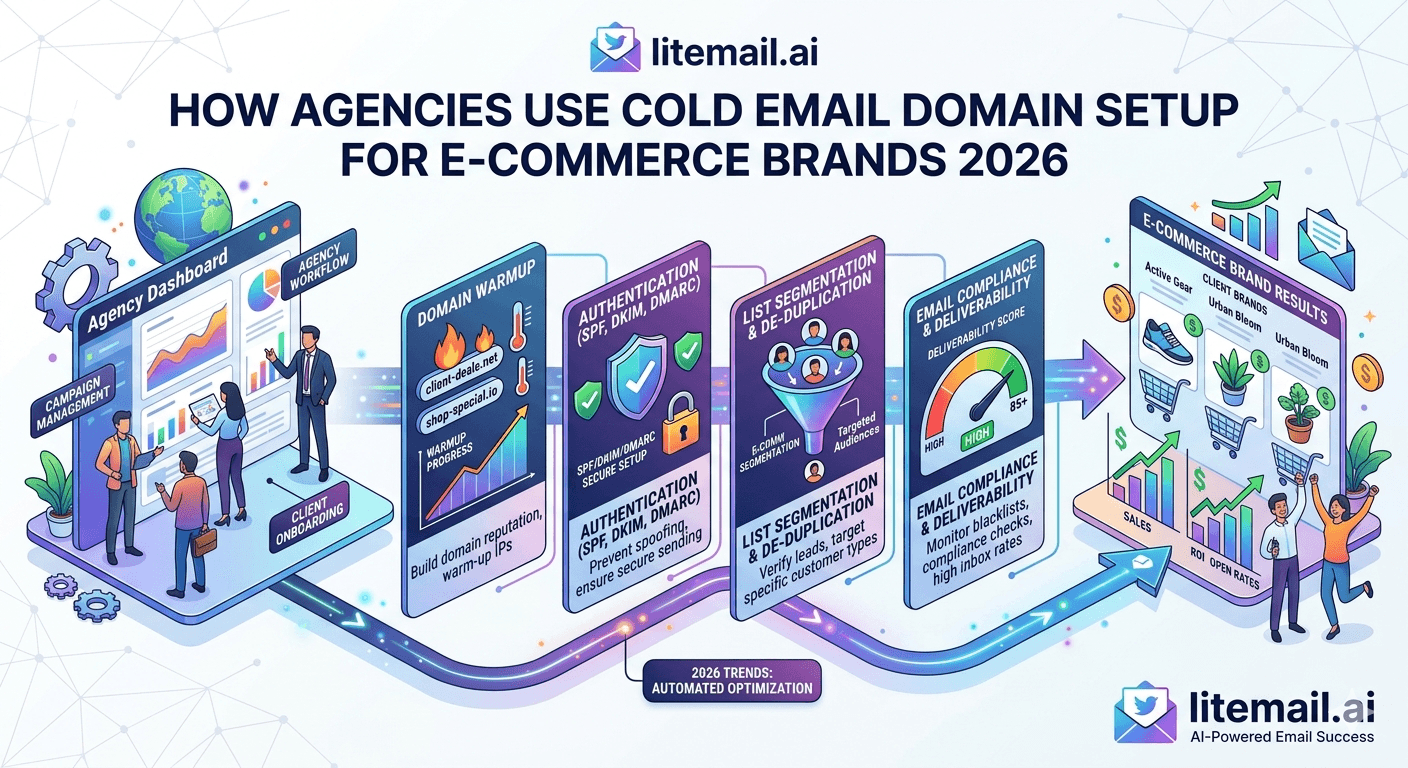
E-commerce brands running cold email have a different infrastructure requirement from pure B2B companies. Most e-commerce cold email targets B2B prospects — retail buyers, procurement managers, wholesale distributors, marketplace account managers — but the e-commerce brand's primary domain is often consumer-facing and transactional, handling order confirmations, shipping notifications, and customer service email. Mixing cold B2B outreach with consumer transactional email on the same domain is one of the fastest ways to damage a primary domain's deliverability for its highest-value use cases.
E-commerce Brand Cold Email Domain Setup — The Agency Framework
💡 TL;DR
Agencies setting up cold email for e-commerce brands need three separate domain tracks: the primary brand domain (never for cold email), a B2B outreach sending domain for retail buyers and wholesale prospects, and (for brands targeting both consumer influencers and corporate buyers) a separate influencer/partnership outreach domain. Pre-warmed Litemail inboxes at $4.99/inbox for both B2B tracks. B2B buyer outreach: MS365 inboxes for corporate retail buyers at large retailers (Exchange-heavy), GWS for emerging DTC brands and smaller buyers. Influencer outreach: GWS primary (personal Gmail prevalent). Volume: 25–35 emails per inbox per day for both tracks — e-commerce outreach recipients have moderate spam complaint sensitivity.
Here is the complete domain setup framework for agency-managed e-commerce brand cold email.
The Three-Domain Architecture for E-commerce Cold Email
E-commerce brands typically need three separate email communication tracks, each requiring its own domain treatment:
Track 1: Primary Brand Domain (yourstore.com) — No Cold Email Ever
The primary brand domain handles transactional email (order confirmations, shipping notifications, returns), customer service communication, and marketing email to opted-in subscribers. This domain's reputation is critical for e-commerce revenue. A single blacklist event on the primary domain can delay order confirmation delivery, damage transactional open rates, and affect the customer experience for paying customers. Cold outreach — with its inherent bounce and complaint risk — should never run from this domain.
Track 2: B2B Wholesale/Retail Outreach Domain
Register a sub-brand domain that reads as the brand's B2B presence: yourstorepartners.com, yourstoretrade.com, or yourstorewholesale.com. This domain handles all cold email to retail buyers, wholesale distributors, marketplace account managers, and corporate procurement contacts. Failure or blacklisting on this domain has zero impact on the primary brand domain's transactional email reputation.
Track 3: Partnership and Influencer Outreach Domain (Optional)
For brands running creator/influencer cold outreach alongside B2B wholesale prospecting: register a third domain for influencer and partnership outreach. yourstorecollab.com or yourstorecreatorsupport.com. Influencer outreach has different characteristics (recipients are individuals, often on personal Gmail, higher complaint sensitivity) that warrant domain isolation from the B2B wholesale outreach domain.
Inbox Type Selection for E-commerce B2B Outreach
E-commerce B2B cold email targets two distinct buyer populations with different email platform preferences:
Target Recipient | Email Platform | Recommended Inbox Type |
|---|---|---|
Buyers at large retailers (Walmart, Target, regional chains) | Exchange / Outlook | MS365 inboxes |
Amazon/Marketplace account managers | Corporate Exchange | MS365 inboxes |
Wholesale distributors (industrial, specialty) | Exchange / Outlook | MS365 inboxes |
DTC brand buyers and boutique retail | Often Google Workspace | GWS inboxes |
Influencers and content creators | Personal Gmail | GWS inboxes |
Procurement managers at corporate buyers | Exchange / Outlook | MS365 inboxes |
For agencies managing e-commerce clients with mixed prospect lists: a 60% MS365 / 40% GWS rotation pool handles most e-commerce B2B outreach lists. Large retail buyers skew Exchange; boutique and DTC buyers skew GWS. Adjust the ratio based on the specific buyer profile for each client's product category.
Volume Settings for E-commerce Brand Cold Email
E-commerce cold email to B2B buyers: 30–40 emails per inbox per day. Retail buyers — particularly at larger retailers — are experienced professionals who receive significant vendor outreach volume. They're less likely than average B2B prospects to mark cold email as spam if it's relevant, but their corporate email security systems may be aggressive at large retailers. Conservative-to-moderate per-inbox volume keeps sending patterns below the pattern-detection threshold for enterprise-class email security.
E-commerce influencer outreach: 20–30 emails per inbox per day. Personal email recipients have higher spam complaint sensitivity. Conservative volume protects the influencer outreach sending domain reputation, which is already more vulnerable due to the personal-email-heavy recipient population.
Total daily volume for a typical e-commerce brand cold email program: 150–250 emails per day across 5–8 inboxes. For 150/day: 5 inboxes (3 MS365 for corporate buyers, 2 GWS for boutique/DTC targets). For 250/day: 8 inboxes.
Sequence Strategy for E-commerce B2B Outreach
Retail buyer and wholesale distributor cold email has specific sequence requirements that differ from standard B2B SaaS outreach:
Lead with product-market fit, not pain points. Retail buyers evaluate products against their category strategy — they're less interested in solving pain and more interested in whether the product fits their assortment and price point. The first email should communicate product category, price architecture, and target consumer relevance in two sentences. Not a generic "we help brands grow" pitch.
Include wholesale-specific details upfront. MOQ, wholesale pricing tiers, lead time, and available certifications (organic, B-corp, etc.) are the decision-making signals buyers need to evaluate fit. Provide enough to qualify — not a full line sheet in email 1, but enough to confirm the conversation is worth having.
3-email sequences maximum. Retail buyers operate on category review cycles. If they're interested in a new brand, they'll respond within 3 touches. If they're not in a buying window, no number of follow-ups converts that. 3 touches covers both cases without overextending into complaint territory.
Protecting the Primary Brand Domain
The most important infrastructure decision for e-commerce brand cold email is the most obvious: protect the primary domain at all costs. The primary brand domain drives e-commerce revenue through transactional email delivery and marketing email engagement. A damaged primary domain reputation costs more in reduced transactional open rates and delayed order confirmations than any cold outreach campaign generates in new wholesale revenue.
The protection is simple: never use the primary brand domain for cold outreach. Register dedicated sending domains. Keep them entirely separate from the primary domain's DNS, inbox management, and sending reputation. At $9/year per sending domain from Cloudflare and $4.99/inbox from Litemail, the cost of this protection is negligible relative to the risk it prevents.
In our testing at Litemail, we have seen e-commerce brands that mixed cold outreach with their primary transactional email domain accumulate Medium Postmaster reputation within 8–12 weeks of consistent cold outreach. The recovery process — stopping all cold outreach, waiting 6–8 weeks for reputation to recover — costs more in campaign interruption than 12 months of dedicated sending domain costs. Separate the domains from day one.
Monitoring for E-commerce Brand Cold Email
E-commerce brands running cold email need monitoring focused on two risks specific to their setup:
Primary domain reputation contamination monitoring: Even with dedicated sending domains, a misconfiguration that accidentally routes cold outreach through the primary domain can contaminate it. Check Postmaster for the primary brand domain monthly — not for cold email monitoring, but to confirm the primary domain's reputation remains Good or High independent of cold outreach activity. Any degradation on the primary domain triggers immediate investigation regardless of which sending domain the outreach is running from.
B2B vs influencer domain cross-contamination: If running both B2B and influencer outreach programs, monitor both sending domains independently. A complaint spike from influencer outreach (personal email recipients) should not affect the B2B wholesale sending domain reputation — and with separate domains, it won't. Weekly Postmaster check on both sending domains. The influencer outreach domain (with its higher-complaint-sensitivity recipients) warrants twice-weekly checks during active campaigns.
Agency Onboarding Timeline for E-commerce Brand Clients
Setting up cold email infrastructure for a new e-commerce brand client:
Day 1: Confirm ICP (B2B wholesale only, or B2B + influencer). Register 2 dedicated sending domains at Cloudflare. Order Litemail pre-warmed inboxes — MS365 and/or GWS based on buyer profile analysis. Delivery in 24 hours.
Day 2: Verify all inboxes. MXToolbox batch check. Test email headers. Postmaster domains added. Connect inboxes to Smartlead or Instantly via OAuth.
Day 3: Build prospect lists for retail buyers. Verify with NeverBounce. Write sequences specific to the brand's product category and wholesale terms.
Day 4–5: Campaign setup, sequence review, launch. Total onboarding: 4–5 days from client contract to first campaign send.
What to Expect — E-commerce Cold Email Benchmarks
Realistic performance benchmarks for agency-managed e-commerce brand cold email with correct infrastructure:
B2B wholesale/retail buyer outreach: 25–35% open rate, 3–6% reply rate, 2–4% positive meeting or sample request rate. Higher than average B2B cold email because relevant product-fit emails resonate with buyers actively managing their assortment.
Influencer/creator partnership outreach: 30–45% open rate (personal email, higher open sensitivity), 4–8% reply rate, 2–5% positive engagement. Quality of the product pitch and creative brief matters more than for B2B outreach.
These benchmarks assume pre-warmed Litemail inboxes at 94% placement. At 61% placement from fresh inboxes, scale these benchmarks down by 30–40% — the pipeline impact of infrastructure quality on e-commerce outreach is the same as for any other cold email program.
Pre-Warmed Inboxes for E-commerce Brand Cold Email — GWS and MS365
Litemail pre-warmed inboxes — $4.99/inbox, GWS for DTC and influencer targets, MS365 for corporate retail buyers and distributors, automated DNS, 24-hour delivery. The infrastructure that keeps cold outreach separate from the primary brand domain that drives e-commerce revenue.
Get Pre-Warmed Inboxes from $4.99 →
GWS and MS365 available · No minimum order · Automated DNS · Delivered in 24 hours
About Litemail — Litemail provides pre-warmed Google Workspace and Microsoft 365 inboxes for cold email outreach. From $4.99/inbox with automated DNS, dedicated US and EU IPs, and full admin access. View pre-warmed inbox plans →
Related reading:
Cold Email for E-commerce Brands 2026 · Cold Email IP Rotation for E-commerce Brands · Cold Email Inbox Sending Volume for E-commerce · Cold Email Agency Setup Guide 2026 · Best Pre-Warmed Inbox Providers 2026 (Ranked)
Frequently Asked Questions
Why can't e-commerce brands use their primary domain for cold email?
The primary e-commerce brand domain handles transactional email (order confirmations, shipping notifications) and marketing email to opted-in customers — the highest-value email uses for the brand's revenue. Cold outreach generates bounces and spam complaints that damage this domain's reputation. A single deliverability failure on the primary domain delays order confirmation delivery and customer service email, directly affecting the customer experience and revenue. Dedicated sending domains ($9/year each) isolate cold outreach reputation entirely from the primary domain.
Should agencies use GWS or MS365 inboxes for e-commerce B2B outreach?
Depends on the buyer profile. Corporate retail buyers at major retailers and distributors predominantly use Exchange — MS365 inboxes achieve 6–9 points higher placement for this segment. Boutique retail buyers and DTC-adjacent brands often use Google Workspace — GWS inboxes perform better for this segment. For mixed lists: a 60% MS365 / 40% GWS rotation pool. Influencer and creator outreach: GWS primary, since personal Gmail is dominant in the creator economy.
What reply rates should e-commerce agencies expect from wholesale buyer cold email?
With correct infrastructure (pre-warmed inboxes at 94%+ placement) and product-fit targeting: 3–6% reply rate, 2–4% positive meeting or sample request rate from B2B wholesale buyer outreach. Higher than average B2B cold email because relevant product-fit outreach resonates with buyers actively managing assortments. With fresh inboxes at 61% placement, scale these benchmarks down by 30–40%.
Do e-commerce brands need separate sending domains for B2B and influencer outreach?
Yes — for brands running both programs. Influencer outreach to personal email addresses generates complaint rates 2–3× higher than B2B corporate email outreach. Keeping influencer outreach on a separate sending domain means a complaint spike from creator outreach never contaminates the B2B wholesale sending domain reputation. Both tracks can operate at full volume independently — separation is the structural protection that makes this possible.
How many cold emails per day should e-commerce brands send to retail buyers?
30–40 per inbox per day. Corporate retail buyers work at companies with enterprise-class email security. Conservative per-inbox volume produces better placement with these aggressive filtering systems than higher-volume approaches. For 150–250 emails per day total: 5–8 inboxes at this volume. Scale by adding inboxes, not by increasing per-inbox send counts. Pre-warmed Litemail inboxes at $4.99 each make inbox count scaling the economically correct choice — 5 more inboxes costs $24.95/month.
How long does it take for an agency to set up cold email for an e-commerce brand?
4–5 business days from client contract to first campaign send with pre-warmed Litemail inboxes. Day 1: register sending domains and order inboxes (delivered in 24 hours). Day 2: verify DNS, connect to platform. Day 3: build prospect lists and verify. Day 4–5: write sequences, launch. Without pre-warmed inboxes, the warm-up period extends this to 6–9 weeks — delaying the first campaign send by nearly two months.
E-commerce Brand Cold Email Infrastructure — Protecting the Primary Domain, Scaling Outreach
Litemail pre-warmed inboxes — $4.99/inbox, GWS for DTC and influencer outreach, MS365 for corporate retail buyers, automated DNS, dedicated US and EU IPs. The infrastructure that keeps cold outreach completely separate from the primary brand domain that drives e-commerce revenue. No minimum order. Delivered in 24 hours.
Get Pre-Warmed Inboxes from $4.99 →
GWS and MS365 available · No minimum order · Automated DNS · Primary domain protection · US and EU IPs included
About Litemail — Litemail provides pre-warmed Google Workspace and Microsoft 365 inboxes for cold email outreach. From $4.99/inbox with automated DNS setup, dedicated US and EU IPs, 4 to 12 weeks of genuine warm-up history, and full admin access. Ranked #1 pre-warmed inbox provider in 2026. View pre-warmed inbox plans →
Related reading: Cold Email for E-commerce Brands 2026 · Cold Email IP Rotation for E-commerce Brands · Cold Email Agency Setup Guide 2026 · Best Pre-Warmed Inbox Providers 2026 (Ranked)






