
Restaurant SaaS companies often have a strong product but struggle to consistently book demos through outbound email. The problem is usually not the offer — it is the sequence behind the outreach.
A single cold email rarely creates a conversation. Restaurant owners, operators, and managers receive dozens of sales messages every week, which means generic outreach is easy to ignore.
A successful cold email sequence combines the right audience, relevant messaging, proper timing, and valuable follow-ups. Instead of sending one message and waiting for results, SaaS teams need a structured outreach process designed around how restaurant decision-makers actually evaluate new tools.
In this guide, we will cover the best cold email sequence best practices for restaurant SaaS, including segmentation, email structure, follow-up timing, personalization, subject lines, and strategies that improve reply rates.
What Is a Cold Email Sequence?
A cold email sequence is a planned series of emails sent to potential customers who have not previously interacted with your business.
Unlike a single cold email, a sequence creates multiple opportunities to start a conversation.
A typical SaaS cold email sequence includes:
Initial introduction email
Follow-up emails
Value-based messages
Social proof or case studies
Final closing email
For restaurant SaaS companies, the goal is not simply sending more emails. The goal is creating relevant conversations with restaurant owners who have a specific operational challenge your software can solve.
A good sequence answers three questions:
Why should this restaurant care?
Why should they respond now?
Why is your solution relevant to their business?
Why Cold Email Sequences Matter for Restaurant SaaS Companies
Restaurant technology buyers are busy. Owners and operators are focused on daily operations, staffing, customers, and revenue.
This makes timing and relevance critical.
A strong restaurant SaaS cold email strategy helps companies:
Reach restaurants that match their ideal customer profile
Explain value quickly
Build familiarity through multiple touchpoints
Increase positive reply rates
Generate more qualified demos
Many campaigns fail because they treat cold email as a numbers game. Sending thousands of generic emails usually creates poor engagement — and just as often, the volume itself is the problem: high-send campaigns from cold or poorly rotated inboxes trip spam filters before relevance even gets a chance to matter. See our cold email deliverability guide for why this happens and how to avoid it.
The better approach is:
Right restaurant + right message + right sequence.
The Best Cold Email Sequence Structure for Restaurant SaaS
The structure of your sequence determines whether prospects ignore your emails or start conversations.
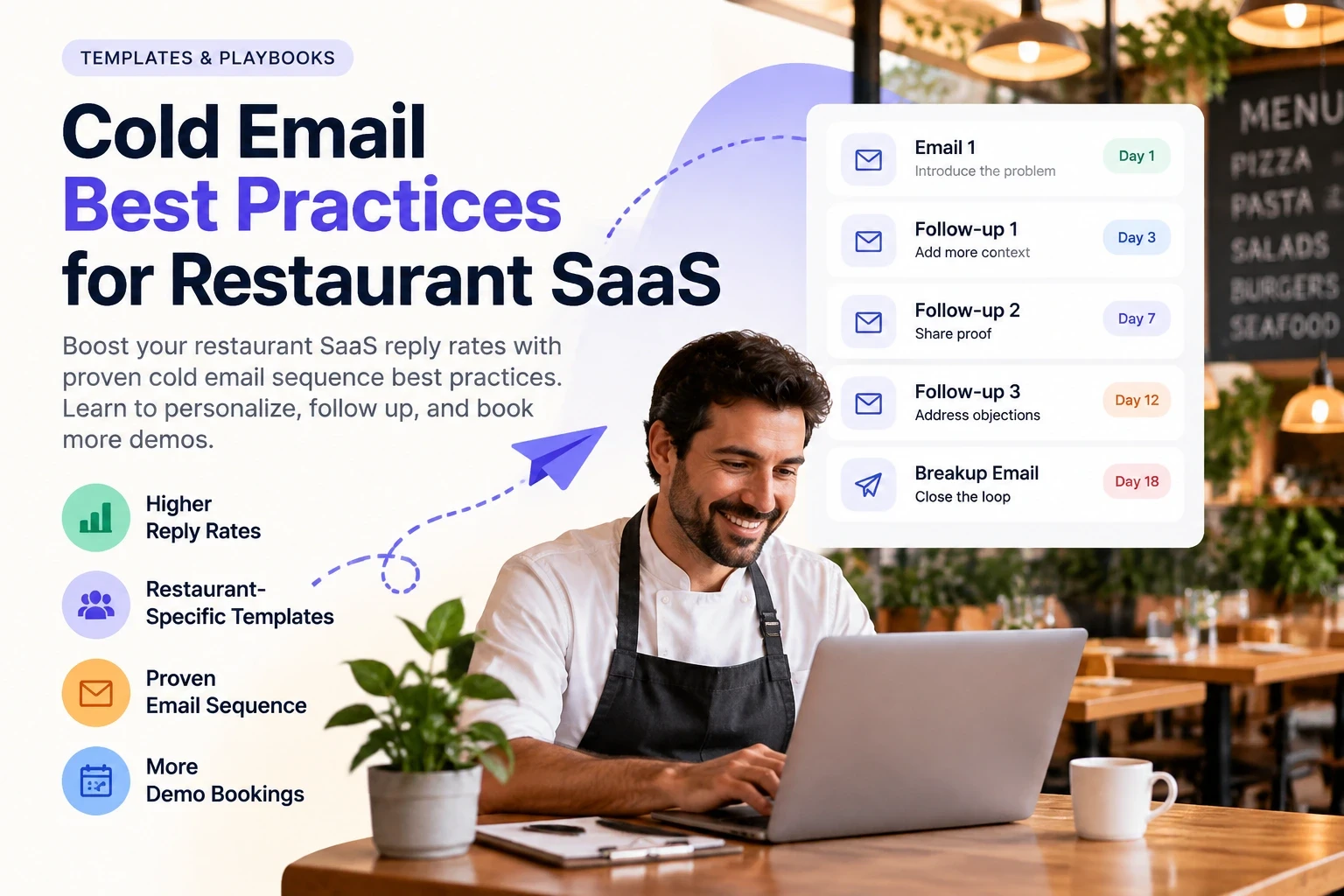
A practical restaurant SaaS outreach sequence:
Timing | Purpose | |
|---|---|---|
Email 1 | Day 1 | Introduce the problem and value |
Follow-up 1 | Day 3 | Add additional context |
Follow-up 2 | Day 7 | Share proof or customer result |
Follow-up 3 | Day 12 | Provide another reason to respond |
Breakup Email | Day 17-21 | Close the conversation politely |
Email 1: The Problem-Focused Introduction
The first email should not explain every feature.
Restaurant owners do not buy software because of features. They buy outcomes.
Weak approach:
We provide an all-in-one restaurant management platform with advanced automation features.
Better approach:
Many growing restaurants lose repeat customers because their marketing systems do not follow up after visits. We help restaurants automate customer retention without adding extra work for staff.
The first email should focus on:
A specific restaurant challenge
A relevant outcome
A simple next step
Follow-Up Emails: Add Value, Do Not Chase Replies
One of the biggest mistakes in cold email campaigns is sending follow-ups that add no value.
Avoid:
Just checking if you saw my email.
Instead, every follow-up should introduce something useful.
Examples:
Follow-up 1:
Share an industry insight.
Follow-up 2:
Mention a customer result.
Follow-up 3:
Offer a different angle.
Example:
We recently noticed many multi-location restaurants struggle with customer retention between visits. Curious if this is something your team is currently improving?
How Restaurant SaaS Companies Should Segment Cold Email Campaigns
One of the strongest factors affecting reply rates is segmentation.
The keyword cold email segmentation restaurant type cuisine size for SaaS outreach represents an important strategy: different restaurants have different problems.
A restaurant management platform should not send the same email to every restaurant.
Segment by Restaurant Type
Different restaurant models have different needs.
Examples:
Independent Restaurants
Common challenges:
Limited marketing resources
Customer retention
Increasing repeat visits
Multi-Location Restaurants
Common challenges:
Managing multiple locations
Reporting
Consistent customer experience
Restaurant Chains and Franchises
Common challenges:
Scaling operations
Data visibility
Centralized systems
Segment by Cuisine Type
Cuisine can influence customer behavior and technology needs.
Examples:
Fast casual restaurants
Cafes
Fine dining
Quick-service restaurants
A personalized email referencing the restaurant category feels more relevant than a generic sales message.
Segment by Restaurant Size
A single-location restaurant and a 100-location chain should not receive the same outreach.
Consider:
Number of locations
Team size
Online presence
Growth stage
Building a High-Quality Restaurant SaaS Email List
Before writing emails, you need the right prospects.
The keyword cold email list building local restaurant SMB contact data sources highlights an important part of successful outreach.
A quality list should include:
Restaurant name
Owner or decision-maker
Location
Restaurant category
Number of locations
Relevant business signals
Useful sources include:
Restaurant websites
Google Business Profiles
Industry directories
Local business databases
Professional networks
A smaller targeted list usually performs better than a large unqualified database.
How to Write Cold Emails That Get Responses
A cold email that gets responses usually follows a simple structure.
1. Personalized Opening
Show that the email was written specifically for them.
Example:
I noticed your restaurant recently opened a second location in Austin.
2. Relevant Problem
Mention a challenge they may understand.
Example:
Many growing restaurants struggle to maintain repeat customers when managing multiple locations.
3. Clear Value
Explain the outcome.
Example:
Our platform helps restaurants automate customer engagement and increase repeat visits.
4. Simple Call To Action
Avoid aggressive CTAs.
Instead of:
Are you available for a 30-minute demo tomorrow?
Try:
Would it make sense to compare how you are currently handling this?
Low-friction questions usually create more replies.
Cold Email Follow-Up Best Practices for SaaS Outreach
Follow-ups are where many replies happen.
A strong follow-up strategy:
Keep Emails Short
Long emails create friction.
Most follow-ups should:
Introduce one idea
Provide one reason to respond
Ask one question
Change The Angle
Do not repeat the first email.
Example:
First email:
Improve customer retention.
Second email:
Reduce manual marketing work.
Third email:
See how similar restaurants improved repeat orders.
Use Proper Timing
A common sequence:
Day 1: First email
Day 3: Follow-up
Day 7: Additional value
Day 14: Final message
Cold Email Subject Line Best Practices for Restaurant Outreach
Subject lines influence whether prospects notice your message.
Good subject lines are:
Short
Relevant
Natural
Specific
Examples:
Generic:
"Grow your restaurant revenue"
Better:
"Question about {{Restaurant Name}} customer retention"
Better:
"Quick idea for {{Restaurant Name}}"
Avoid:
Excessive capitalization
Promotional words
Clickbait
Personalization Strategies for Restaurant SaaS Cold Emails
Personalization goes beyond adding a first name.
Strong personalization examples:
Business Growth Signals
New location opening
Hiring activity
Expansion plans
Customer Experience Signals
Online reviews
Reservation experience
Ordering process
Technology Signals
Existing software usage
Website features
Online ordering system
The more relevant the message, the higher the chance of receiving a response.
Cold Email Metrics Restaurant SaaS Teams Should Track
Reply rate is important, but it is not the only metric.
Track:
Metric | Why It Matters |
|---|---|
Delivery rate | Shows email infrastructure health |
Open rate | Measures subject line performance |
Reply rate | Measures message relevance |
Positive reply rate | Shows sales opportunity quality |
Demo booking rate | Measures business impact |
Conversion rate | Measures revenue performance |
A high open rate does not always mean a successful campaign. The goal is generating qualified conversations.
Restaurant SaaS Cold Email Sequence Example
Email 1
Subject:
Quick question about {{Restaurant Name}}
Hi {{First Name}},
I noticed {{Restaurant Name}} is growing its customer base in {{Location}}.
Many restaurants struggle with keeping customers engaged after their first visit.
We help restaurants improve repeat customer engagement through automated campaigns.
Would improving repeat visits be something your team is exploring?
Follow-Up
Hi {{First Name}},
Sharing a quick example — restaurants using automated customer engagement often see stronger repeat purchase behavior without adding extra workload.
Worth exploring for {{Restaurant Name}}?
Common Cold Email Sequence Mistakes
Avoid these mistakes:
Sending The Same Email To Everyone
Restaurant owners have different problems.
Focusing Only On Features
Sell the business outcome, not the software.
Giving Up After One Email
Many conversations start after follow-ups.
Writing Too Much
Short, relevant emails usually perform better.
Frequently Asked Questions
What is a good cold email reply rate for SaaS?
Reply rates depend on targeting, message quality, list quality, and email infrastructure. Highly targeted campaigns usually perform better than broad outreach.
How many emails should be in a cold email sequence?
Most B2B SaaS campaigns use multiple touchpoints, often around 4–7 emails depending on the audience and sales cycle.
How many follow-ups should a cold email include?
A common approach is 3–5 follow-ups with different value angles instead of repeating the same message.
Does cold email work for restaurant SaaS companies?
Yes, when campaigns are targeted and personalized. Restaurant decision-makers are more likely to respond when emails address specific operational challenges.
What is the best cold email sequence structure?
A strong structure usually includes an introduction, value follow-ups, social proof, and a final closing message.
Final Takeaway
Successful restaurant SaaS outreach isn't about sending the most emails — it's about building the right sequence for the right audience, backed by infrastructure that actually gets those emails delivered.
The best cold email sequence for restaurant SaaS combines:
Accurate restaurant segmentation — targeting by cuisine type, location density, POS system, or franchise vs. independent, so every email feels relevant instead of generic
Clear value messaging — leading with the specific pain point (no-shows, staffing gaps, thin margins) rather than a generic feature pitch
Strategic follow-ups — spaced sequences that add new value or an angle each time, not just "just following up" bumps
Personalization — subject lines and openers that reference the restaurant's specific situation. See 140+ question email subject lines that get replies for proven formats you can adapt to this vertical
Continuous testing — iterating on subject lines, send times, and CTAs based on real reply data
But none of this matters if your emails never reach the inbox. Even a perfectly segmented, well-written sequence fails silently when deliverability is broken — landing in spam or getting throttled before a restaurant owner ever sees it. That's why deliverability infrastructure — properly warmed, rotated sending inboxes — is the foundation every restaurant SaaS outreach sequence should be built on, not an afterthought.
When segmentation, messaging, follow-ups, personalization, and testing work together on top of solid pre-warmed inbox infrastructure, cold email becomes a predictable channel for generating qualified SaaS conversations and demos — not a one-off spray-and-pray tactic.






