
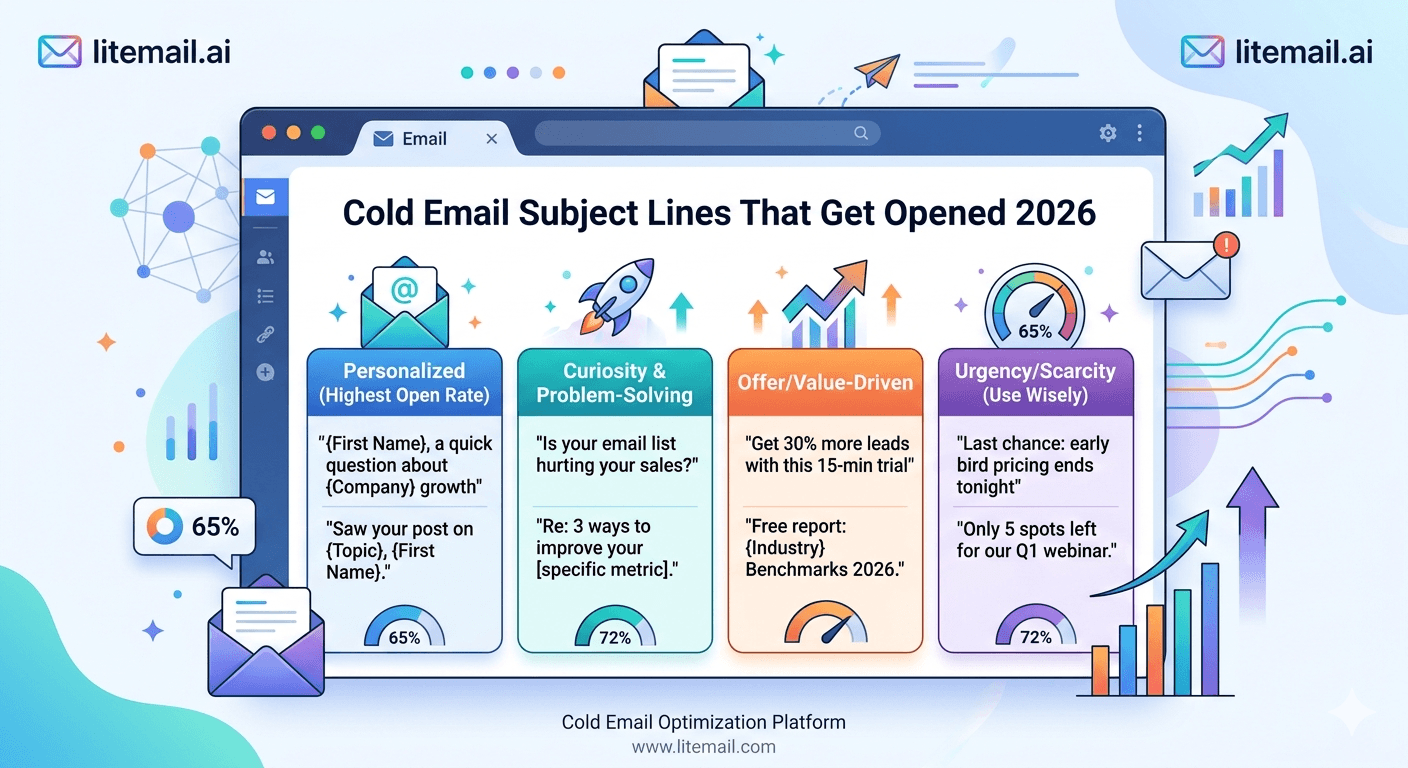
Cold email success often starts before someone reads the first sentence of your message. The first thing a prospect sees is your subject line, and that small line can decide whether your email gets opened, ignored, or deleted.
A strong cold email subject line does not need to be clever or complicated. The best subject lines usually feel natural, relevant, and personal. They look like a normal message someone would send during a busy workday, not like a promotional advertisement.
For B2B sales teams, agencies, SaaS companies, and professionals doing outbound outreach, the goal is not only getting an open. A good subject line should create the right expectation so the prospect is more likely to read, trust, and reply.
In this guide, you will find 200+ cold email subject lines for sales and outreach, along with templates, formulas, examples, and practical tips to improve your email performance.
What Makes a Good Cold Email Subject Line?
A successful cold email subject line usually follows a few simple principles.
Keep It Short and Clear
Most people check emails quickly, especially on mobile devices. Long subject lines often lose attention before the reader understands the purpose.
Short subject lines work well because they are easy to scan.
Examples:
quick question
idea for your team
growth question
hiring question
about your launch
A short subject line does not mean it should be vague. It should still give the reader a reason to open the email.
Make It Relevant to the Prospect
The biggest mistake in cold outreach is writing subject lines that focus only on the sender.
For example:
❌ New software solution for your business
This talks about you.
A better approach:
✅ question about your sales process
This focuses on something the prospect may care about.
Good cold email subject lines connect with:
A recent company update
A business challenge
A role responsibility
An industry problem
A specific opportunity
Make It Sound Human
People receive hundreds of emails that look automated. A subject line that sounds too promotional can immediately trigger distrust.
Compare:
❌ Unlock exclusive growth opportunities today
✅ quick question about growth
The second one feels more like a real conversation.
Avoid Overusing Sales Words
Many sales-focused words can make emails feel like advertisements.
Avoid words like:
Free
Discount
Limited time
Act now
Guaranteed
Exclusive offer
These words may reduce trust and can also increase the chance of triggering spam filters.
Why Natural-Looking Subject Lines Perform Better
A cold email subject line should feel like it belongs in the prospect's inbox.
Think about emails you receive from coworkers. They are usually:
Short
Simple
Direct
Written casually
Examples:
project update
quick thought
meeting question
budget review
A cold email does not need to pretend you already know the person. Instead, it should create familiarity through relevance.
For example:
❌ We help companies increase revenue by 40%
This sounds like a sales pitch.
✅ question about your outbound process
This sounds like a business conversation.
The goal is not to trick the reader. The goal is to reduce friction and make the email feel worth opening.
How Long Should a Cold Email Subject Line Be?
There is no single perfect length for every campaign, but shorter subject lines often perform better because they are easier to understand.
A practical guideline:
2–5 words
Around 20–40 characters
One clear idea
Examples:
Good:
quick question
SEO question
hiring plans
growth idea
Too long:
A complete solution to help your company increase sales performance
Long subject lines often look promotional and lose impact.
The 2–4 Word Rule
Many successful cold email campaigns use very short subject lines.
Examples:
pipeline question
hiring plans
security review
growth idea
quick thought
Short does not mean meaningless. The subject line should connect to something important for the prospect.
Cold Email Subject Line Psychology
A good subject line usually uses one or more psychological triggers.
Curiosity
People naturally want to complete unfinished information.
Example:
quick question about {{company}}
The reader wants to know what the question is.
Relevance
A relevant subject line tells the reader:
"This email is about something connected to me."
Example:
your new product launch
Personal Connection
Personalized emails feel more valuable.
Example:
saw your hiring update
Low Commitment
People avoid things that require effort.
A simple subject line feels easier to open.
Example:
quick question
Best Cold Email Subject Lines for B2B Sales
Here are examples you can adapt for different campaigns.
General B2B Sales Subject Lines
quick question about {{company}}
idea for your team
question about growth
noticed your expansion
improving your pipeline
quick thought
sales process question
growth opportunity
about your strategy
customer acquisition question
Sales Outreach Subject Lines
improving sales workflow
pipeline question
outbound question
your sales process
reducing sales friction
lead generation idea
prospecting question
sales team growth
conversion question
revenue question
Short Cold Email Subject Lines
Short subject lines are useful when you want your email to feel natural and easy to open.
Examples:
quick question
quick thought
small idea
one question
your thoughts?
growth idea
sales question
marketing question
hiring plans
about {{company}}
noticed something
worth discussing?
quick feedback
simple question
your strategy
one idea
small suggestion
question for you
regarding growth
about your team
Personalized Cold Email Subject Lines
Personalization works best when it is based on something real about the prospect.
Examples:
saw your recent update
congrats on the launch
noticed your hiring plans
your new team growth
question about {{company}}
loved your recent post
saw your expansion
about your new role
your recent announcement
noticed your growth
your {{industry}} strategy
saw your customer growth
question after your webinar
enjoyed your interview
your recent article
Avoid fake personalization such as adding only a company name without any real context.
Curiosity-Based Cold Email Subject Lines
Curiosity can increase opens when it creates interest without sounding like clickbait.
Examples:
quick idea for you
something I noticed
thought you might like this
saw an opportunity
interesting observation
one thing I noticed
possible improvement
question about your process
noticed a pattern
idea worth sharing
something about {{company}}
small suggestion
The key is making sure the email body delivers what the subject line promises.
Question-Based Cold Email Subject Lines
Questions encourage people to think about their own situation.
Examples:
how are you handling growth?
question about your pipeline
who manages outbound?
is this still a priority?
how are you solving this?
quick question about sales
are you exploring new tools?
how do you handle leads?
what is your current process?
who owns this project?
have you considered this approach?
is your team scaling?
Referral and Social Proof Subject Lines
These work best when there is a genuine connection.
Examples:
{{name}} suggested I reach out
connecting through {{company}}
saw your work with {{company}}
common connection
referral from {{name}}
enjoyed your presentation
following your work
heard about your team
saw your industry update
Never use fake referrals because it damages trust.
Follow-Up Cold Email Subject Lines
Many opportunities are lost because people stop after one email.
Follow-up subject lines:
following up
quick follow-up
checking in
any thoughts?
still relevant?
wanted your opinion
circling back
should I close this?
last question
worth revisiting?
bringing this back
any interest?
Breakup Email Subject Lines
Breakup emails should be respectful, not aggressive.
Examples:
should I close this?
closing the loop
last note from me
moving on
final follow-up
should I step back?
no worries if not
leaving this here
B2B Cold Email Subject Lines by Industry
Different industries respond to different messages. Use language your audience understands.
SaaS Cold Email Subject Lines
Examples:
reducing churn question
SaaS growth idea
onboarding question
product adoption idea
customer retention question
scaling your platform
product feedback
improving activation
your SaaS metrics
user growth question
Marketing Agency Cold Email Subject Lines
Examples:
client acquisition idea
marketing growth question
campaign improvement idea
lead generation question
improving conversions
website traffic idea
SEO opportunity
content strategy question
paid ads question
improving ROI
Real Estate Cold Email Subject Lines
Examples:
property lead question
local market idea
listing strategy
buyer pipeline question
real estate growth idea
improving inquiries
market opportunity
property marketing question
Healthcare Cold Email Subject Lines
Examples:
patient growth question
appointment booking idea
improving patient experience
healthcare marketing question
practice growth idea
patient retention question
Ecommerce Cold Email Subject Lines
Examples:
conversion question
store growth idea
reducing cart abandonment
customer retention idea
ecommerce strategy
improving repeat sales
product page question
Recruiting Cold Email Subject Lines
Examples:
hiring question
talent pipeline idea
open role question
recruitment strategy
candidate sourcing idea
improving hiring speed
your hiring plans
Cold Email Subject Lines by Buyer Role
The same company may have different decision-makers. The subject line should match their responsibilities.
For CEOs and Founders
Focus on growth, strategy, and business results.
Examples:
growth idea for {{company}}
scaling question
quick business idea
noticed your expansion
improving efficiency
question about growth
For Sales Leaders
Focus on revenue, pipeline, and sales performance.
Examples:
pipeline question
improving outbound
sales process idea
increasing meetings
lead quality question
outbound strategy
For Marketing Managers
Focus on campaigns, leads, and acquisition.
Examples:
campaign question
marketing growth idea
improving conversions
content opportunity
lead generation question
For CFOs
Focus on efficiency and financial impact.
Examples:
cost reduction idea
efficiency question
improving ROI
budget question
operational savings
For HR Managers
Focus on hiring and workforce challenges.
Examples:
hiring process question
recruitment idea
talent pipeline
employee growth question
Cold Email Subject Line Templates and Formulas
Instead of copying random examples, use formulas that can be customized.
Personalization Formula
[Specific observation] + [simple question]
Examples:
noticed your expansion — question
saw your hiring plans
about your new product launch
Problem Formula
[Business problem] + [conversation starter]
Examples:
pipeline challenge?
reducing churn?
improving conversions?
Trigger Event Formula
Use a recent event.
Examples:
congrats on funding
saw your new hire
noticed your expansion
Benefit Formula
Focus on a useful outcome.
Examples:
reducing sales delays
improving lead quality
increasing conversions
Social Proof Formula
Examples:
helping similar companies
worked with SaaS teams
supporting agencies like yours
How To Write a Cold Email Subject Line Step by Step
Writing a good cold email subject line is not about finding a clever phrase. It is about understanding the prospect and creating a reason for them to open your message.
Follow this simple process.
Step 1: Research the Prospect
Before writing your subject line, understand who you are contacting.
Look for:
Recent company updates
New hires
Product launches
Funding announcements
Website changes
Industry challenges
LinkedIn activity
Example:
You notice a company recently hired five salespeople.
Instead of:
❌ Improve your sales results
Use:
✅ your new sales team
The second option connects to something happening in their business.
Step 2: Choose the Right Subject Line Angle
Different situations require different approaches.
If You Found a Trigger Event
Use:
saw your expansion
congrats on the launch
noticed your hiring plans
If You Have a Business Question
Use:
quick question about sales
how are you handling growth?
question about your process
If You Have a Specific Benefit
Use:
reducing lead costs
improving conversions
increasing pipeline
Step 3: Create Multiple Versions
Do not send your first idea immediately.
Create 3–5 variations.
Example:
Original:
growth opportunity
Variations:
quick growth question
idea for your team
improving growth process
question about expansion
Testing different angles helps you understand what your audience responds to.
Step 4: Use the Inbox Test
Before sending, ask:
"Does this look like a normal email I would receive from a person?"
Good:
✅ quick question
✅ hiring plans
✅ security review
Bad:
❌ Unlock massive growth today
❌ Exclusive business opportunity
❌ Limited-time offer
The best cold email subject lines feel natural.
Cold Email Subject Line Mistakes To Avoid
Even a good offer can fail because of a poor subject line.
1. Making It Too Promotional
Avoid turning your subject line into an advertisement.
Bad:
❌ Increase revenue by 500% instantly
Better:
✅ question about your sales process
2. Using Fake Urgency
Words like:
urgent
last chance
act now
can reduce trust.
Cold emails should start conversations, not pressure people.
3. Being Too Generic
Examples:
❌ Hello
❌ Business opportunity
❌ Partnership idea
These do not tell the reader why the email matters.
Better:
✅ question about {{company}}
✅ your hiring plans
4. Overusing Personalization
Adding only a name is not real personalization.
Weak:
❌ Hi John
Better:
✅ noticed your new product launch
Good personalization shows you understand the prospect.
5. Creating a Subject Line That Does Not Match the Email
The subject line should match the message.
Example:
Subject:
"your website update"
Email:
Talking about sales software.
This creates disappointment and reduces trust.
Words That Can Hurt Cold Email Performance
Some words make emails feel like advertisements.
Avoid using too many:
Free
Discount
Buy
Offer
Deal
Guaranteed
Limited time
Act now
Exclusive
Promotion
Instead, use natural business language.
Examples:
Instead of:
❌ Free consultation available
Try:
✅ quick question about your process
Instead of:
❌ Exclusive growth opportunity
Try:
✅ idea for your team
How Deliverability Affects Cold Email Subject Lines
A great subject line is useless if your email never reaches the inbox.
Many marketers focus only on copywriting but ignore email infrastructure.
Your email performance depends on:
Sender reputation
Domain health
Authentication
Sending behavior
Email quality
SPF, DKIM, and DMARC Matter
These authentication systems help email providers verify that your messages are legitimate.
Without proper setup, even strong subject lines may end up in spam folders.
Domain Reputation
Email providers track how recipients interact with your emails.
Poor signals:
High bounce rates
Spam complaints
Low engagement
Sending too many emails too quickly
Strong reputation improves inbox placement.
Email Warm-Up
New domains should not immediately send large campaigns.
A proper warm-up process helps build trust with email providers.
Subject Line and Deliverability Work Together
A subject line should:
Be relevant
Avoid spam patterns
Match the email content
Create genuine interest
Good copy and good infrastructure work together.
How To A/B Test Cold Email Subject Lines
Testing helps you improve based on real results instead of guesses.
Test One Thing at a Time
Do not change everything together.
Example:
Version A:
quick question about sales
Version B:
sales growth idea
The difference is the angle.
Measure More Than Open Rates
Open rates are useful, but replies are usually more important.
Track:
Open rate
Reply rate
Positive response rate
Meetings booked
A subject line that gets fewer opens but more replies may be more valuable.
Test Different Types
Try:
Question vs statement
Short vs medium length
Personalized vs general
Problem-focused vs benefit-focused
AI Prompts for Creating Cold Email Subject Lines
AI can help generate ideas, but the final subject line should always sound human.
Prompt 1: Generate Personalized Subject Lines
"Create 10 short cold email subject lines for a B2B company. Make them natural, personalized, and less than five words."
Prompt 2: Improve Existing Subject Lines
"Rewrite these cold email subject lines to sound more human and less promotional."
Prompt 3: Create Industry-Specific Subject Lines
"Generate cold email subject lines for reaching SaaS founders. Focus on growth, customer acquisition, and operational challenges."
Key Takeaways
Subject line optimisation moves open rates 8–16 percentage points when infrastructure is right. On fresh unwarmed inboxes, it moves almost nothing — infrastructure is the constraint, not the subject line.
Four frameworks that work in 2026: specific question (no fluff), named peer reference, blunt observation (no verb), and trigger-referenced open (recent company event, under 30 days).
Patterns that are now overused: "quick question," name-in-subject token substitution, generic question marks, all-lowercase thread-mimicking, and emoji in B2B subject lines.
Technical rules: 3–7 words for mobile, avoid spam trigger words (Free, Guaranteed, Limited time), no ALL CAPS, no excessive punctuation, avoid Re: and Fwd: prefixes.
Test correctly: one variable at a time, minimum 200 sends per variant, measure reply rate not just open rate, test on pre-warmed inboxes only.
At 94–96% primary inbox placement from Litemail, subject line improvements compound on top of a clean delivery foundation — rather than trying to compensate for placement gaps that copy can't fix.
Frequently Asked Questions
What is the best cold email subject line?
The best cold email subject line is one that is short, relevant, and connected to the prospect's situation. There is no single phrase that works for every audience.
How many words should a cold email subject line have?
Many effective cold email subject lines use around 2–5 words. The important factor is clarity and relevance.
Do emojis work in cold email subject lines?
For B2B cold outreach, plain text usually works better because professional emails typically avoid emojis.
Should cold email subject lines be personalized?
Yes. Personalization based on real information usually performs better than generic messages.
Why are my cold emails not getting opened?
Common reasons include:
Weak subject lines
Poor targeting
Low sender reputation
Emails landing in spam
Too much sales language
What subject lines avoid spam filters?
Avoid:
Excessive urgency
Promotional words
ALL CAPS
Misleading claims
Use simple, relevant language instead.
Conclusion
A cold email subject line is a small part of your outreach campaign, but it plays a major role in whether your message gets noticed. The best subject lines are not complicated or overly promotional. They are short, relevant, personalized, and written like a real conversation.
Successful cold email outreach is not only about getting opens. The real goal is building trust and encouraging replies. A strong subject line should match the email content, focus on the prospect's needs, and create a reason for them to continue reading.
Testing different subject lines, improving personalization, and maintaining strong email deliverability can significantly improve campaign performance. Even the best subject line will not work if your emails reach spam folders, which is why sender reputation, authentication, and inbox placement are equally important.
Use the examples, templates, and strategies in this guide as a starting point, but continue testing what works best for your audience. The most effective cold email subject lines are the ones that feel natural, provide relevance, and start meaningful business conversations.