
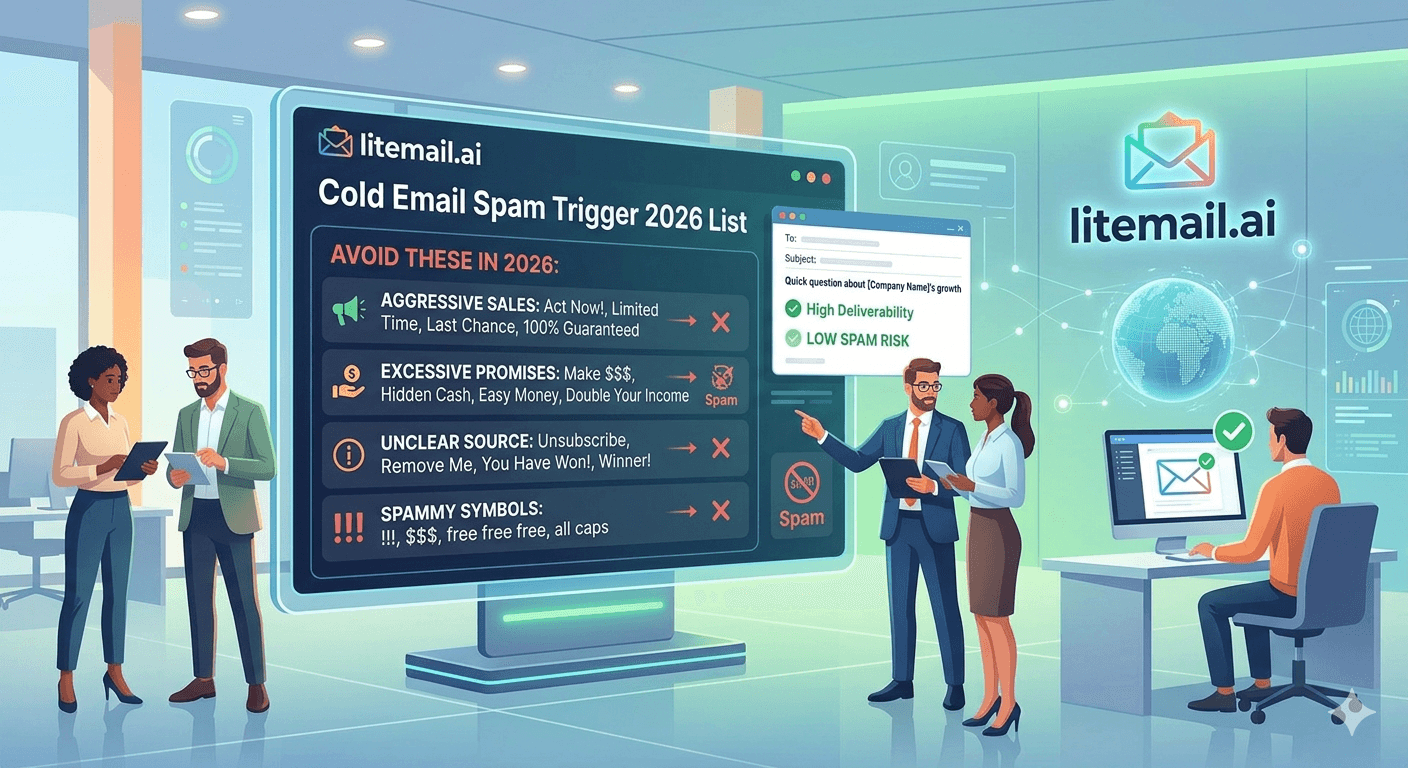
Spam trigger words get more attention than they deserve. The idea that avoiding "free" and "guaranteed" in your subject line will fix deliverability has been circulating since 2012 — and it was only partially true then. In 2026, modern spam filters are sophisticated content models, not keyword blocklists. Here's what they actually check, which words still matter, and why infrastructure is the lever that moves deliverability more than copy ever will.
How Spam Filters Actually Work in 2026
Modern spam filtering — Google's, Microsoft's, Proofpoint's, Mimecast's — is a multi-signal scoring system. Specific words are one input. They're not the primary input.
Signal | Weight in 2026 Filtering | What It Measures |
|---|---|---|
Sender reputation (domain + IP) | Very High | Historical sending behaviour, engagement rates, complaint rates |
Authentication (SPF, DKIM, DMARC) | Very High | Whether the sending domain is verified and authenticated |
Engagement history with recipient | High | Whether the recipient has previously opened or replied to you |
Email content patterns | Medium | Structure, link density, HTML complexity, content relevance |
Specific spam trigger words | Low-Medium | Individual flagged terms in subject or body |
Recipient engagement (opens, replies) | High | Whether similar emails from this domain get positive engagement |
Specific spam trigger words sit at Low-Medium impact in the scoring system. A well-authenticated pre-warmed inbox from a domain with Good Postmaster reputation can send emails containing flagged words and deliver them to primary inbox — because the reputation signals outweigh the content signals. A fresh inbox with broken DNS will land in spam even with perfectly clean copy. Fix the infrastructure before worrying about word choice.
Words That Still Matter in 2026 (And Why)
Some word and phrase patterns still contribute meaningfully to spam scores in 2026 — not because they appear on a static blocklist, but because they correlate with content patterns that spam filters have learned to associate with commercial bulk email.
High-Risk Subject Line Patterns
All-caps words: FREE, GUARANTEED, URGENT, ACT NOW — not the words themselves, but the all-caps rendering that spam filters flag as aggressive marketing signals.
Excessive punctuation: Multiple exclamation marks, question mark combinations (??!), or ellipses used to create false urgency.
Re: or Fwd: prefixes on cold emails: Implying a prior conversation that didn't exist. This is also a CAN-SPAM violation for commercial email. Avoid.
Dollar signs and price mentions: "$$$", "Save $X", "Earn $X/day" — financial promise patterns that correlate strongly with spam content models.
High-Risk Body Content Patterns
Excessive links: More than 2 links in a cold email body significantly increases spam scores on most filtering systems. One link, or zero, is the standard for first-touch cold email.
Image-heavy HTML: High image-to-text ratio is a mass marketing pattern that content filters flag. Plain text or minimal HTML performs better for cold email deliverability.
Attachment in the first email: Triggers enterprise security scanning and adds significant spam score regardless of attachment content.
Unsubscribe link language: "Click here to unsubscribe" in the body (as opposed to a plain-text opt-out line) adds newsletter-pattern signals that hurt cold email deliverability.
Words You've Been Warned About That Don't Matter Much
The spam trigger word lists circulating online are largely outdated. Several commonly avoided terms have minimal impact on modern spam filters when sender reputation and authentication are clean.
Word/Phrase | Actual 2026 Risk Level | Context That Matters |
|---|---|---|
"Free" | Low-Medium | In context ("free consultation", "free trial") — minimal risk. In all-caps: higher risk. |
"Limited time" | Low-Medium | Minimal risk in B2B context. Higher risk when paired with urgency punctuation. |
"Guaranteed" | Low | Low risk in plain text context. Higher risk in promotional HTML email. |
"Opportunity" | Very Low | Overblown — this word alone has minimal spam signal in 2026 content models. |
"Click here" | Low-Medium | Still slightly flagged as a generic call-to-action pattern. Use specific anchor text. |
"Unsubscribe" | Very Low | Required by CAN-SPAM. The word itself is not a spam signal — the pattern around it matters. |
💡 The Correct Frame for Spam Word Avoidance
Don't avoid words. Avoid content patterns. An email with three exclamation marks in the subject line, four links in the body, and a PDF attachment reads like spam because of the pattern — not because any individual word is flagged. Clean, specific, plain-text cold email with one call to action and zero attachments passes content scoring easily regardless of which specific words appear in it.
Spam Words vs Infrastructure: The Deliverability Priority Order
Here's the prioritised list of deliverability improvements by impact. Copy optimisation appears at step 5 — four infrastructure steps come first.
Pre-warmed inbox with verified Good/High Postmaster reputation. Primary inbox placement difference: 40–60% (fresh) vs 88–96% (pre-warmed). No other change produces this magnitude of improvement.
Clean DNS: SPF, DKIM, and DMARC all passing. Authentication failure eliminates the reputation advantage of a pre-warmed inbox. All three must pass.
Dedicated IP addresses. Shared IP contamination can destroy placement rates regardless of domain reputation quality.
List hygiene: bounce rate under 2%, complaint rate under 0.08%. High bounce and complaint rates degrade reputation faster than any copy change can compensate for.
Content pattern hygiene. Plain text, zero attachments in first email, 0–1 links, no all-caps, no excessive punctuation. This matters — but less than the four steps above.
Specific word avoidance. The lowest-impact lever. Meaningful only when the first five are already in place.
In our experience at Litemail, switching a campaign from a fresh inbox to a pre-warmed inbox improves primary inbox placement by 30–50 percentage points. Removing flagged words from the same email on the same fresh inbox improves it by 0–5 percentage points. The infrastructure fix is orders of magnitude more impactful than the copy fix.
Copy Pattern Checklist for Clean Cold Email in 2026
Run this checklist on every cold email before sending — not to avoid specific words, but to eliminate patterns that correlate with spam content models.
☑️Subject Line
No all-caps words. No more than one exclamation mark (preferably zero). No Re: or Fwd: prefix on a cold email. Under 50 characters. Specific to the recipient's situation rather than generic benefit claims.
☑️Body Format
Plain text or minimal HTML. Zero images in the first email. Zero attachments in the first email. Maximum 1–2 links in the body. Under 150 words for the first touch.
☑️Call to Action
One CTA only. Specific anchor text (not "Click here"). A small ask — 15-minute call, not a demo or proposal meeting.
☑️Opt-Out Line
Plain-text opt-out at the bottom: "Not relevant? Reply and I'll remove you." Not a formal unsubscribe link — that pattern adds newsletter classification signals.
Fix Deliverability at the Infrastructure Level — Pre-Warmed Inboxes
Copy optimisation moves deliverability by 0–5%. Pre-warmed inboxes move it by 30–50%. Litemail pre-warmed inboxes from $4.99 — the highest-impact deliverability investment you can make.
Get Pre-Warmed Inboxes from $4.99 →
Verified Good/High reputation · Automated DNS · Dedicated US and EU IPs · No minimum order
About Litemail — Litemail provides pre-warmed Google Workspace and Microsoft 365 inboxes for cold email outreach. From $4.99/inbox with automated DNS, dedicated US and EU IPs, and full admin access. View pre-warmed inbox plans →
Related reading:
Cold Email Deliverability Guide 2026 · How to Improve Email Deliverability Fast 2026 · Why Emails Land in Promotions Tab · Low Open Rate Cold Email Fix · Improve Cold Email Open Rate Tactics 2026
Key Takeaways
Modern spam filters are multi-signal scoring systems. Sender reputation and authentication dominate. Specific spam trigger words are a Low-Medium weight input — not the primary lever.
The highest-risk patterns in 2026 are structural: all-caps subject lines, multiple exclamation marks, 3+ links in the body, image-heavy HTML, and attachments in the first email.
Words commonly listed as spam triggers — "free", "opportunity", "guaranteed" in plain-text B2B context — have minimal impact on modern content scoring when sender reputation is clean.
Infrastructure improvements produce 30–50 percentage point deliverability gains. Copy optimisation produces 0–5 percentage point gains. Fix infrastructure first.
The deliverability priority order: (1) pre-warmed inbox, (2) clean DNS, (3) dedicated IPs, (4) list hygiene, (5) content patterns, (6) specific word avoidance. Don't start at step 6 when you haven't completed steps 1–4.
Clean cold email copy: plain text, zero attachments, 0–1 links, subject line under 50 characters, no all-caps, one specific CTA, plain-text opt-out. Pattern matters more than individual words.
Frequently Asked Questions
Do spam trigger words still matter for cold email deliverability in 2026?
Less than they used to — and less than most guides suggest. Modern spam filters are multi-signal systems where sender reputation and authentication dominate. Specific flagged words are a Low-Medium weight input. A pre-warmed inbox with Good Postmaster reputation can deliver emails containing most "trigger words" to primary inbox, while a fresh unwarmed inbox will land in spam even with perfectly clean copy. Fix infrastructure first, then worry about word choice.
What words should I avoid in cold email subject lines in 2026?
Avoid patterns more than specific words: all-caps words (FREE, GUARANTEED, URGENT), multiple exclamation marks, fake Re: or Fwd: prefixes, and excessive punctuation. These structural signals matter more than the underlying words. In plain-text B2B context, words like "free", "guaranteed", or "opportunity" have minimal impact on modern spam scoring — it's the formatting and structure around them that triggers filters.
How many links can I include in a cold email without triggering spam filters?
0–1 links in a first-touch cold email. One link is acceptable and common. Two links increases spam score noticeably on most filtering systems. Three or more links significantly flags the email as commercial bulk content. For follow-up emails where the context is established, 1–2 links is the ceiling. Never include more than one link in a cold email subject line or preheader.
Does email infrastructure matter more than spam word avoidance?
Significantly more. Pre-warmed inbox infrastructure improves primary inbox placement by 30–50 percentage points. Removing flagged words from the same email on an unwarmed inbox improves it by 0–5 points. The infrastructure gap between a fresh unwarmed inbox (40–60% primary placement) and a Litemail pre-warmed inbox (88–96%) is an order of magnitude larger than any copy-level optimisation. Start with infrastructure.
Should I use plain text or HTML for cold email in 2026?
Plain text for cold email to corporate recipients. HTML formatting — particularly image-heavy layouts, multiple styled sections, and rich link formatting — adds mass marketing pattern signals that hurt deliverability scores with enterprise email gateways (Proofpoint, Mimecast). Plain text reads as more personal and scores better on content filtering. If you use HTML, keep it minimal: no images, no tables, no more than one styled element.
What is the most important deliverability fix for cold email in 2026?
Pre-warmed inbox infrastructure. A fresh Google Workspace or Microsoft 365 inbox lands in spam 40–60% of the time on cold lists. A Litemail pre-warmed inbox with Good/High Postmaster reputation delivers to primary inbox at 88–96%. No copy change, word avoidance, or subject line optimisation produces an improvement of this magnitude. Infrastructure is the highest-impact deliverability lever — everything else is optimisation within the ceiling that infrastructure sets.
Cold Email Deliverability | Litemail Pre-Warmed Inboxes
Fix deliverability at the infrastructure level — not the word level. Pre-warmed inboxes from $4.99. 88–96% primary inbox placement from day one.
View Plans & Pricing →
Related reading:
Cold Email Deliverability Guide 2026 · Improve Deliverability Fast 2026 · Why Emails Land in Promotions Tab · Low Open Rate Cold Email Fix · Improve Open Rate Tactics 2026






