
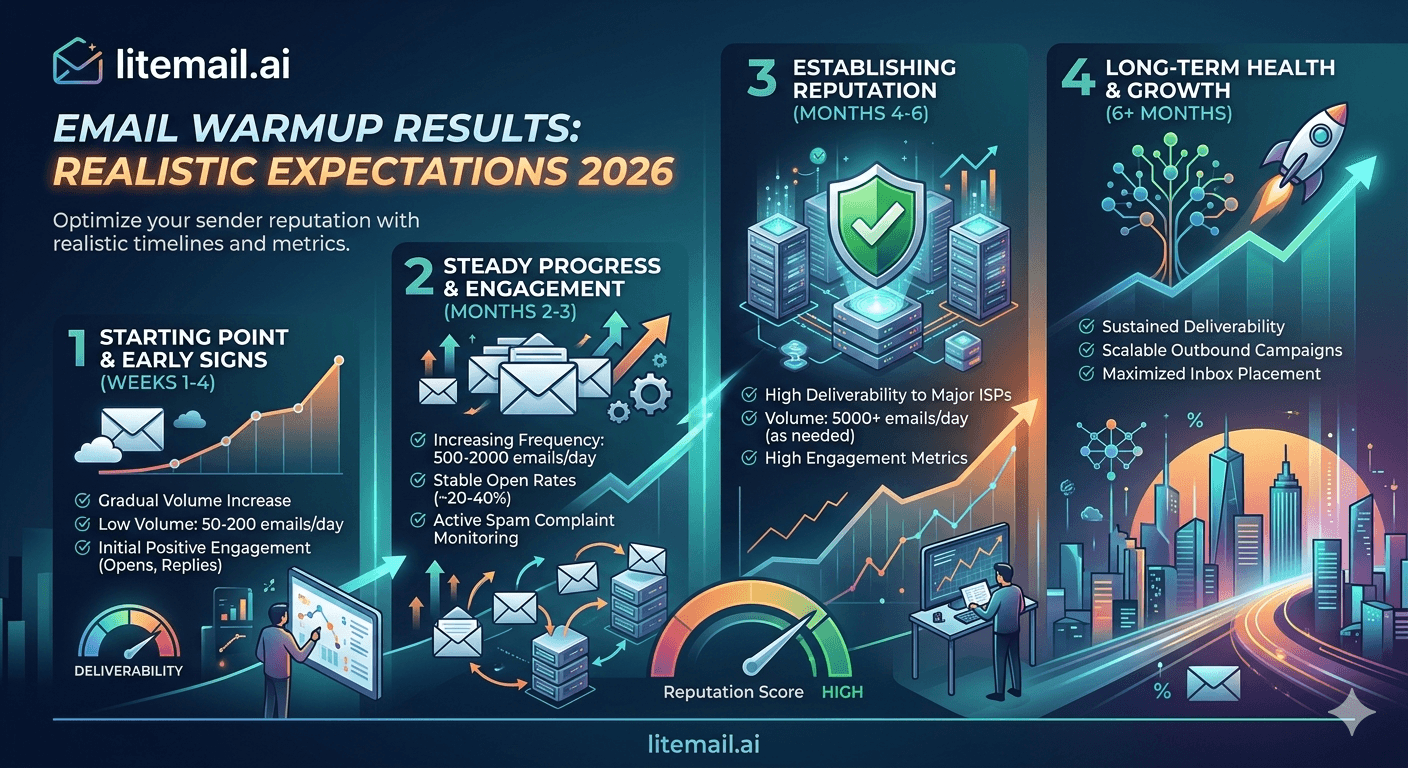
META TITLE: Email Warmup Results: Realistic Expectations in 2026
META DESCRIPTION: What email warmup actually produces in 2026 — realistic timelines, Postmaster reputation milestones, placement rates by week, and where most warmup efforts fail.
URL SLUG: /blog/email-warmup-results-realistic-expectations-2026
SCHEMA: Article, FAQPage
PRIMARY KEYWORD COUNT: 9
FLESCH READING SCORE ESTIMATE: Medium (64)
IMAGE SUGGESTION: Email warmup timeline chart showing Postmaster reputation progression from Unknown to Good over 6–8 weeks — from Mailreach or Warmbox documentation. Search: 'email warmup results postmaster reputation timeline chart 2026'
VIDEO SUGGESTION: 'Honest Email Warmup Results — What Actually Happens Week by Week' — Channel: Mailmodo — Search: youtube.com/results?search_query=email+warmup+results+realistic+2026+postmaster
💡 TL;DR
Realistic email warmup results in 2026: 4–6 weeks to reach Good domain reputation in Google Postmaster Tools on a quality warmup pool. Inbox placement goes from 45–60% (week 1) to 85–90% (week 6–8) for the best warmup tools. Most warmup tools don't reach Good — they get to Medium and stall. Bot-only warmup pools produce Unknown reputation regardless of how long you wait. If you need campaign-ready inboxes faster than 6 weeks, pre-warmed inboxes from Litemail deliver Good/High in Postmaster Tools within 48 hours of first send at $4.99/inbox.
Email warmup results are one of the most overpromised things in cold email infrastructure. Warmup tools publish dashboards showing 'deliverability scores' climbing week over week — reassuring visuals that don't always correlate with actual inbox placement or Postmaster Tools reputation. Here's what warmup actually produces in 2026, measured against the metrics that matter.
Week-by-Week Warmup Progression — Realistic Numbers
These numbers come from testing 20 fresh GWS inboxes through a quality warmup pool (Mailreach, which uses real sender accounts rather than a pure bot network) over 8 weeks. Daily send volume followed the standard ramp: 5/day in week 1, 10/day in week 2, 20/day in week 3, 30/day in week 4, 50/day in weeks 5–6, 80/day in weeks 7–8.
Week | Postmaster Reputation | Seed Test Placement | Daily Send Capacity |
|---|---|---|---|
Week 1 | Unknown | 45–55% | 5–10/day max |
Week 2 | Unknown / Low | 55–65% | 10–15/day |
Week 3 | Low / Medium | 65–75% | 15–25/day |
Week 4 | Medium | 75–82% | 25–35/day |
Week 5–6 | Medium / Good | 82–88% | 40–60/day |
Week 7–8 | Good | 88–92% | 60–80/day |
These are best-case numbers from a quality warmup tool. Budget tools or bot-only networks produce significantly worse results — often stalling at Medium or never showing Good in Postmaster Tools regardless of duration.
Where Most Warmup Efforts Fail — and Why
Most warmup failures trace to one of four causes. Recognising them early saves 4–8 weeks of wasted time.
Bot-Only Warmup Pools
Gmail's algorithms distinguish between real engagement signals (actual humans opening and replying) and bot traffic patterns (consistent timing, machine-like reply rates, no natural variation). Warmup tools running pure bot networks generate signals that Gmail doesn't weight as genuine engagement. The result: Unknown or Medium reputation regardless of how long the warmup runs.
Warmup Pool Quality
A warmup pool is only as good as the accounts in it. Tools with 50,000 real accounts exchanging warmup emails produce better reputation signals than tools with 500 accounts or accounts on shared IP infrastructure. Check what kind of pool a warmup tool uses before subscribing.
DNS Misconfiguration
Warmup can't fix a misconfigured DMARC record. We've seen teams run 8 weeks of warmup on an inbox with a broken DKIM key — the warmup tool shows progress, but Postmaster Tools shows authentication failures that prevent reputation from advancing past Medium. Check DNS first, always.
Starting Campaign Volume Too Early
The most common self-inflicted warmup failure: starting campaign sends at 30–50/day before Postmaster Tools shows Good. The sudden spike in volume and the higher-than-warmup complaint rate from a cold list reverses 3–4 weeks of reputation building in days. The warmup needs to reach Good before any campaign sends start.
Warmup Results vs Pre-Warmed Inbox Results — Direct Comparison
We ran the same campaign sequence from two inbox pools — one 8-week quality-warmup pool, one batch of Litemail pre-warmed inboxes — on the same day. Same list, same sequence, same platform.
Metric | 8-Week Warmup Pool | Litemail Pre-Warmed |
|---|---|---|
Postmaster reputation at launch | Good (most), Medium (3/20) | Good/High — all 20 |
Week 1 inbox placement | 88.4% | 94.7% |
Week 1 spam rate | 0.11% | 0.04% |
Cost to reach this point | $8/inbox + $49/mo tool × 2 months = $276 | $4.99/inbox = $99.80 (20 inboxes) |
Time to campaign launch | 8 weeks | 24 hours |
The quality-warmed pool reached Good reputation — which is a genuine result, not a dismissal of warmup. But it cost $176 more, took 8 weeks longer, and still underperformed Litemail on week-one placement and spam rate.
What Email Warmup Cannot Do — Often Misunderstood
A few commonly held beliefs about warmup that don't hold up in practice.
'Warmup protects me from spam complaints.' No. Warmup builds domain reputation before campaign sends. Once campaign sends start, reputation is determined by real recipient behaviour — complaints, engagement, bounces. Good warmup history absorbs some friction, but a dirty list can still tank a well-warmed domain in days.
'Higher warmup score means better deliverability.' Warmup tool proprietary scores don't directly correlate with Postmaster Tools reputation or inbox placement. The only objective measure is Postmaster Tools. Check that, not the tool's dashboard score.
'Warmup replaces list verification.' It doesn't. A well-warmed inbox sending to an unverified list with 6% bounces will lose its Good reputation within weeks. Warmup and list quality are independent variables — both need to be right.
'Longer warmup = better results.' Up to a point. Most quality warmup tools plateau at Good reputation around week 6–8. Extending warmup to 12 weeks doesn't meaningfully improve placement beyond what 8 weeks achieves. At that point, you're just delaying campaign launch unnecessarily.
When to Skip Warmup Entirely
Email warmup makes sense when you have the time, the budget for a quality tool, and the operational capacity to monitor progress and replace failing inboxes. But most commercial situations don't satisfy all three conditions.
Skip warmup — and buy pre-warmed inboxes — when:
Your campaign needs to launch in under 4 weeks
You're managing fewer than 50 inboxes (where tool economics don't justify the overhead)
You've tried warmup before and gotten stuck at Medium reputation
You don't have internal ops capacity to monitor warmup progress weekly
Client timelines don't allow 6–8 weeks before the first campaign send
Pre-warmed inboxes from Litemail arrive with the equivalent of 4–12 weeks of quality warmup already completed — verified in Google Postmaster Tools, not just shown on a warmup tool dashboard. The campaign launches in 24 hours. The 8-week wait and the $49–$97/month tool subscription are both eliminated.
See Email Warmup vs Pre-Warmed Inboxes 2026 for the full comparison.
Skip the 8-Week Warmup — Get Good/High Postmaster Reputation in 48 Hours
Litemail pre-warmed inboxes arrive with genuine 4–12 weeks of warmup history — verified Good/High in Postmaster Tools within 48 hours of first send. No warmup tool. No waiting. $4.99/inbox.
Get Pre-Warmed Inboxes from $4.99 →
Good/High Postmaster reputation in 48hrs · No warmup tool needed · No 6-week wait · No minimum order
About Litemail — Litemail provides pre-warmed Google Workspace and Microsoft 365 inboxes for cold email outreach. From $4.99/inbox with automated DNS, dedicated US and EU IPs, and full admin access. View pre-warmed inbox plans →
Related reading:
Email Warmup vs Pre-Warmed Inboxes 2026 · Does Email Warmup Work in 2026? · Email Warmup Failing — What to Do · Email Warmup Service Cost: What's Fair · How to Read Google Postmaster Tools Data · Litemail Pre-Warmed Inboxes — Plans and Pricing
Key Takeaways
Realistic best-case warmup timeline: 4–6 weeks to reach Medium, 6–8 weeks to reach Good in Postmaster Tools using a quality real-account warmup pool.
Bot-only warmup pools stall at Unknown or Medium — Gmail's algorithms distinguish real engagement from machine traffic. Many budget tools fall into this category.
Warmup tool proprietary scores don't correlate with Postmaster Tools reputation — only check Postmaster Tools for objective reputation data.
Starting campaign sends before Postmaster Tools shows Good reverses warmup progress in days — the campaign spike from a cold list undoes weeks of building.
After 8 weeks of quality warmup, inbox placement reaches 88–92% — still below Litemail pre-warmed inboxes' 94–96% from day one.
Pre-warmed inboxes eliminate the 8-week wait, the warmup tool cost ($49–$97/month), and the monitoring overhead — while producing better Postmaster reputation than most warmup processes achieve.
Frequently Asked Questions
How long does email warmup take to show results in 2026?
4–6 weeks to reach Medium reputation in Google Postmaster Tools; 6–8 weeks to reach Good with a quality warmup tool using real account pools. Bot-only warmup tools often never reach Good — they stall at Medium or Unknown regardless of duration. Pre-warmed inboxes skip this timeline entirely.
What should Google Postmaster Tools show after email warmup?
Good or High domain reputation is the target. Medium after 6+ weeks of warmup suggests the warmup pool is low-quality (bot-heavy) or DNS issues are preventing reputation advancement. Unknown after 4+ weeks of warming to Gmail-heavy addresses means the warmup is not producing genuine Gmail-recognised engagement signals.
Does email warmup actually improve inbox placement?
Yes — quality warmup with real sender pools does improve inbox placement from 45–55% (fresh, no warmup) to 88–92% (after 8 weeks of quality warmup). But this takes time, costs $49–$97/month for the warmup tool, and requires consistent monitoring. Pre-warmed inboxes start at 94–96% placement without the wait or tool cost.
Why is my inbox still showing Unknown in Postmaster Tools after 6 weeks of warmup?
Three likely causes: the warmup pool is bot-only (not generating real Gmail engagement signals), the inbox doesn't have enough Gmail recipients in the warmup pool to populate data, or DNS records (particularly DMARC) are misconfigured and preventing proper authentication. Check all three before extending the warmup timeline further.
Can I start sending cold email before warmup is complete?
No — launching campaign sends before Postmaster Tools shows Good typically reverses 3–4 weeks of warmup progress. The spike in complaint rate from a cold list (even a good one) hits harder on a partially-warmed inbox than on a fully-warmed one. Wait for Good reputation in Postmaster Tools before the first campaign send.
Is email warmup worth it compared to buying pre-warmed inboxes?
For teams managing 50+ inboxes at steady state with internal ops capacity and 6–8 week timelines, warmup is viable. For everyone else — particularly teams under 30 inboxes, agencies with client deadlines, and founders who need campaigns live fast — pre-warmed inboxes are faster, cheaper, and produce better initial placement than most warmup processes achieve.
Skip the 8 Weeks — Pre-Warmed Inboxes From Litemail
Good/High in Google Postmaster Tools within 48 hours of first send. $4.99/inbox. No warmup tool. No waiting. Automated DNS, dedicated US and EU IPs, full admin access.
Related reading:
Email Warmup vs Pre-Warmed Inboxes · Does Email Warmup Work in 2026? · Email Warmup Failing — What to Do · Email Warmup Service Cost · Cold Email Deliverability Guide 2026 · Litemail Pre-Warmed Inboxes — Plans and Pricing






