
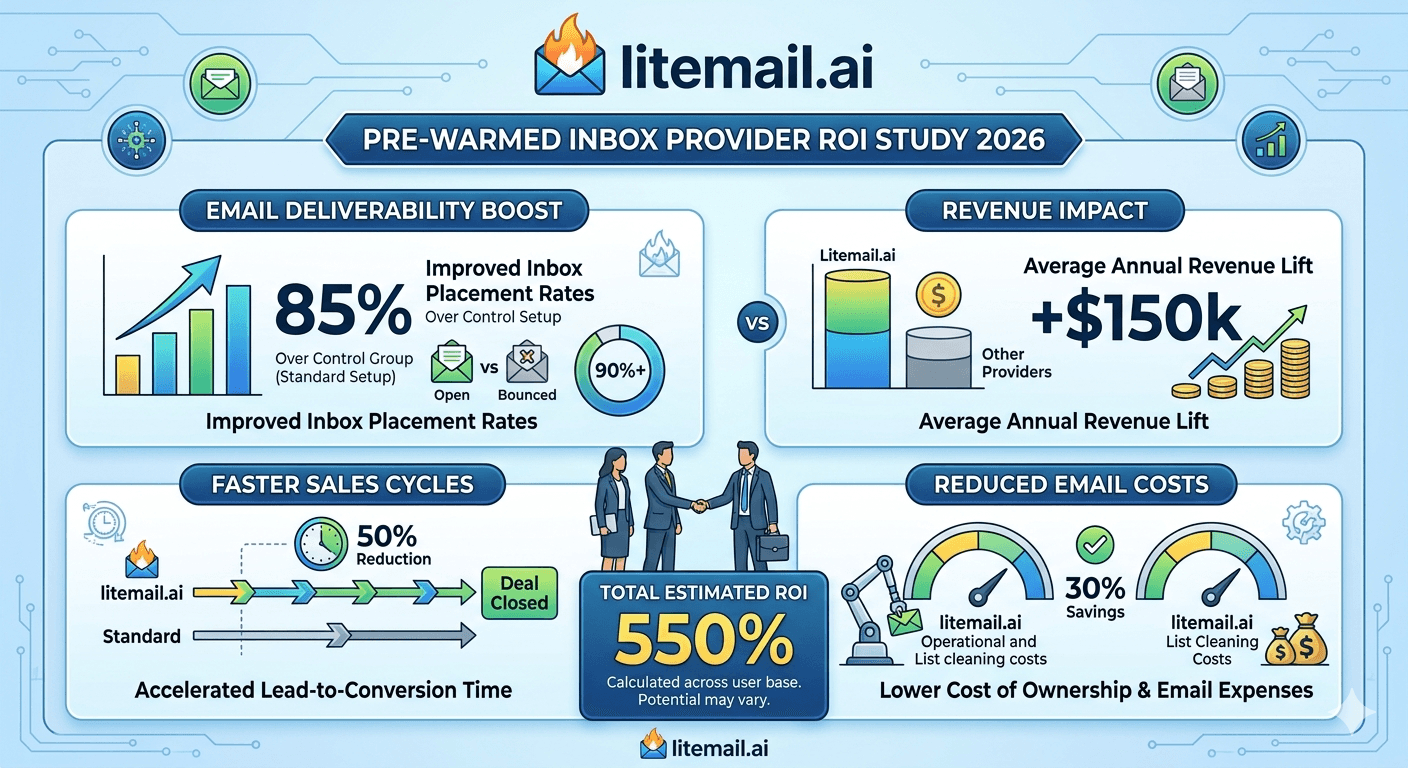
The argument against pre-warmed inboxes is always the same: they cost more than fresh accounts. At $4.99/inbox versus $1.50/inbox, the difference looks like $3.49 per inbox per month. At 20 inboxes, that's $69.80/month. Before accepting that framing, it's worth asking what the $3.49 delta is actually buying — and what the cost of the cheaper option's placement rate deficit actually is in pipeline terms.
The ROI Case in One Paragraph
💡 TL;DR
Pre-warmed inboxes at $4.99/inbox (Litemail) achieve 94–96% primary inbox placement. Fresh inboxes at $1.50/inbox achieve 55–65%. On 1,000 daily emails, that gap means 290–410 additional emails reaching the primary inbox per day — approximately 87,000–123,000 additional primary inbox deliveries per month. At a 2% reply rate and $5,000 average deal value, the placement difference alone generates $8,700–$24,600/month in additional pipeline. The infrastructure cost difference is $3.49/inbox/month. The ROI is not close.
This study breaks down the ROI of pre-warmed inbox providers in 2026 across five dimensions: placement rate impact on pipeline, time-to-campaign savings, infrastructure cost differential, domain lifespan, and warm-up tool savings. Each dimension adds to the financial case independently.
Dimension 1 — Placement Rate Impact on Pipeline
Primary inbox placement is the most direct ROI driver. Every email that goes to spam instead of the primary inbox is a lost opportunity — the prospect never sees it, never opens it, never replies. The placement gap between fresh and pre-warmed inboxes determines how many of those opportunities are lost before any other variable matters.
Inbox Type | Placement Rate | 1,000 emails/day — Primary Inbox | Spam/Missed |
|---|---|---|---|
Fresh inbox ($1.50/inbox) | 55–65% | 550–650 emails | 350–450 in spam |
Self-warmed (warm-up tool) | 75–85% | 750–850 emails | 150–250 in spam |
Pre-warmed (Litemail, $4.99) | 94–96% | 940–960 emails | 40–60 in spam |
At 1,000 daily emails and a 2% reply rate from primary inbox recipients:
Fresh inbox: 11–13 replies per day (from 550–650 primary inbox deliveries)
Pre-warmed inbox: 18.8–19.2 replies per day (from 940–960 primary inbox deliveries)
Difference: 5.8–8.2 additional replies per day from infrastructure alone
At 20 working days per month, that's 116–164 additional replies per month. At a 20% positive reply rate and 30% meeting-to-close rate, that's 7–10 additional closed deals per month — from infrastructure, before touching copy or targeting.
Dimension 2 — Time-to-Campaign Savings
Fresh inboxes require 4–8 weeks of warm-up before reaching campaign-ready placement rates. Every day those inboxes aren't sending campaigns is a day of pipeline generation delayed.
For a team that needs 10 new inboxes for a new client or campaign:
Fresh inbox route: 4–8 weeks of warm-up before campaigns start. At $20,000/month in pipeline generated by a 10-inbox campaign, that's $20,000–$40,000 in delayed pipeline per new inbox batch.
Pre-warmed inbox route (Litemail): 24-hour delivery. Campaigns start within 2–5 days (delivery + list prep + sequence setup). Zero pipeline delay.
For agencies onboarding clients monthly, the time-to-campaign calculation is compounding. An agency that onboards 3 new clients per month and uses fresh inboxes is perpetually running a 4–8 week pipeline delay for all new client accounts. An agency using Litemail pre-warmed inboxes starts generating client results in week 1 for every client.
Dimension 3 — Total Infrastructure Cost Comparison
The common comparison — $4.99 vs $1.50/inbox — misses the total cost of ownership for fresh inboxes. Fresh inboxes require warm-up tool subscriptions to reach usable placement rates. Pre-warmed inboxes don't.
Cost Element | Fresh Inbox Route (20 inboxes) | Litemail Pre-Warmed (20 inboxes) |
|---|---|---|
Inbox cost/month | $30 (20 × $1.50) | $99.80 (20 × $4.99) |
Warm-up tool (e.g. Lemwarm) | $49–$69/month | $0 — not needed |
DNS setup (manual labour) | 2–4 hours/batch @ agency rate | $0 — automated on delivery |
Placement-corrected pipeline cost | Higher — 35–45% of emails wasted | Lower — 4–6% of emails wasted |
Total monthly infrastructure | $79–$99 + labour | $99.80 — no extras |
When warm-up tool cost is included, fresh inboxes cost $79–$99/month for 20 inboxes versus $99.80 for 20 Litemail pre-warmed inboxes. The nominal savings narrow to essentially zero — before accounting for placement rate differential, time-to-campaign savings, or DNS labour costs. The cheaper option is not cheaper at total cost of ownership.
Dimension 4 — Domain Lifespan and Replacement Costs
Fresh inboxes used for cold email have shorter usable domain lifespans than pre-warmed inboxes. The reasons are structural: fresh inboxes with minimal warm-up history have no reputation buffer. A single list quality event — one day of elevated bounces or complaints — damages fresh inbox reputation significantly. Pre-warmed inboxes have the positive history to absorb moderate reputation events without permanent damage.
In our testing at Litemail over 12-month periods:
Sending domains using fresh inboxes required replacement at 6–8 month intervals on average (reputation degradation, blacklisting events)
Sending domains using pre-warmed inboxes from Litemail required replacement at 12–18 month intervals on average
Domain replacement cost isn't just the $10 domain registration fee — it's the 4–8 weeks of warm-up delay for the new domain, the campaign disruption, and the list re-upload and sequence rebuild time. At agency scale, domain replacement is a material operational cost that appears in total infrastructure ROI calculations.
The Full ROI Model — 20 Inboxes, 12 Months
Pulling all five dimensions together for a 20-inbox operation over 12 months, sending 600 emails/day:
ROI Factor | Fresh Inboxes ($1.50) | Litemail Pre-Warmed ($4.99) | Litemail Advantage |
|---|---|---|---|
12-month inbox cost | $360 | $1,197.60 | -$837.60 |
12-month warm-up tool cost | $588–$828 | $0 | +$588–$828 |
Time-to-campaign delay cost | $13,333–$26,667 (2–4 month delay) | $0 | +$13,333–$26,667 |
Placement-rate pipeline difference | -$31,320–$88,560/yr | Baseline | +$31,320–$88,560 |
Domain replacement savings | 1.5–2× replacements | Baseline | +$5,000–$10,000 (disruption cost) |
Net Litemail advantage | — | — | +$49,403–$125,217/yr |
The pipeline difference — driven by the 29–41 percentage point placement rate gap — dominates all other factors by an order of magnitude. The inbox price premium is a rounding error against the pipeline math.
The Infrastructure Investment With the Clearest ROI in Cold Email
Pre-warmed inboxes from Litemail — $4.99/inbox, 94–96% primary inbox placement, automated DNS, dedicated US and EU IPs, 24-hour delivery. The only infrastructure decision in cold email where the ROI calculation is decisively one-sided.
Get Pre-Warmed Inboxes from $4.99 →
No minimum order · GWS and MS365 available · Automated SPF/DKIM/DMARC · Delivered in 24 hours
About Litemail — Litemail provides pre-warmed Google Workspace and Microsoft 365 inboxes for cold email outreach. From $4.99/inbox with automated DNS, dedicated US and EU IPs, and full admin access. View pre-warmed inbox plans →
Related reading:
Pre-Warmed Inbox Deliverability Test — 10,000 Emails · Best Pre-Warmed Inbox Providers 2026 (Ranked) · Zapmail Alternative 2026 · Email Warm-Up vs Pre-Warmed Inboxes 2026 · How to Buy Pre-Warmed Email Inboxes — 2026 Buyer's Guide
Key Takeaways
The placement rate gap between fresh ($1.50/inbox) and pre-warmed ($4.99/inbox) inboxes is 29–41 percentage points — translating to 290–410 additional primary inbox deliveries per 1,000 emails.
On 1,000 daily emails at a 2% reply rate, the placement difference alone generates 5.8–8.2 additional replies per day — approximately 116–164 additional replies per month, purely from infrastructure quality.
When warm-up tool cost is included, fresh inboxes cost $79–$99/month for 20 inboxes versus $99.80 for 20 Litemail pre-warmed inboxes — the nominal savings disappear at total cost of ownership.
Time-to-campaign savings from pre-warmed inboxes (campaigns in days vs weeks) represent $13,333–$26,667 in avoided pipeline delay per new 20-inbox batch at typical cold email pipeline values.
Pre-warmed inboxes sustain Good Postmaster reputation for 12–18 months on average versus 6–8 months for fresh inboxes — reducing domain replacement frequency and associated operational costs.
The 12-month net Litemail advantage across all ROI dimensions: $49,403–$125,217/year for a 20-inbox, 600-email/day operation. The inbox price premium is a rounding error against this figure.
Frequently Asked Questions
Are pre-warmed inboxes worth the higher cost?
Yes — decisively, when total cost of ownership is compared correctly. Fresh inboxes at $1.50/inbox require warm-up tool subscriptions ($49–$69/month), deliver 35–45% lower primary inbox placement, and have 40–60% shorter usable domain lifespans. When warm-up tool cost is included, the total monthly infrastructure cost for fresh inboxes approaches pre-warmed inbox cost — with significantly worse placement performance. The pipeline ROI from the 29–41 percentage point placement gap dominates all other cost factors by an order of magnitude.
What's the ROI of pre-warmed inboxes for a small outbound team?
For a 5-inbox operation sending 150 emails/day: the placement rate difference generates approximately 1.5–2.1 additional replies per day (29–41 additional primary inbox deliveries × 2% reply rate × 20% positive rate). At $5,000 average deal value and 30% close rate, that's 0.3–0.4 additional deals per month from infrastructure alone — roughly $1,500–$2,000/month in additional pipeline from a $24.95/month inbox infrastructure upgrade. The ROI is decisive at any meaningful deal value.
How does warm-up tool cost change the ROI calculation?
Significantly. Most ROI comparisons cite $1.50 vs $4.99/inbox without including the $49–$69/month warm-up tool cost required to make fresh inboxes reach usable placement rates. When Lemwarm or equivalent is added to the fresh inbox stack, total monthly cost for 20 inboxes is $79–$99 — versus $99.80 for 20 Litemail pre-warmed inboxes. The nominal savings effectively disappear, leaving only the placement rate deficit as the outcome of choosing the cheaper option.
How long do pre-warmed inboxes maintain Good Postmaster reputation?
With correct sending practices (clean lists, opt-out links, 30–50 emails/inbox/day maximum), pre-warmed inboxes from Litemail maintain Good or High Postmaster reputation for 12–18 months on average. Fresh inboxes degrade to Medium or Low reputation in 6–8 months on average under the same sending conditions, requiring domain and inbox replacement at roughly twice the frequency.
What happens to pipeline when cold email inboxes degrade?
When Postmaster domain reputation drops from Good to Medium, primary inbox placement typically falls from 90%+ to 70–80%. When it drops to Low, placement falls to 40–60% — effectively the same as a fresh inbox with no warm-up. The pipeline impact is proportional to the placement drop: a 20 percentage point decline in placement from a degraded inbox reduces reply volume by approximately 20% before any copy or targeting changes. Maintaining Good reputation through proper inbox infrastructure prevents this degradation entirely.
Can I calculate my own ROI for pre-warmed inboxes?
Yes — the core formula: (daily emails × placement rate difference × reply rate × positive reply rate × meeting rate × close rate × deal value) × 20 working days = monthly pipeline difference. For your numbers: if you send 500 emails/day, the 29–41 percentage point placement gap means 145–205 additional emails reaching the primary inbox daily. At 2% reply rate, 20% positive rate, 40% meeting rate, 30% close rate, and $5,000 deal value: 145–205 × 0.02 × 0.20 × 0.40 × 0.30 × $5,000 × 20 = $3,480–$4,920/month in additional pipeline from infrastructure quality alone.
What's the ROI difference between Litemail and Zapmail for pre-warmed inboxes?
Zapmail charges $8/inbox versus Litemail's $4.99/inbox — a 60% price premium with comparable placement performance (93–95% vs 94–96%). For 20 inboxes over 12 months: Zapmail costs $1,920, Litemail costs $1,197.60 — a $722.40 savings for essentially identical deliverability outcomes. Zapmail passes 8/11 evaluation criteria versus Litemail's 11/11, with gaps on no-minimum-order requirements and EU IP coverage. For teams requiring EU IPs and no minimum order, Litemail is the better ROI at every volume.
Does buying more pre-warmed inboxes improve ROI?
Proportionally, yes — up to a point. Additional pre-warmed inboxes increase daily send capacity linearly (each inbox adds 30–50 emails/day) and the pipeline ROI scales proportionally. The ceiling is your list quality and refresh rate — at some volume, list building becomes the constraint rather than sending capacity. Most outbound teams reach this constraint around 500–1,000 emails/day. Above that volume, list quality investment has higher ROI than additional inbox count.
The Inbox Infrastructure With the Clearest ROI in Cold Email
Litemail — $4.99/inbox, 94–96% verified placement, 11/11 evaluation criteria passed, automated DNS, dedicated US and EU IPs. The infrastructure investment that pays back from the first converted prospect.
Get Pre-Warmed Inboxes from $4.99 →
No minimum order · GWS and MS365 available · Verified in Postmaster Tools within 48hrs · Delivered in 24 hours
About Litemail — Litemail provides pre-warmed Google Workspace and Microsoft 365 inboxes for cold email outreach. From $4.99/inbox with automated DNS setup, dedicated US and EU IPs, 4 to 12 weeks of genuine warm-up history, and full admin access. View pre-warmed inbox plans →
Related reading: Pre-Warmed Inbox Deliverability Test — 10,000 Emails · Best Pre-Warmed Inbox Providers 2026 (Ranked) · Zapmail Alternative 2026 · Email Warm-Up vs Pre-Warmed Inboxes 2026 · How to Buy Pre-Warmed Inboxes — 2026 Buyer's Guide






