
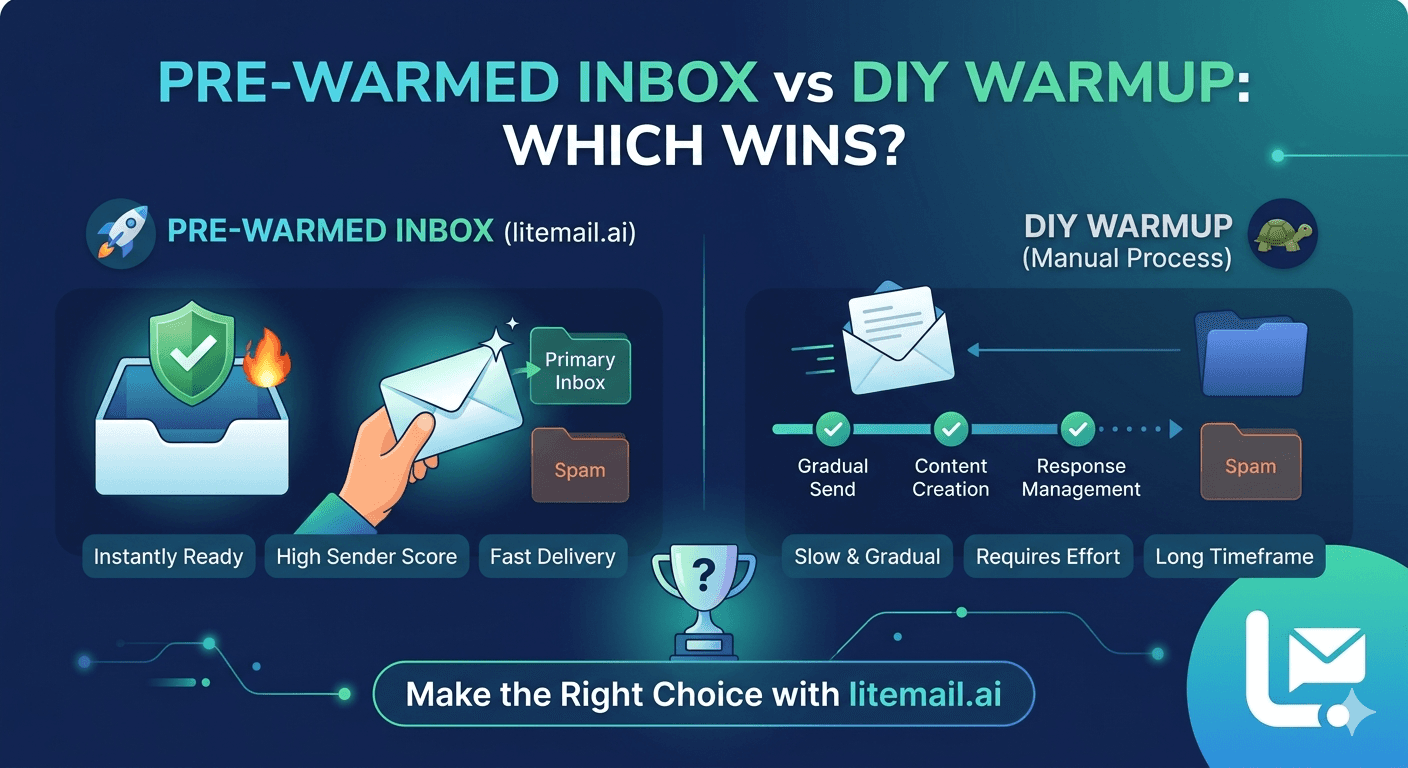
Six weeks. That's how long a proper DIY inbox warm-up takes before you can safely send cold outreach at volume. During those six weeks, you're paying for the inbox, paying for a warm-up tool, and generating zero pipeline from that sending slot. A pre-warmed inbox is ready in 24 hours. The question isn't which one sounds better — it's whether the time and cost difference is worth it for your specific situation. Here's the honest comparison, including where DIY warmup still makes sense and where it doesn't.
The Real Cost — What DIY Warmup Actually Costs You
Most people compare pre-warmed inbox price ($4.99–$8/inbox/month) against fresh inbox price ($6–8/inbox/month) and conclude they're roughly equal. That's wrong. The comparison misses three hidden costs of DIY warmup.
Cost Component | DIY Warmup (Fresh Inbox) | Pre-Warmed Inbox (Litemail) |
|---|---|---|
Monthly inbox fee | $6–8/inbox | $4.99/inbox |
Warm-up tool subscription | $29–$97/month | $0 — included |
DNS setup time (per domain) | 45–90 min | 0 — automated |
Warm-up period (not sending) | 4–6 weeks | 0 — ready in 24 hrs |
Pipeline lost during ramp-up | High — 6 weeks of dead inboxes | Zero |
Inbox replacement rate | 15–25% every 90 days | Under 5% at Litemail |
When we set up a cost comparison across 10 fresh inboxes vs 10 Litemail pre-warmed inboxes over 6 months, the DIY route cost $847 more — even though the monthly inbox fee was slightly lower. The warm-up tool, the lost 6 weeks of sending, and two replacement cycles wiped out any savings.
💡 The Hidden Cost Nobody Talks About
Six weeks of inbox downtime isn't just a cost — it's pipeline delay. If your average cold email campaign generates 3 qualified meetings per inbox per month, six weeks of warmup means 4.5 meetings per inbox that never happened. At a $5,000 average deal value and a 20% close rate, that's $4,500 in lost pipeline per inbox. Per inbox. The math changes fast when you frame it that way.
Deliverability Head-to-Head: Pre-Warmed vs DIY at Week 1, Week 4, Week 12
DIY warmup defenders always say "just give it time, results are the same eventually." In our testing at Litemail, that's partially true — but the "eventually" matters enormously for active outreach teams.
Timepoint | DIY Warmup Inbox | Litemail Pre-Warmed Inbox |
|---|---|---|
Week 1 — inbox placement | 38–52% primary inbox | 91–96% primary inbox |
Week 1 — open rate (est.) | 11–17% | 34–48% |
Week 4 — inbox placement | 65–78% | 92–96% |
Week 8 — inbox placement | 81–89% | 93–96% |
Week 12 — inbox placement | 88–93% | 93–96% |
Google Postmaster (Day 2) | Unknown / Low | Good / High ✓ |
By week 12, a well-executed DIY warmup closes most of the gap. But weeks 1 through 8 are months of below-target performance. And that assumes your warm-up tool is working properly — which, in our experience, isn't always the case.
Warm-up tools operate by sending emails between accounts in a pool and auto-opening them. Google's ML systems have become significantly better at detecting pool-based engagement in 2025–2026. Accounts warmed exclusively through tool pools sometimes plateau at Medium reputation — not Good — because the engagement pattern looks artificial. Pre-warmed inboxes use real historical sends, not bot pools.
Actually — DIY Warmup Still Makes Sense in Two Scenarios
I'm not going to pretend pre-warmed inboxes are the right answer for every situation. There are two cases where DIY warmup is the rational choice.
Scenario 1 — You Have Zero Time Pressure
If you're 90 days from launching a cold email programme and you're still building your ICP and offer, there's no cost to a 6-week warmup window. You'd be waiting anyway. In that case, buy fresh GWS or MS365 inboxes, configure DNS, run a warmup tool, and let the inboxes mature while you finalise your strategy. The only additional cost is the warm-up tool subscription — $29–$97/month for 6 weeks.
But here's the honest caveat: most teams that think they have 90 days actually get pressure to start sending at week 3. And then they send on half-warmed inboxes and damage domains that weren't ready. If there's any chance your timeline compresses, pre-warmed inboxes remove the risk entirely.
Scenario 2 — You're Testing a New Niche With Low Confidence
If you're not sure a new outreach angle will work and you want to test with 2–3 inboxes before committing to a full infrastructure build, fresh inboxes at $6–8/month are lower financial risk. Test the offer. If it converts, upgrade to pre-warmed inboxes for scale. If it doesn't, you haven't spent $50–$80 on pre-warmed infrastructure for a campaign you're going to kill anyway.
✅ The Rule of Thumb
Pre-warmed inboxes win when time-to-send matters, when you're running more than 5 inboxes, or when you're at agency scale. DIY warmup wins when you have zero time pressure and you're genuinely testing something new with low commitment. Most situations are the first case, not the second.
The Four DIY Warmup Mistakes That Kill Results
If you're committed to DIY warmup, at least avoid the mistakes that make it fail. These are the four we see most often.
Sending cold emails before warmup is complete. "Complete" means 4–6 weeks minimum, Postmaster Tools showing Good or High, and GlockApps showing 85%+ primary inbox placement. Not "I've been running the tool for 3 weeks and it seems fine." Sending too early is the #1 way to permanently damage a fresh domain.
Using a warm-up tool pool that's too small. Warm-up tools need a large, diverse pool of accounts to generate believable engagement signals. Pools under 10,000 accounts look artificial to Google's ML systems. Check your tool's pool size before subscribing. Instantly's pool: 300,000+ accounts. Lemwarm: 18,000+. Smaller tools are a risk.
Setting warm-up volume too high too fast. Starting at 50 emails/day in week one reads as unnatural for a new domain. Start at 5–10/day. Increase by 10–15% per day. Reach 50/day by week 3. Reach your target volume by week 6–8.
Skipping DMARC configuration. SPF and DKIM get set up (usually). DMARC gets skipped because it seems optional. It's not optional in 2026 — Google and Microsoft both enforce authentication requirements that include DMARC. Set p=quarantine at minimum, p=reject if the domain is dedicated to cold outreach.
The Hybrid Approach Agencies Actually Use at Scale
The smartest agencies don't choose between pre-warmed and DIY — they use both strategically. Here's the model that works at 20+ clients:
Active campaigns: Pre-warmed inboxes exclusively. No warmup delay, no placement risk, no pool detection issues. Litemail delivers in 24 hours, ready to connect to Instantly or Smartlead via OAuth immediately.
Future capacity building: 2–3 fresh domains on DIY warmup at any given time, always in the pipeline. When a pre-warmed inbox gets retired or a client needs additional volume, the DIY-warmed inboxes are ready to deploy as reinforcements.
New client onboarding: Always pre-warmed. The first 30 days of a client relationship are when you need to prove value fastest. Six weeks of warm-up delay is a retention risk at exactly the wrong moment.
This hybrid model keeps your active campaigns on bulletproof infrastructure while building a backup pool of low-cost capacity. Most agencies running this model spend 80% of their inbox budget on pre-warmed inboxes and 20% on fresh infrastructure in the pipeline.
Skip the Warmup Wait — Use Litemail Pre-Warmed Inboxes
Litemail pre-warmed inboxes arrive with 4–12 weeks of genuine send history, Good or High in Google Postmaster Tools within 48 hours, automated SPF/DKIM/DMARC, and dedicated US and EU IPs. No warm-up tool needed. $4.99/inbox — connect to your sending platform in minutes.
Get Pre-Warmed Inboxes from $4.99 →
Ready to send in 24 hours · No warm-up tool needed · 94–96% inbox placement from day one
About Litemail — Litemail provides pre-warmed Google Workspace and Microsoft 365 inboxes for cold email outreach. From $4.99/inbox with automated DNS, dedicated US and EU IPs, and full admin access.
View pre-warmed inbox plans →
Related reading:
Email Warm-Up vs Pre-Warmed Inboxes 2026 · Does Email Warmup Work in 2026? · Email Warmup Sequence Optimal Settings 2026 · Pre-Warmed vs Fresh Email Inboxes: Which Should You Buy in 2026? · Pre-Warmed Inbox Buying Mistakes 2026
Key Takeaways
DIY warmup takes 4–6 weeks before inboxes are campaign-ready. Pre-warmed inboxes are ready in 24 hours. For teams with active pipeline targets, that time gap has a real revenue cost.
The real cost of DIY warmup includes the warm-up tool subscription ($29–$97/month), DNS setup time (45–90 min per domain), and pipeline lost during the ramp period — not just the inbox fee. Over 6 months and 10 inboxes, DIY typically costs $800+ more than pre-warmed.
Warm-up tool pools can trigger Google's ML detection for artificial engagement, causing fresh inboxes to plateau at Medium reputation rather than Good. Pre-warmed inboxes use real historical sends — no pool detection risk.
Pre-warmed inboxes hit 91–96% primary inbox placement from week one. DIY inboxes hit 38–52% in week one and don't catch up until week 10–12 with a perfect warmup.
DIY warmup still makes sense when you have zero time pressure or when you're genuinely testing a new niche with low commitment and fewer than 3 inboxes.
The hybrid model — pre-warmed inboxes for active campaigns, DIY warmup building backup capacity in the pipeline — is how smart agencies manage infrastructure at scale.
Litemail pre-warmed inboxes at $4.99/inbox are cheaper than fresh GWS at $6–8/inbox once warm-up tool cost is included — and they're ready 6 weeks faster.
Frequently Asked Questions
How long does DIY email warmup take before you can send cold email?
A proper DIY warmup takes 4–6 weeks minimum. Week 1–2: start at 5–10 emails per day and increase slowly. Week 3–4: reach 30–50 emails per day. Week 5–6: check Google Postmaster Tools for Good or High reputation and run a GlockApps placement test before sending any cold outreach. Skipping any of these stages and sending early is the most common way to permanently damage a cold email domain.
Are pre-warmed inboxes actually better than DIY warmup in 2026?
For active outreach teams, yes — on placement rate, time-to-send, and total cost when warm-up tools are factored in. The only scenarios where DIY warmup wins are zero time pressure and low-commitment niche testing. In every other situation, pre-warmed inboxes deliver higher placement from day one, no tool subscription, and no 6-week wait.
Do warm-up tools still work in 2026?
They work — but with reduced effectiveness compared to 2024. Google's ML systems have improved at detecting pool-based engagement patterns. Accounts warmed exclusively through smaller tool pools sometimes plateau at Medium reputation rather than reaching Good. Tools with large, diverse pools (Instantly's 300,000+ account pool) perform better than smaller alternatives. Pre-warmed inboxes avoid this risk entirely by using real send history rather than pool simulations.
What's the minimum cost to DIY warmup 10 inboxes for 6 months?
Fresh GWS inboxes: ~$60–80/month × 6 months = $360–480. Warm-up tool: $37–97/month × 6 months = $222–582. DNS setup time: 10 hours at $25/hr = $250. Total: $832–$1,312. Litemail pre-warmed inboxes for the same 10 inboxes: $4.99 × 10 × 6 months = $299.40. With no warm-up tool or setup time cost. The difference is $530–$1,000+ in favour of pre-warmed over 6 months.
Can I mix pre-warmed inboxes with DIY-warmed inboxes in the same campaign?
Technically yes — but don't. Mixing inboxes with different reputation levels in the same campaign makes attribution impossible. If your open rate drops, you won't know if it's the pre-warmed inboxes or the DIY inboxes causing the problem. Keep pre-warmed inboxes in dedicated campaigns. Run DIY inboxes separately until they reach Good reputation, then integrate them into your main rotation.
How does Litemail verify that inboxes are genuinely pre-warmed?
Every Litemail inbox shows Good or High domain reputation in Google Postmaster Tools within 48 hours of delivery — verified by the customer, not self-reported. This is the only objective test that can't be faked. Unknown or Low reputation in Postmaster Tools after 48 hours confirms the inbox was never genuinely warmed. Litemail's 94–96% inbox placement rate on GlockApps from the first test is the direct result of 4–12 weeks of real send history built before delivery.
What warm-up tool should I use if I go the DIY route?
Instantly's warmup (included in their Hypergrowth plan) has the largest pool — 300,000+ accounts — which reduces artificial engagement detection risk. Lemwarm at $29–$49/month is a solid standalone option. Avoid tools with pools under 10,000 accounts — the engagement pattern is too small and too uniform to pass Google's ML checks. Regardless of tool, always confirm Postmaster Tools shows Good or High before sending a single cold email.
Buy Pre-Warmed Email Inboxes & Domains | Litemail
Skip the 6-week wait. Buy pre-warmed Google Workspace & Microsoft 365 inboxes from $4.99/inbox. Postmaster-verified Good/High in 48 hours. Automated DNS. Dedicated US & EU IPs. Ready to send in 24 hours.
Related reading:
Email Warm-Up vs Pre-Warmed Inboxes 2026 · Does Email Warmup Work in 2026? · Pre-Warmed vs Fresh Email Inboxes 2026 · Email Warmup Sequence Optimal Settings 2026 · Pre-Warmed Inbox Buying Mistakes 2026
📺 VIDEO SUGGESTION: "Email Warmup vs Pre-Warmed Inboxes — What Actually Works in 2026" — CHANNEL: Jeremy Choi — Search on YouTube: email warmup vs pre-warmed inbox deliverability 2026