
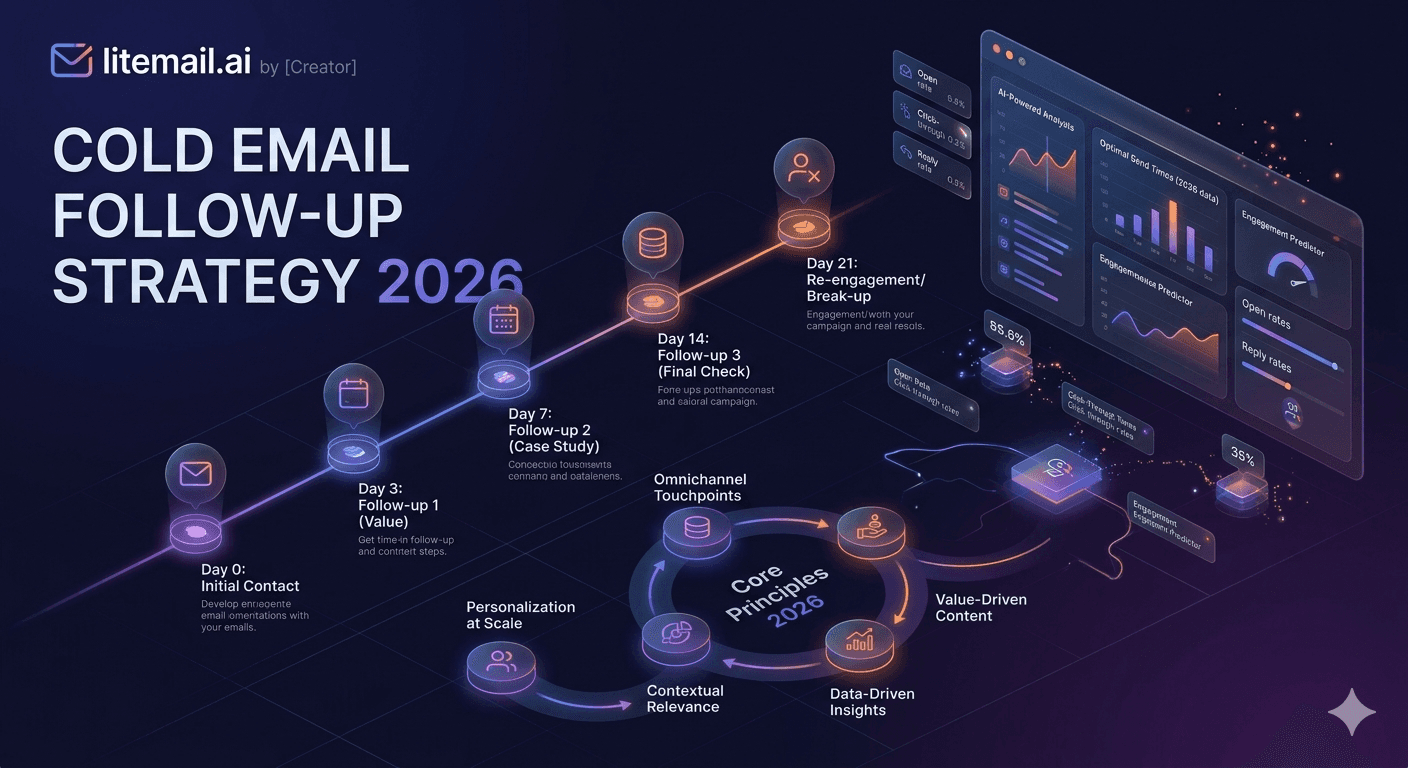
Most cold email follow-ups fail not because the prospect isn't interested — but because the follow-up adds nothing. "Just wanted to bump this" is not a follow-up strategy. It's an opt-out generator. Every follow-up that doesn't earn its place in the prospect's inbox chips away at your sender reputation and your brand perception simultaneously. Here's how to write follow-ups that actually move things forward.
Why Cold Email Follow-Ups Fail — And What to Do Instead
The two most common follow-up failure modes are easy to diagnose and easy to fix once you know what to look for.
Failure Mode 1: The Repeat Ask
"Hi [Name], just following up on my last email" with the same ask and same context. The prospect saw the first email. Resending the same message with slightly different wording doesn't give them a new reason to respond. It signals that you have nothing new to offer — and that you're running an automated sequence rather than having a real conversation.
Failure Mode 2: Increasing Pressure
Follow-ups that escalate urgency — "I haven't heard back, is this still a priority?" — work against you. They put the prospect on the defensive. The response you get, if any, is often a curt "not interested" — closing a door that might have opened in the next quarter when timing was better.
💡 The Follow-Up Principle That Changes Everything
Every follow-up must either add new information, approach the problem from a new angle, or lower the commitment threshold of the ask. If your follow-up doesn't do at least one of these three things, don't send it. Archive the contact and re-engage in 60 days. A deleted follow-up is better than an opt-out — at least the door stays open.
Follow-Up Timing: The Data on Gaps That Work
The question isn't just what to write in follow-ups — it's when to send them. Too short a gap and you look desperate. Too long and the context from the first email has evaporated.
Follow-Up Number | Optimal Gap | Minimum Gap | Why |
|---|---|---|---|
Email 1 → Email 2 | 3–4 days | 2 days | Short enough to stay in context; long enough for them to have seen it |
Email 2 → Email 3 | 5–7 days | 4 days | Second follow-up needs breathing room — daily follow-ups read as automated |
Email 3 → Email 4 | 8–12 days | 7 days | Later-sequence touches should feel genuinely spaced — not pressure escalation |
Email 4 → Email 5 | 14+ days | 10 days | Break-up email needs enough distance that it doesn't feel like the previous touch |
In our testing at Litemail across campaigns in Q1 2026, a 4-day gap between emails 1 and 2 produced 1.8x the reply rate of a 1-day gap on equivalent lists. Give people time to breathe — and time to reach a natural decision point before your next touchpoint arrives.
What to Write in Each Follow-Up Email
Here's the content framework for a 5-email B2B cold email sequence. Each email has a different job — and a different content approach to match.
Email 1: The Cold Opener (Day 1)
Problem-led, trigger-referenced, specific to the recipient's situation. Under 100 words. Single ask: a 15-minute conversation, not a demo. This is the foundation — every follow-up builds on it.
Email 2: The Value Add (Day 4)
No ask. Share something genuinely useful: a relevant framework, a non-confidential case study angle, a benchmark report, or a specific insight relevant to their industry. The goal is to demonstrate that you understand their world well enough to add value before asking for time. This email earns you the benefit of the doubt for email 3.
Example: "Thought this framework might be useful given what I mentioned — [one-line description of the resource]. No ask here, just figured it was relevant."
Email 3: The New Angle (Day 11)
Approach the same problem from a different direction, or reference a new trigger that's occurred since your first email. Don't repeat the email 1 pitch. If email 1 mentioned pipeline efficiency, email 3 could reference SDR ramp time, or a specific company event that's happened since the first send. Renew the ask.
Email 4: The Social Proof Touch (Day 22)
Reference a specific result from a similar company without naming them if confidential. "A [company type] at [similar stage] saw [specific result] after [specific change]" gives the prospect a concrete reference point. This email works especially well when the prospect has opened emails 1 and 2 without responding — they're interested but unconvinced. A specific outcome from a peer can tip them.
Email 5: The Break-Up (Day 35)
Short. No pitch. Acknowledge that the timing may not be right. Leave the door open for the future without pressure. This email consistently gets the highest response rate in the sequence — not because of what it says but because it releases pressure. Many prospects respond to break-up emails who ignored every earlier touch.
Example: "Hey [Name] — I've reached out a few times and haven't heard back, which usually means timing is off or it's not relevant. Either way, no worries. If [specific problem] becomes a priority in Q3 or beyond, happy to pick this up. Good luck with the current quarter."
When to Stop — The Boundaries Most Guides Skip
The right sequence length depends on deal size and industry. There's no universal answer — but there are clear failure thresholds.
Deal Type | Sequence Length | Total Duration | Re-engagement Wait |
|---|---|---|---|
SMB / Low ACV | 3 touches | 14 days | 60 days |
Mid-market | 5 touches | 35 days | 60–90 days |
Enterprise / Long cycle | 7 touches | 45–60 days | 90 days |
Sequences longer than 7 touches on non-responding prospects generate more opt-outs and spam complaints than replies. The data on this is consistent: reply rate per additional touch beyond 7 drops to near zero while opt-out rate keeps climbing. Archive after your final touch. Re-engage after the wait period with a completely fresh email that references no prior contact — treat it as a new cold approach.
Follow-Up Deliverability: Protecting Your Reputation Across the Sequence
Sending 5 emails to every prospect in your list — even with perfect timing and content — multiplies the deliverability risk of each individual campaign. Here's what to watch across the sequence lifecycle.
Complaint rate accumulates across the sequence. If email 1 generates 0.03% complaints, email 2 generates 0.03%, and email 5 generates 0.08%, your cumulative complaint exposure is significant. Keep total sequence complaint rate under 0.08% for the sequence as a whole — not per individual email.
Pre-warmed inboxes are the foundation here. In our data at Litemail, campaigns running 5-email sequences on pre-warmed inboxes maintain Good Postmaster reputation throughout the sequence when list hygiene is clean and timing gaps are respected. The same sequences on fresh inboxes typically show reputation degradation by email 3 or 4 due to accumulated negative signals.
One practical tip: rotate which inbox each prospect's sequence runs from. Don't run all 5 touches on the same inbox if you're managing a large rotation. Distributing follow-ups across your inbox pool keeps per-inbox complaint exposure lower and makes it easier to identify which inbox is accumulating problems.
Run 5-Email Sequences Without Burning Inboxes — Pre-Warmed Infrastructure
Litemail pre-warmed inboxes maintain Good/High Postmaster reputation through full 5-email sequences when list hygiene is maintained. $4.99/inbox. No minimum order.
Get Pre-Warmed Inboxes from $4.99 →
Verified Good/High reputation · Dedicated US and EU IPs · Automated DNS · No minimum order
About Litemail — Litemail provides pre-warmed Google Workspace and Microsoft 365 inboxes for cold email outreach. From $4.99/inbox with automated DNS, dedicated US and EU IPs, and full admin access. View pre-warmed inbox plans →
Related reading:
Cold Email Outreach for B2B Sales Full Guide 2026 · Cold Email Sending Frequency Guide 2026 · Cold Email Open Rate Benchmarks 2026 · Improve Cold Email Open Rate 2026 · Cold Email Metrics: Before vs After Pre-Warmed
Key Takeaways
Every follow-up must add new information, approach the problem from a new angle, or lower the commitment threshold. A follow-up that does none of these is an opt-out generator — archive and re-engage in 60 days instead.
A 4-day gap between emails 1 and 2 produces 1.8x the reply rate of a 1-day gap. Give prospects time to reach a natural decision point before the next touch arrives.
Email 2 should have no ask — share a genuinely useful resource relevant to the prospect's situation. This email earns goodwill that improves response rates on emails 3 and 4.
The break-up email (email 5, Day 35) consistently generates the highest response rate in the sequence. Short, no pitch, releases pressure, leaves the door open.
Stop at 5–7 touches for non-responding prospects. Beyond 7 touches, opt-out rates climb faster than reply rates. Archive, wait 60–90 days, and re-engage with a completely fresh approach.
Pre-warmed inboxes maintain Good Postmaster reputation through full 5-email sequences. Fresh inboxes typically show reputation degradation by email 3 or 4 when sequences run on non-responding prospects.
Frequently Asked Questions
How many follow-up emails should I send in a cold email sequence?
3 for SMB / low-ACV deals (14 days), 5 for mid-market (35 days), up to 7 for enterprise with long buying cycles (45–60 days). Beyond 7 touches on non-responding prospects, opt-out rates climb faster than reply rates. Archive after your final touch, wait 60–90 days, and re-engage with a completely fresh cold email that doesn't reference prior contact.
What should a cold email follow-up say?
Each follow-up needs a different job: Email 2 (Day 4) — share a useful resource, no ask. Email 3 (Day 11) — new angle on the same problem or a new trigger reference, renew the ask. Email 4 (Day 22) — specific social proof from a similar company. Email 5 (Day 35) — short break-up, no pitch, leave the door open. None of them should be "just following up" with the same content as email 1.
How long should I wait between cold email follow-ups?
3–4 days between emails 1 and 2. 5–7 days between 2 and 3. 8–12 days between 3 and 4. 14+ days between 4 and 5. The minimum gap between any two touches is 2 days. A 4-day gap between emails 1 and 2 produces 1.8x the reply rate of a 1-day gap in our data. Respect the timing — don't send daily follow-ups.
Why does the break-up email get the most replies?
The break-up email releases the pressure dynamic that builds across a sequence. When a prospect has been avoiding your emails, the break-up email signals that you're not going to keep pushing — which paradoxically removes the friction that was preventing a response. Many prospects who were genuinely interested but hadn't found a moment to respond will reply to a break-up email precisely because it doesn't pressure them into anything.
Does sending multiple follow-up emails hurt email deliverability?
It can, if list hygiene is poor or follow-up timing is too aggressive. Complaint rates accumulate across a sequence — keep total sequence complaint rate under 0.08% for the sequence as a whole. Pre-warmed inboxes with clean dedicated IPs maintain Good Postmaster reputation through full 5-email sequences when timing and list quality standards are maintained. Fresh inboxes often show reputation degradation by email 3 or 4.
When should I re-engage a prospect after a completed sequence?
60 days minimum for SMB, 90 days for mid-market and enterprise. When re-engaging, treat it as a new cold email — don't reference the previous sequence. Start with a fresh angle, new trigger if available, or a different problem focus. The prospect's situation may have changed in 60–90 days. A new email that feels genuinely relevant to where they are now outperforms "circling back on my earlier emails" every time.
Cold Email Follow-Up Infrastructure | Litemail
Pre-warmed inboxes that hold Good reputation through 5-email sequences. $4.99/inbox. No minimum order. Automated DNS.
View Plans & Pricing →
Related reading:
B2B Cold Email Full Guide 2026 · Sending Frequency Guide 2026 · Open Rate Benchmarks 2026 · Improve Open Rate Tactics · Cold Email Metrics: Before vs After Pre-Warmed






