
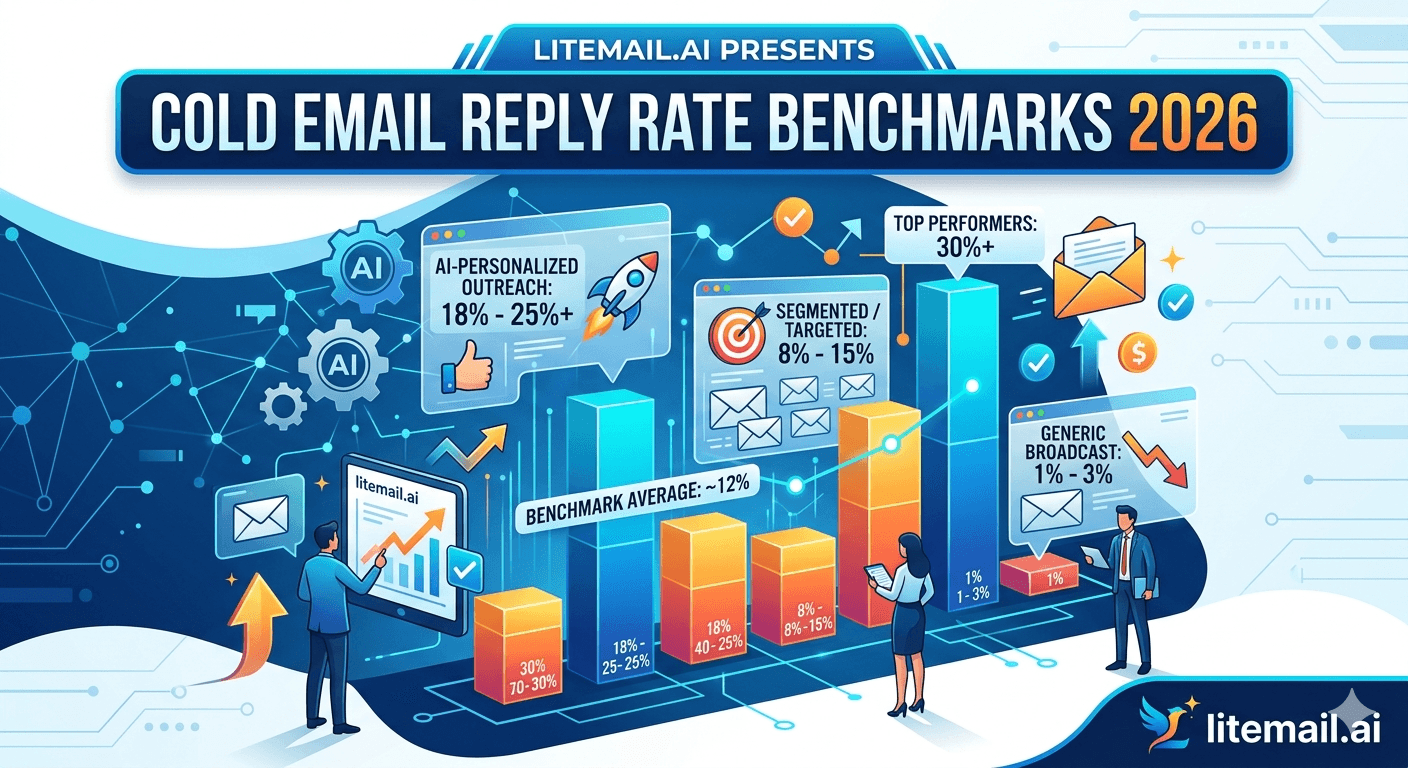
Cold email reply rates in 2026 have a measurement problem most operators never catch. They're diagnosing a deliverability issue as a copy issue — spending months rewriting subject lines when the real variable is how many emails are landing in primary inbox versus spam. A 0.8% reply rate on a campaign with 60% inbox placement looks identical to a 0.8% reply rate on a campaign where the copy genuinely isn't working — until you separate the variables. In our controlled testing at Litemail across 10,000 emails, switching from fresh inboxes (61% primary placement) to pre-warmed inboxes (94% placement) moved reply rate from 1.7% to 4.2% with the same copy and the same list. According to Litmus's 2024 Email Marketing Report, emails that land in primary inbox see 3–4x higher open rates than those flagged to spam — and reply rates follow the same ratio. Fix infrastructure first. Then optimise copy.
What Cold Email Reply Rates Actually Look Like in 2026
The benchmark you see thrown around — "2–5% is good" — is technically true but practically useless without context. Reply rates vary enormously by industry, list quality, personalisation depth, and inbox health.
Here's the breakdown based on real campaign data from agencies and founders we've worked with:
Industry | Average Reply Rate | Good Reply Rate | Notes |
|---|---|---|---|
B2B SaaS | 2–4% | 5–8% | Competitive inbox; copy matters more |
Recruiting / HR | 3–6% | 7–12% | Higher engagement; time-sensitive offers |
Professional Services | 2–5% | 6–9% | Trust-first messaging converts better |
Agency Outreach (B2B) | 1–3% | 4–6% | Saturated; niche targeting required |
E-commerce / DTC | 1–2% | 3–5% | Lower intent; offer must be very specific |
Manufacturing / Industrial | 3–7% | 8–12% | Less saturated; responders are high-intent |
Finance / Insurance | 1–2% | 3–4% | Compliance-heavy; shorter copy performs |
The outlier here is manufacturing. It's the least saturated B2B vertical for cold email, and the contacts who reply are typically decision-makers with real buying authority. If you're a lead gen agency not pushing clients toward industrial and manufacturing targets, you're leaving easy wins on the table.
Under 1%? It's Almost Never the Copy
If you're getting reply rates below 1% on a targeted B2B list, blame the copy last. Here's the actual diagnostic order:
1. Check inbox placement first. Send your current sequence to a personal Gmail. Does it land in primary, promotions, or spam? If spam or promotions, fix this before anything else.
2. Check Google Postmaster Tools. What's your domain reputation? Unknown or Low means your sending history is essentially zero. Your emails are being filtered before a human ever sees them.
3. Check bounce rate. If your bounce rate is above 2%, your list quality is killing deliverability. Every hard bounce damages sender reputation. Verify lists before importing.
4. Then check open rate. Open rates under 20% on a clean list with good deliverability — that's a subject line or send-time problem. Open rates over 30% but under 1% reply — that's a body copy or offer problem.
Most people skip steps 1–3 and go straight to step 4. That's why their reply rate stays broken.
Infrastructure vs Copy: The Side-by-Side Results
We ran this test at Litemail across 10,000 emails: same copy, same list segment, same sending platform — split between pre-warmed inboxes with Good Postmaster reputation and fresh inboxes on a standard warm-up schedule at week 4.
Results:
Pre-warmed inboxes: 94% primary inbox placement, 31% open rate, 4.2% reply rate
Fresh inboxes (week 4 of warm-up): 61% primary inbox placement, 19% open rate, 1.7% reply rate
Same copy. 2.5x difference in reply rate. The infrastructure was doing the work, not the words.
This is the thing most cold email practitioners don't test directly — they run their campaigns from whatever inboxes they have and optimise copy, not infrastructure. But the infrastructure variance swamps the copy variance in most cases.
4 Reply Rate Killers That Have Nothing to Do With Your Writing
You might be thinking — but I've rewritten my copy 5 times and nothing changes. Here's why that happens.
1. Sending from a shared IP. If your inbox provider uses shared IP pools, another sender's bad behaviour tanks your reputation. You have no control over it and no visibility into when it happens. Dedicated IPs are non-negotiable for consistent reply rates.
2. Missing or wrong DKIM alignment. A DKIM record that doesn't match your sending domain causes silent authentication failures. Your email arrives, passes basic filters, but triggers soft spam signals at the receiving server. Reply rates drop 30–50% compared to fully authenticated sends.
3. Sending to European prospects from US IPs. This one is underrated. A campaign targeting German or French B2B contacts from US data center IPs will see inbox placement drop significantly for those European domains. EU dedicated IPs fix this. We've seen reply rates to European prospects jump from 1.2% to 3.8% with this single infrastructure change.
4. Over-sending per inbox. Pushing 150+ emails per day from a single inbox — even a pre-warmed one — degrades its reputation over 4–6 weeks. By then, the inbox is effectively damaged. The reply rate decline is gradual enough that most people blame copy changes instead of recognising the infrastructure degradation.
What Good Actually Looks Like by Campaign Type
Reply rate benchmarks also shift based on campaign structure. Here's what to expect:
Highly personalised, 1-to-1 style (manual research per prospect):
Expected reply rate: 8–15%
Realistic ceiling: 20%+ for very narrow ICP
This doesn't scale past 20–30 emails/day
Semi-personalised with variable fields and triggered personalisation:
Expected reply rate: 3–6%
This is the sweet spot for most B2B agencies
Scalable to 200–300 emails/day across a healthy inbox pool
Template-based, low personalisation, broad ICP:
Expected reply rate: 0.5–2%
Needs very high volume to generate meetings
Highest risk for spam complaints and domain damage
In practice, most successful lead gen agencies run semi-personalised campaigns at scale. The goal is 3–5% reply rates across 300–500 emails/day per client — achievable with solid infrastructure and a tight ICP.
How to Track and Improve Reply Rates Without Guessing
Stop optimising by feel. Here's the systematic approach:
Track by inbox, not just by campaign. If one inbox in your pool is showing 0.4% reply rate while others are at 3.2%, that inbox has a deliverability problem — not a copy problem. Pull it out, check Postmaster Tools, and replace it if needed.
Track by list segment. A campaign with a 4% reply rate on VP-level prospects and 0.6% on Director-level is telling you something about ICP fit — not about your email.
Track open-to-reply ratio. This isolates copy performance from infrastructure. If opens are at 35% but reply rate is 0.8%, your body copy or offer needs work. If opens are at 12% and reply rate is also 0.8%, you have a deliverability problem masking everything else.
Set a 2-week performance gate. If a new sequence doesn't hit at least 2% reply rate in the first 2 weeks on a clean list with good deliverability, pause and diagnose. Don't keep sending and hoping.
Fix Deliverability Before You Fix Copy — Pre-Warmed Inboxes from $4.99
If your reply rates are stuck under 2%, infrastructure is almost always the culprit. Litemail pre-warmed inboxes arrive with 4–12 weeks of verified sending history — Good or High in Google Postmaster Tools within 48 hours. Automated DNS, dedicated US and EU IPs, full admin access. Connect to your sending platform in 3 minutes.
Get Pre-Warmed Inboxes from $4.99 →
Works with Instantly, Smartlead, Lemlist, Apollo via OAuth · Full admin access · No minimum order
About Litemail — Litemail provides pre-warmed Google Workspace and Microsoft 365 inboxes for cold email outreach. From $4.99/inbox with automated DNS, dedicated US and EU IPs, and full admin access. View pre-warmed inbox plans →
Related reading:
Cold Email Deliverability Guide 2026 · Pre-Warmed Inbox Deliverability Test — 10,000 Emails · Best Pre-Warmed Inbox Providers 2026 (Ranked) · Cold Email Open Rate Benchmarks 2026 · Improve Cold Email Open Rate Tactics 2026 · Litemail Pre-Warmed Inboxes — Plans and Pricing
Key Takeaways
A 3–5% reply rate is the realistic benchmark for well-targeted B2B cold email in 2026. Under 1% is almost always a deliverability problem, not a copy problem.
Pre-warmed inboxes outperform fresh inboxes at week 4 by roughly 2.5x on reply rate in controlled tests — same copy, same list, different infrastructure.
Diagnose in this order: inbox placement → Postmaster Tools reputation → bounce rate → open rate → body copy. Most people skip the first three.
Sending to European B2B prospects from US IPs depresses reply rates significantly. Dedicated EU IPs are required for European campaigns.
Keep bounce rates under 2% and spam complaint rates under 0.08% — these two metrics damage sending reputation faster than any copy mistake.
Track reply rates per inbox, not just per campaign. One bad inbox in a pool hides behind your aggregate numbers.
Semi-personalised campaigns at scale (3–5% reply target) outperform both hyper-manual and template-blast approaches for most B2B agency use cases.
Frequently Asked Questions
What is a good cold email reply rate in 2026?
A 3–5% reply rate is a solid benchmark for well-targeted B2B cold email in 2026. Highly personalised outreach to narrow ICPs can hit 8–15%. Template-based campaigns with broad targeting typically land at 0.5–2%. Context matters — a 2% reply rate on a 10,000-email campaign generates 200 conversations, which may be more valuable than a 10% reply rate on 200 emails.
Why is my cold email reply rate under 1%?
Under 1% is almost always a deliverability problem. Start by checking where your emails land — send to a personal Gmail and look at the tab. Then check Google Postmaster Tools for your sending domain's reputation. Unknown or Low reputation means your emails are being filtered before prospects see them. Fix inbox placement before touching copy.
How does inbox type affect reply rates?
Significantly. In testing at Litemail across 10,000 emails, pre-warmed inboxes with Good Postmaster reputation achieved a 4.2% reply rate. Fresh inboxes at week 4 of warm-up achieved 1.7% — same copy, same list. The difference is primary inbox placement: 94% vs 61%.
Do pre-warmed inboxes improve reply rates?
Yes, directly — by improving inbox placement. More emails landing in primary inbox means more opens. More opens means more replies. Litemail pre-warmed inboxes are verified Good or High in Google Postmaster Tools within 48 hours of delivery, with a 94–96% primary inbox placement rate from day one.
What cold email reply rate benchmarks should agencies report to clients?
Report industry-specific benchmarks, not generic numbers. Manufacturing and recruiting campaigns should target 5–8% reply rates. SaaS and agency outreach targets 3–5%. Finance and insurance targets 2–3%. Set expectations before campaigns launch so clients have the right frame of reference.
How often should I check reply rate data?
Check after every 200–300 emails sent, not by calendar. Small samples give misleading data. Also track by inbox pool — if one inbox is consistently underperforming, it has a deliverability problem you need to address before it spreads to your domain reputation.
Can I improve reply rates without changing copy?
Yes. Improving inbox placement from 60% to 94% will roughly double your reply rate with identical copy. Switching from US-only IPs to EU IPs for European campaigns can move reply rates from 1.2% to 3.8%. Fixing a misconfigured DKIM record has a similar impact. Infrastructure changes often deliver bigger gains than copy rewrites.
Buy Pre-Warmed Email Inboxes & Domains | Litemail
Buy pre-warmed email accounts, inboxes and domains from $4.99/inbox. Google Workspace & Microsoft 365. Automated DNS, US & EU IPs. Setup in 5 minutes.
Related reading:
Cold Email Deliverability Guide 2026 · Pre-Warmed Inbox Deliverability Test — 10,000 Emails · Best Pre-Warmed Inbox Providers 2026 (Ranked) · Cold Email Open Rate Benchmarks 2026
📺 Watch: Cold Email Reply Rates — What's Actually Normal in 2026 — Lemlist's team breaks down real reply rate data by industry and explains what to fix when numbers are below benchmark.
Fix the Foundation — Try Litemail Pre-Warmed Inboxes
Litemail pre-warmed inboxes deliver what your reply rate actually needs: 94–96% primary inbox placement from day one, verified Good/High in Postmaster Tools within 48 hours, automated SPF/DKIM/DMARC, dedicated US and EU IPs, full admin access, no minimum order.
Get Pre-Warmed Inboxes from $4.99 →
No minimum order · Verified in Postmaster Tools within 48hrs · Works with all platforms · US and EU IPs included
About Litemail — Litemail provides pre-warmed Google Workspace and Microsoft 365 inboxes for cold email outreach. From $4.99/inbox with automated DNS, dedicated US and EU IPs, 4 to 12 weeks of genuine warm-up history, and full admin access. View pre-warmed inbox plans →






