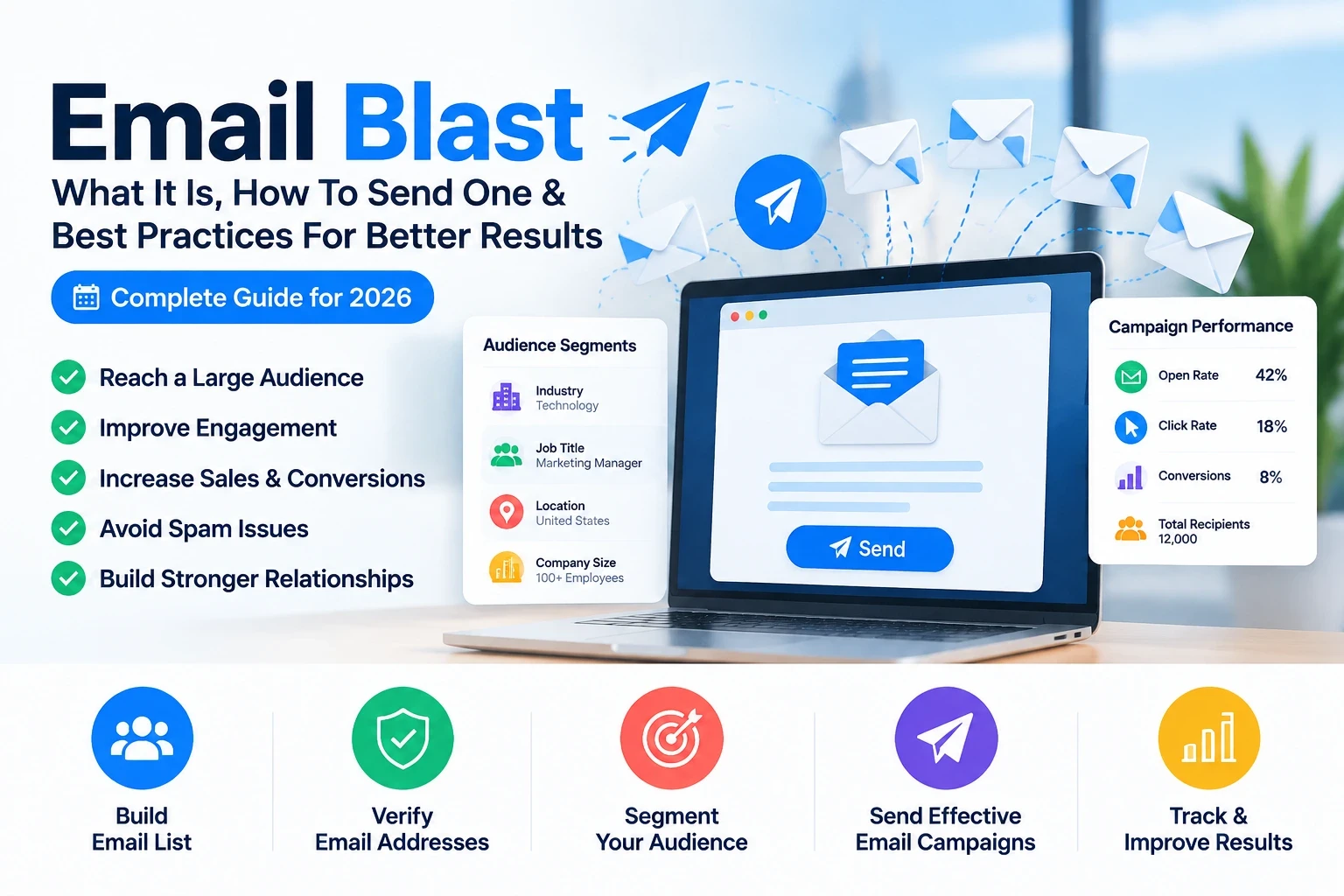
Email marketing remains one of the most powerful ways for businesses to communicate with customers, prospects, and subscribers. However, as inboxes become more crowded, simply sending the same message to thousands of people is no longer enough.
An email blast is a marketing method where a single email message is sent to a large group of recipients at the same time. Businesses commonly use email blasts to announce products, share promotions, distribute updates, invite users to events, or communicate important information.
Traditionally, many companies used email blasts as a simple "send to everyone" strategy. However, modern email marketing has changed. Successful businesses now combine email blasts with audience segmentation, personalization, and data-driven targeting to create more relevant experiences.
A poorly planned email blast can lead to:
Low open rates
High unsubscribe rates
Poor engagement
Damaged sender reputation
On the other hand, a well-designed email blast campaign can help businesses:
Reach thousands of potential customers
Promote products effectively
Generate website traffic
Increase sales opportunities
Build stronger customer relationships
According to Twilio SendGrid's explanation, an email blast refers to sending one email message to a large email list simultaneously, and the main challenge is ensuring that mass sending remains valuable rather than becoming irrelevant communication. Pasted text
This complete guide explains everything you need to know about email blasts, including how they work, how to create successful campaigns, best practices, common mistakes, and how businesses can improve results with better targeting.
What Is an Email Blast?
An email blast is a single email campaign sent to a large number of recipients at the same time.
It is also commonly called:
Eblast
Blast email
Email marketing blast
Mass email campaign
Broadcast email
The purpose of an email blast is usually to deliver one message to many people quickly.
Examples include:
Product launch announcements
Holiday promotions
Company updates
Event invitations
Special offers
Newsletter announcements
Limited-time deals
For example:
A software company launching a new feature may send an email blast announcing the update to thousands of existing users.
An ecommerce company may send a promotional email blast informing customers about a seasonal discount.
A B2B company may send a targeted announcement to business prospects about a new service.
How Does an Email Blast Work?
An email blast campaign usually follows several important steps.
Step 1: Build an Email List
Every successful email blast starts with a quality contact list.
A list may contain:
Customers
Subscribers
Business prospects
Leads
Partners
The quality of the list directly affects campaign performance.
A poor-quality list may contain:
Invalid emails
Duplicate contacts
Uninterested recipients
Outdated information
A high-quality list contains:
Accurate email addresses
Relevant contacts
Proper segmentation
Updated information
Step 2: Define Your Campaign Goal
Before sending an email blast, businesses should clearly define what they want to achieve.
Common goals include:
Increasing Sales
Example:
Promoting a discount offer or new product.
Generating Leads
Example:
Encouraging users to request a demo or consultation.
Increasing Engagement
Example:
Sharing educational content or company updates.
Driving Website Traffic
Example:
Promoting a blog article, webinar, or landing page.
Step 3: Create Email Content
A successful email blast requires valuable content.
A strong email usually includes:
Attention-Grabbing Subject Line
The subject line determines whether people open the email.
Examples:
Weak:
"New Update"
Better:
"Introducing Our New AI Feature: Available Today"
Clear Message
Recipients should quickly understand:
What is the email about?
Why does it matter?
What action should they take?
Strong Call-To-Action (CTA)
Every email blast should guide users toward a specific action.
Examples:
Get Started
Schedule a Demo
Download Now
Learn More
Claim Offer
Step 4: Send Through an Email Platform
Businesses typically use email marketing platforms to send large campaigns.
Email platforms provide:
Email templates
Scheduling options
Analytics
Automation
Deliverability monitoring
Twilio explains that email service providers help improve delivery by managing email infrastructure, monitoring sending reputation, and reducing issues related to bounced or spam emails.
Step 5: Measure Campaign Performance
After sending an email blast, businesses analyze results.
Important metrics include:
Open Rate
Shows how many recipients opened the email.
Click-Through Rate
Measures how many users clicked links inside the email.
Conversion Rate
Shows how many recipients completed the desired action.
Bounce Rate
Measures emails that failed delivery. If yours is climbing, see our email deliverability guide.
Unsubscribe Rate
Shows how many people removed themselves from the list.
Benefits of Email Blasts
Although email blasts are often associated with mass communication, they provide several advantages when used correctly.
1. Reach a Large Audience Quickly
One of the biggest advantages of an email blast is speed.
Businesses can communicate with thousands of people within minutes.
Examples:
Product announcements
Company news
Sales promotions
Event invitations
Instead of contacting each person individually, businesses can deliver one message to a large audience efficiently.
2. Save Time and Marketing Resources
Creating one campaign can be faster than sending individual messages.
Email blasts help businesses:
Reduce manual work
Automate communication
Maintain consistent messaging
3. Promote Products and Services
Companies use email blasts to introduce:
New products
Features
Discounts
Special offers
Events
A well-written campaign can encourage recipients to take immediate action.
4. Increase Brand Awareness
Regular communication helps businesses stay connected with their audience.
Email blasts can remind customers about:
New updates
Useful resources
Company announcements
5. Support B2B Outreach
Businesses can also use email blasts for professional communication.
Examples:
SaaS companies announcing new solutions
Agencies reaching potential clients
Companies promoting partnerships
Sales teams contacting qualified prospects
However, B2B success depends heavily on sending relevant messages to the right audience.
Email Blast vs Targeted Email Campaign
Many marketers confuse email blasts with targeted email campaigns.
The main difference is personalization and audience selection.
Feature | Email Blast | Targeted Email Campaign |
|---|---|---|
Audience | Large group | Specific segment |
Personalization | Limited | High |
Targeting | Basic | Advanced |
Message | General | Customized |
Engagement | Usually lower | Usually higher |
Best Use | Announcements | Sales & relationship building |
Modern email marketing focuses more on targeted communication because customers expect relevant messages.
Why Traditional Email Blasts Often Fail
Sending the same email to everyone may create problems.
1. Lack of Personalization
People are more likely to ignore emails that feel generic.
Example:
"Dear Customer"
is less engaging than:
"Hi Sarah, here is an offer based on your interests."
2. Poor Audience Targeting
Not every subscriber has the same needs.
A customer interested in one product may not care about another.
3. Higher Spam Risk
Large, irrelevant campaigns may trigger spam filters.
Common causes:
Poor-quality lists
Too many emails
Spam-related wording
Low engagement
4. Lower Conversion Rates
When content does not match recipient interests, fewer people take action.
How To Create a Successful Email Blast Campaign Step-by-Step
A successful email blast is not just about sending thousands of emails at once. The best campaigns combine accurate data, clear messaging, proper targeting, and continuous optimization.
Follow these steps to create an effective email blast campaign.
Step 1: Identify Your Target Audience
Before creating an email blast, understand who you are sending the message to.
Ask:
Who is the ideal recipient?
What problem do they have?
Why would they be interested?
What action should they take?
For example:
A B2B software company should not send the same email to:
CEOs
Marketing managers
Developers
Existing customers
Each audience requires a different message.
Step 2: Build a Quality Email List
The success of an email blast depends heavily on the quality of your contact database.
A strong email list should contain:
✅ Accurate email addresses
✅ Relevant contacts
✅ Active subscribers
✅ Proper business information
✅ Updated records
For B2B campaigns, businesses should focus on collecting:
Company name
Contact person
Job title
Industry
Professional email address
Company size
Location
A targeted list produces better results than a large but irrelevant database.
Step 3: Verify Email Addresses Before Sending
Email verification is one of the most important steps in email marketing.
Sending emails to invalid addresses can cause:
High bounce rates
Lower deliverability
Poor sender reputation
Before launching an email blast, businesses should verify:
Email validity
Domain status
Mail server availability
Duplicate contacts
A clean database improves the chances of reaching real people.
Step 4: Segment Your Audience
Segmentation transforms a basic email blast into a targeted marketing campaign.
Instead of sending one message to everyone, divide your audience into groups.
Common segmentation methods include:
Industry-Based Segmentation
Examples:
Healthcare companies
SaaS businesses
Financial services
Manufacturing companies
Real estate businesses
Job Role Segmentation
Examples:
CEOs
Founders
Marketing Directors
Sales Managers
IT Managers
Location-Based Segmentation
Examples:
United States
United Kingdom
Canada
Specific states or cities
Customer Behavior Segmentation
Based on:
Previous purchases
Website activity
Email engagement
Product interest
Klaviyo highlights segmentation and personalization as key methods for improving email blast engagement because targeted messages are more relevant to recipients. Pasted text
Step 5: Write a High-Converting Email
A successful email blast requires more than sending information.
The email should provide value.
Create a Strong Subject Line
Your subject line should:
Create curiosity
Explain value
Encourage opening
Examples:
Weak:
"New Update Available"
Better:
"Discover 5 New Features That Save Your Team Hours"
Personalize Your Message
Personalization can include:
Recipient name
Company name
Industry
Previous interaction
Example:
Instead of:
"Businesses need better marketing tools."
Use:
"Hi John, we noticed growing SaaS teams like yours are looking for faster ways to generate qualified leads."
Keep the Message Simple
Avoid long paragraphs.
A good email structure:
Problem
Solution
Benefit
CTA
Step 6: Optimize Your Call-To-Action
Every email blast should have a clear purpose.
Examples:
Sales CTA
Book a demo
Request pricing
Contact sales
Content CTA
Read article
Download guide
Watch webinar
Product CTA
Try free
Start now
Explore features
A confusing CTA reduces conversions.
Step 7: Test Before Sending
Before sending to thousands of contacts, test your email.
Check:
Subject Line
Test different versions.
Email Design
Check:
Mobile view
Images
Links
Formatting
Delivery
Test whether the email reaches inboxes.
Step 8: Analyze Results and Improve
After sending an email blast, review performance.
Important metrics:
Metric | Purpose |
|---|---|
Open Rate | Measures interest |
Click Rate | Shows engagement |
Conversion Rate | Measures success |
Bounce Rate | Shows data quality |
Unsubscribe Rate | Measures audience satisfaction |
Use results to improve future campaigns.
Email Blast Examples
Here are common examples of effective email blast campaigns.
Example 1: Product Launch Email Blast
Purpose:
Announce a new product.
Structure:
Subject:
"Introducing Our New AI-Powered Sales Tool"
Message:
Explain:
New features
Benefits
How users can try it
CTA:
"Start Free Trial"
Example 2: Promotional Email Blast
Purpose:
Increase sales.
Example:
"Get 30% Off Until Friday"
Includes:
Offer details
Deadline
CTA button
Example 3: B2B Lead Generation Email Blast
Purpose:
Generate business opportunities.
Target:
Business owners
Marketing managers
Sales leaders
Message:
Explain:
Business problem
Solution
Meeting opportunity
Example 4: Event Invitation Email Blast
Purpose:
Increase registrations.
Examples:
Webinars
Conferences
Product demos
Email Blast Tools Comparison
Different tools serve different purposes.
Tool | Best For |
|---|---|
Litemail.ai | Finding targeted business contacts |
Mailchimp | Small business email campaigns |
Klaviyo | Ecommerce marketing automation |
SendGrid | High-volume email delivery |
HubSpot | CRM-based marketing |
How Litemail.ai Helps Businesses Create Better Email Blast Campaigns
An email blast is only as effective as the audience receiving it.
Many businesses struggle because they do not have accurate contact information.
They spend hours searching for:
Company contacts
Decision-makers
Professional emails
Business information
Litemail.ai helps simplify the prospecting process by helping businesses discover and organize professional contact data for better outreach.
With Litemail.ai, businesses can:
✓ Find relevant business contacts
✓ Build targeted prospect lists
✓ Improve audience targeting
✓ Support B2B outreach campaigns
✓ Reduce manual research time
Instead of sending generic emails to unknown audiences, businesses can create more focused campaigns with better-quality prospect data.
Common Email Blast Mistakes To Avoid
Mistake 1: Sending Without Verification
Unverified lists create:
Bounce problems
Deliverability issues
Poor results
Mistake 2: Sending The Same Message To Everyone
Different audiences need different messages.
Segment your recipients before sending.
Mistake 3: Buying Low-Quality Lists
Cheap databases often contain:
Fake contacts
Outdated emails
Irrelevant recipients
Quality matters more than quantity.
Mistake 4: Ignoring Analytics
Without tracking results, businesses cannot improve campaigns.
Always measure:
Opens
Clicks
Conversions
Mistake 5: No Follow-Up Strategy
Many opportunities require multiple interactions.
Create follow-up sequences instead of sending one email and stopping.
Frequently Asked Questions (FAQs)
What is an email blast?
An email blast is a marketing email sent to a large group of recipients at the same time to share promotions, announcements, updates, or other information.
Are email blasts still effective?
Yes, when they are properly targeted, personalized, and sent to a quality email list. Poorly targeted mass emails usually perform worse.
What is the difference between an email blast and a newsletter?
An email blast is usually a one-time message sent to a large audience, while a newsletter is a recurring communication that shares regular updates or content.
How do I create an email blast?
To create an email blast:
Define your goal
Build a quality email list
Verify contacts
Create email content
Segment your audience
Send and analyze results
How can I improve email blast open rates?
Improve open rates by:
Writing better subject lines
Personalizing emails
Sending relevant content
Maintaining a clean list
How do I avoid email blast spam issues?
Avoid spam problems by:
Using verified contacts
Sending relevant messages
Following email regulations
Maintaining good sender reputation
What is the best email blast strategy for B2B companies?
B2B companies should focus on:
Targeted prospect lists
Decision-maker contacts
Personalized messaging
Follow-up sequences
Final Thoughts: Create Smarter Email Blast Campaigns With Better Data
Email blasts remain a powerful marketing method when they are used strategically.
The difference between a successful campaign and a failed campaign is not simply the number of emails sent. It is the quality of the audience, relevance of the message, and effectiveness of the strategy.
Modern businesses should focus on:
Verified contacts
Audience segmentation
Personalization
Strong messaging
Continuous optimization
By combining a quality email database with smart campaign strategies, businesses can reach the right people and create meaningful opportunities.
Ready To Build Better Email Campaigns?
Start finding targeted business contacts with Litemail.ai and create more effective B2B outreach campaigns.