
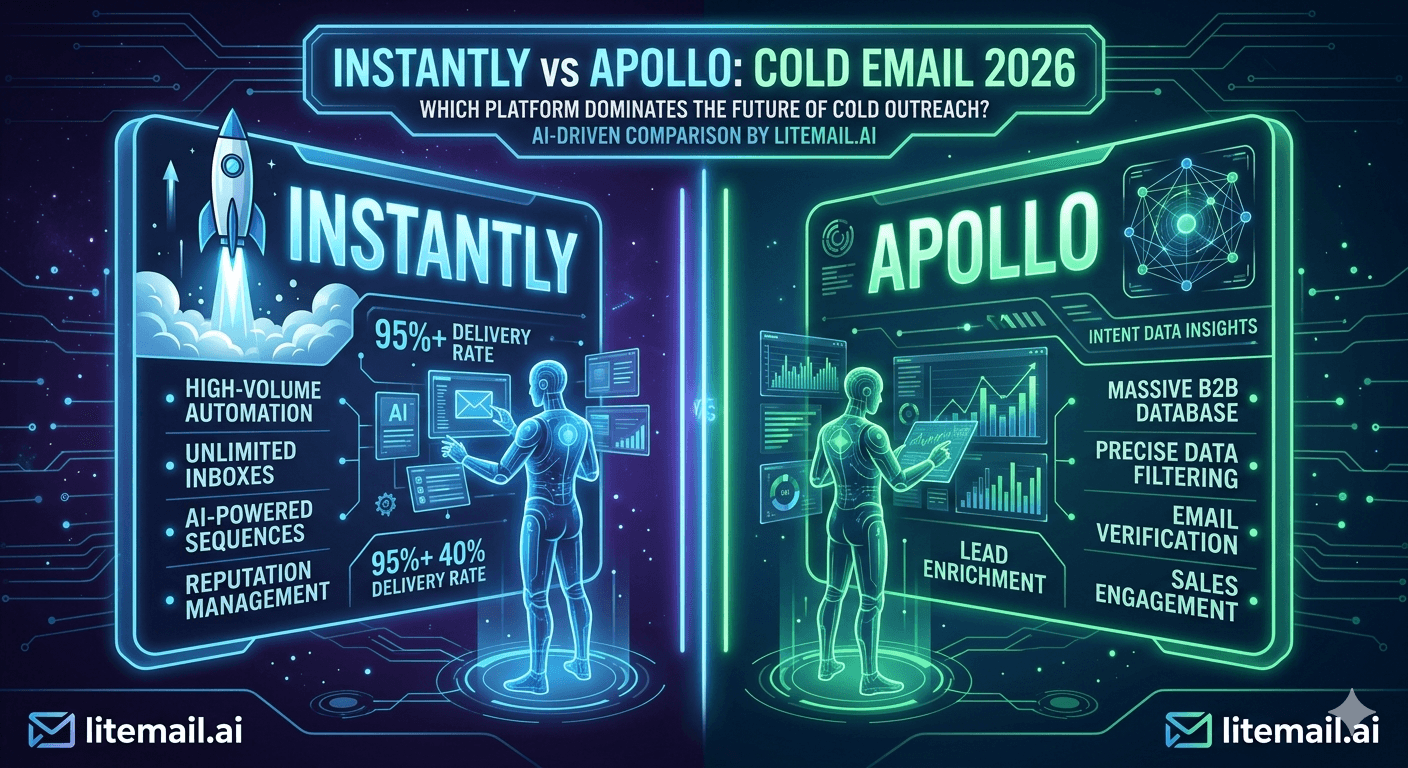
Instantly vs Apollo in 2026 is not a simple feature comparison because these tools solve different parts of the outbound sales process. Apollo is primarily a sales intelligence and B2B lead data platform that helps teams find prospects, enrich contact information, and manage multi-channel outreach. Instantly is a cold email sending platform built around email campaigns, inbox rotation, and scaling outbound volume.
The real question most teams are asking is not “Instantly or Apollo?” — it is whether Apollo’s built-in outreach features are enough, or whether they should use Apollo for lead generation and Instantly for cold email execution. The right choice depends on your workflow, campaign volume, deliverability requirements, pricing expectations, and how much control you need over your sending infrastructure.
In this Instantly vs Apollo 2026 comparison, we break down pricing, lead databases, email sequencing, warm-up features, deliverability, and the best setup for scaling cold email campaigns.
Instantly vs Apollo Pricing Comparison 2026
Pricing is one of the biggest differences between Instantly and Apollo. The cheaper option depends on whether you mainly need lead data or cold email sending infrastructure.
Instantly vs Apollo Pricing Table
Feature | Instantly | Apollo |
|---|---|---|
Main purpose | Cold email sending & campaign scaling | Sales intelligence + lead database + outreach |
Pricing model | Workspace/subscription-based | Per-user subscription |
Free plan | Available | Available |
Starting paid plan | Around $47/month (Outreach) | Around $49/user/month (Basic annual billing) |
Best for | Teams focused on email volume | Teams needing prospect data + outreach |
Lead database | Available through separate plans | Built-in B2B database |
Email sequencing | Core feature | Included |
Inbox scaling | Strong focus | Available but not the main focus |
Best value for | Agencies and high-volume senders | Sales teams needing data + outreach |
What Instantly and Apollo Actually Do
💡 TL;DR
Apollo is a lead database and sales engagement platform — it finds prospects, enriches contact data, and has a built-in email sequencing tool. Instantly is a dedicated cold email sending platform — it handles sequences, rotation, analytics, and inbox management, but has no lead database of its own. Most serious cold email operations use Apollo for data and Instantly (or Smartlead) for sending — because dedicated sending platforms handle inbox rotation, deliverability monitoring, and large-scale sequence management better than Apollo's built-in sequencer. The inbox infrastructure underlying either platform — pre-warmed inboxes from Litemail at $4.99/inbox — determines whether the emails actually reach prospects regardless of which platform sends them.
Here's the full breakdown of each tool, where they overlap, and the stack decision that makes sense for different operation sizes.
Instantly vs Apollo: Which Tool Should You Choose in 2026?
The right choice depends on your workflow.
Apollo is designed for finding prospects, contact enrichment, and sales intelligence.
Instantly is designed for cold email sending, inbox rotation, and scaling outbound campaigns.
Many high-volume teams combine both: Apollo for lead sourcing and Instantly for sending.
Are Apollo and Instantly Actually Competitors?
Apollo and Instantly are often compared as cold email tools, but they are built for different parts of the outbound workflow.
Apollo is primarily a sales intelligence and prospecting platform. Its biggest strength is helping teams find leads, enrich contact data, identify buying signals, and manage prospects through a built-in sales engagement system.
Instantly is primarily a cold email sending infrastructure platform. It focuses on campaign execution, inbox rotation, multiple account management, deliverability monitoring, and scaling outbound email campaigns.
The biggest difference between Apollo and Instantly is that Apollo helps you answer "Who should I contact?", while Instantly helps answer "How do I send emails at scale without damaging deliverability?"
For smaller teams running simple outreach campaigns, Apollo alone may be enough because it combines prospecting and sequencing in one platform.
However, high-volume cold email operations usually separate these workflows:
Apollo for finding and enriching leads
Instantly for sending campaigns
This approach gives teams more control over data quality, sending infrastructure, inbox rotation, and campaign performance.
So while Apollo and Instantly overlap in email sequencing, they solve different problems. Apollo is a lead intelligence platform with email capabilities, while Instantly is a dedicated cold email sending platform.
Apollo — Where It Wins
Apollo's core value is lead data: 275M+ contacts, accurate email verification built in, firmographic and technographic filters, job change tracking, intent data, and LinkedIn integration. For list building and contact enrichment, Apollo is one of the strongest tools available at its price point ($49–$149/month depending on plan).
Apollo's built-in sequencer works — but it's built primarily for the Apollo ecosystem. It connects to the Apollo contact database naturally, triggers sequences from Apollo workflow automations, and syncs engagement data back to Apollo CRM records. For users who want everything in one platform and are running moderate volume (under 500 emails/day), Apollo's sequencer is capable enough.
Where Apollo's sequencer falls short for serious cold email operations: inbox rotation is more limited than dedicated platforms (fewer inboxes per campaign, less flexible rotation logic), deliverability monitoring is less granular (no per-inbox analytics at the depth Instantly or Smartlead provides), and the sequencer isn't built for high-volume multi-inbox operations. Apollo's primary product is lead data — the sequencer is a value-add, not the core competency.
Instantly vs Apollo: Quick Verdict
High-volume cold email operations require more than just finding contacts. Teams need reliable sending infrastructure, inbox management, personalization, and deliverability controls.
Apollo works well when prospecting is the main challenge because it combines contact data and outreach features.
Instantly is better suited for teams that already have prospect lists and need to scale email sending across multiple inboxes.
For agencies and outbound teams managing many campaigns, separating lead generation from email sending often provides more flexibility.
Apollo Pricing and Email Sequence Capabilities (2026)
Apollo offers a combination of prospecting, sales engagement, and CRM features, making it popular among sales teams that want an all-in-one outbound solution.
Apollo pricing starts with a free plan, while paid plans unlock additional contact credits, advanced filters, automation features, and team capabilities.
Typical Apollo pricing structure includes:
Free Plan: Basic prospect searching, limited credits, and access to core prospecting features.
Basic Plan: Around $49/user/month with additional contact credits and outreach capabilities.
Professional Plan: Around $79/user/month with more advanced automation, reporting, and team features.
Organization Plan: Designed for larger teams requiring advanced controls and collaboration.
Apollo's email sequence builder allows users to create automated outreach campaigns with multiple steps, including:
Automated email follow-ups
Manual tasks
LinkedIn activities
Call reminders
Personalization variables
Basic A/B testing
The biggest advantage of Apollo email sequences is the connection between prospect data and outreach automation. Users can find contacts, build lists, and launch campaigns without moving data between multiple platforms.
Apollo also integrates with popular CRMs such as HubSpot, Salesforce, and Pipedrive, allowing sales teams to keep prospect activity synchronized.
However, Apollo's sequencing system is not designed primarily for large-scale cold email infrastructure. Teams managing hundreds or thousands of daily sends may require more advanced inbox rotation, sending controls, and deliverability monitoring.
For high-volume cold email operations, many teams use Apollo for lead generation and combine it with dedicated sending platforms like Instantly.
This allows Apollo to handle what it does best — finding prospects — while specialized sending tools manage email infrastructure.
Instantly — Where It Wins
Instantly is purpose-built for cold email sending at scale. It handles large inbox pools (100+ inboxes per campaign), automated rotation, per-inbox volume caps, A/B testing at the inbox and sequence level, and granular per-inbox analytics that surface deliverability problems early. Instantly also provides Instantly Accounts — its own inbox marketplace — though these have limitations (SMTP-only, platform lock-in) compared to pre-warmed inboxes from Litemail that connect via full OAuth.
Instantly has no lead database. You bring your own lists — from Apollo, Clay, LinkedIn Sales Navigator, or any other source — and Instantly handles the sending infrastructure. This separation is actually a feature for operations that prioritise deliverability: the sending platform can be optimised purely for sending, without the database product priorities affecting inbox management decisions.
Instantly also includes a warm-up pool feature — but teams using Litemail pre-warmed inboxes don't need the warm-up pool, since the inboxes arrive with established history. The warm-up pool is valuable for teams bringing fresh inboxes to Instantly; it's unnecessary overhead for pre-warmed inbox users.
Instantly vs Apollo: Deliverability and Warm-Up Differences
When comparing Instantly vs Apollo for cold email deliverability, the biggest difference is their primary focus.
Apollo was designed around sales intelligence and prospecting. While it includes email sending features, deliverability infrastructure is not its main product focus.
Apollo provides useful features such as:
Email verification
Sending limits
Basic email health guidance
CRM-connected outreach workflows
However, it provides less granular control over large-scale inbox management compared with dedicated cold email platforms.
Instantly focuses heavily on email sending infrastructure and deliverability optimization.
Key Instantly deliverability features include:
Inbox rotation across multiple accounts
Multiple sending inbox management
Automated warm-up
Campaign-level analytics
Sending limits per inbox
Deliverability monitoring
For teams managing multiple domains and inboxes, Instantly provides more control over how campaigns are distributed across sending accounts.
The difference can be summarized simply:
Apollo focuses on finding the right prospects.
Instantly focuses on reaching those prospects consistently.
For small outreach campaigns, Apollo's built-in sending features may be enough.
For high-volume cold email operations, Instantly's sending infrastructure provides more flexibility because teams can manage larger inbox pools and monitor performance at a more detailed level.
Many professional outbound teams combine Apollo's database capabilities with Instantly's sending infrastructure to create a complete cold email stack.
Apollo vs Instantly for High-Volume Cold Email Operations
Choosing between Apollo and Instantly depends heavily on your sending volume and workflow requirements.
Under 200 Emails Per Day
For founders, freelancers, and small sales teams, Apollo can be enough.
At this volume:
Lead discovery is more important than advanced sending infrastructure
Apollo's built-in sequences are convenient
Managing a small number of inboxes is easier
A simple setup:
Apollo → Lead sourcing + sequencing
200–1,000 Emails Per Day
At this stage, dedicated sending infrastructure becomes more important.
Most growing teams use:
Apollo → Lead database
Instantly → Email sending
Pre-warmed inboxes → Deliverability foundation
Benefits include:
Better inbox rotation
More sending flexibility
Better campaign analytics
Easier scaling
This setup reduces dependency on a single platform and gives teams more control over deliverability.
1,000+ Emails Per Day
Large outbound teams and agencies usually separate every part of the workflow.
A common stack:
Apollo or Clay → Prospect data
Instantly or Smartlead → Sending platform
Pre-warmed inboxes → Email infrastructure
At this volume, important factors include:
Number of sending inboxes
Inbox health monitoring
Domain reputation management
Campaign-level analytics
Automated rotation
For serious cold email operations, the sending infrastructure underneath the platform often matters more than the platform itself.
Direct Comparison: Apollo vs Instantly for Cold Email
Feature | Apollo | Instantly |
|---|---|---|
Lead database | 275M+ contacts ✓ | None — bring your own ✗ |
Email verification | Built-in ✓ | Requires external tool ✗ |
Email sequencing | Capable — limited for high volume | Purpose-built for scale ✓ |
Inbox rotation (100+ inboxes) | Limited ✗ | Native, fully supported ✓ |
Per-inbox analytics | Limited ✗ | Granular, per-inbox ✓ |
Pre-warmed inbox support | Via SMTP or OAuth (limited) | Full OAuth — Litemail connects natively ✓ |
Price (base plan) | $49/month | $37/month |
Best for | Lead data + moderate sending | High-volume sending + inbox management |
CRM sync | Strong | Basic |
LinkedIn outreach | Yes | No |
Inbox rotation | Limited | Advanced |
Agency workflows | Limited | Better |
Lead enrichment | Strong | Basic |
High-volume sending | Moderate | Strong |
Apollo vs Instantly vs Smartlead: Which Stack Should You Choose?
Apollo, Instantly, and Smartlead are often compared because they solve different parts of the outbound process.
Apollo is best for teams that need a powerful prospect database, contact enrichment, and sales intelligence. It helps businesses find and organize potential customers.
Instantly is best for teams focused on cold email execution. Its strengths are inbox rotation, campaign management, and scaling email outreach.
Smartlead is often preferred by agencies and teams managing multiple client campaigns because of its workspace management and automation features.
The right choice depends on your workflow:
Need leads and prospect research → Apollo
Need scalable email sending → Instantly
Need agency-focused campaign management → Smartlead
Many high-performing outbound teams do not choose only one platform. Instead, they combine tools based on their strengths.
A common setup is:
Apollo for data → Instantly for sending → Pre-warmed inboxes for deliverability.
Which Stack to Use — Based on Your Volume
Under 200 emails/day (solo founders, early-stage outbound): Apollo for data + Apollo sequencer for sending. One platform, simple setup, manageable at this volume. Add Litemail pre-warmed inboxes for better placement than Apollo's default inbox options.
200–1,000 emails/day (growing operations, small agencies): Apollo for data → export to Instantly for sending. This is the most common and effective stack for this volume range. Apollo's list-building capabilities plus Instantly's dedicated sending infrastructure. Pre-warmed Litemail inboxes connected to Instantly via OAuth.
1,000+ emails/day (agencies, high-volume outbound): Apollo or Clay for data, Smartlead or Instantly for sending (Smartlead has stronger multi-client workspace management for agencies). Litemail pre-warmed inboxes — 20+ inboxes at $99.80/month for 20 inboxes covers 800–1,000 daily sends across the pool.
Pre-Warmed Inboxes for Any Stack — Apollo, Instantly, or Both
Litemail pre-warmed inboxes connect via OAuth to Instantly, Smartlead, Apollo, and all major platforms. $4.99/inbox — the infrastructure layer that determines whether your Apollo data or Instantly sequences actually generate results.
Get Pre-Warmed Inboxes from $4.99 →
OAuth-compatible with Instantly and Apollo · No minimum order · GWS and MS365 · Delivered in 24 hours
About Litemail — Litemail provides pre-warmed Google Workspace and Microsoft 365 inboxes for cold email outreach. From $4.99/inbox with automated DNS, dedicated US and EU IPs, and full admin access. View pre-warmed inbox plans →
Related reading:
Pre-Warmed Inboxes + Apollo.io 2026 · Best Pre-Warmed Inbox for Apollo 2026 · Instantly AI Review 2026 · Instantly vs Lemlist 2026 Comparison · Best Pre-Warmed Inbox Providers 2026 (Ranked)
Key Takeaways
Instantly vs Apollo is not an apples-to-apples comparison. Apollo is a lead database with a sequencer. Instantly is a dedicated sending platform with no database. Most serious cold email operations use both — Apollo for data, Instantly for sending.
Apollo's built-in sequencer is adequate for under 200 emails/day and works best for teams that want everything in one platform. Above 200 emails/day, Instantly's dedicated sending infrastructure (better rotation, per-inbox analytics, inbox management) outperforms Apollo's sequencer for deliverability control.
Pre-warmed inboxes from Litemail connect via OAuth to both platforms. When used with Instantly, Litemail inboxes give full OAuth integration and platform compatibility that Instantly Accounts (SMTP-only) don't provide. When used with Apollo, Litemail inboxes improve placement versus Apollo's default inbox options.
The inbox quality underneath either platform determines campaign performance more than platform features. At 94–96% placement (Litemail pre-warmed), both Apollo and Instantly deliver results. At 61% placement (fresh inboxes), neither platform's features compensate for the placement deficit.
Recommended stack by volume: under 200/day → Apollo all-in. 200–1,000/day → Apollo data + Instantly sending. 1,000+/day → Clay or Apollo data + Smartlead or Instantly sending. All with Litemail pre-warmed inboxes as the infrastructure layer.
Apollo vs Instantly vs Smartlead: Which Stack Should You Choose?
Apollo, Instantly, and Smartlead are often compared because they solve different parts of the outbound process.
Apollo is best for teams that need a powerful prospect database, contact enrichment, and sales intelligence. It helps businesses find and organize potential customers.
Instantly is best for teams focused on cold email execution. Its strengths are inbox rotation, campaign management, and scaling email outreach.
Smartlead is often preferred by agencies and teams managing multiple client campaigns because of its workspace management and automation features.
The right choice depends on your workflow:
Need leads and prospect research → Apollo
Need scalable email sending → Instantly
Need agency-focused campaign management → Smartlead
Many high-performing outbound teams do not choose only one platform. Instead, they combine tools based on their strengths.
A common setup is:
Apollo for data → Instantly for sending → Pre-warmed inboxes for deliverability.
Frequently Asked Questions
Should I use Instantly or Apollo for cold email?
Instantly and Apollo solve different parts of the outbound process. Apollo is primarily a sales intelligence platform for finding prospects, building lists, and enriching contact data. Instantly is focused on cold email sending, inbox management, and scaling outbound campaigns.
For smaller campaigns, Apollo alone may be enough because it combines prospecting and outreach features. For larger cold email operations, many teams use Apollo for lead generation and Instantly for sending because it provides more control over inbox management, sending volume, and campaign scaling.
Can I use LiteMail pre-warmed inboxes with both Apollo and Instantly?
Yes. LiteMail pre-warmed Google Workspace and Microsoft 365 inboxes can be connected with cold email platforms that support external inbox connections, including Apollo and Instantly.
Using properly configured inboxes helps teams maintain better email infrastructure with features such as domain authentication, inbox setup, and sending readiness.
Is Apollo's built-in sequencer good enough for high-volume cold email?
Apollo's built-in sequencer can work well for teams running smaller outreach campaigns that want prospecting and email automation in one platform.
For larger operations with multiple inboxes and higher sending volume, teams often use dedicated sending platforms because they provide more specialized controls around inbox management, campaign scaling, and deliverability monitoring.
The right choice depends on your sending volume, workflow, and infrastructure requirements.
Which is better for high-volume cold email: Apollo or Instantly?
For high-volume cold email campaigns, Instantly is more focused on sending infrastructure, inbox rotation, and campaign scaling.
Apollo is stronger when the main requirement is finding prospects and accessing B2B contact data.
Many outbound teams combine both:
Apollo for prospect research and lead generation
Instantly for email sending and campaign execution
Does Apollo replace Instantly for cold email campaigns?
Apollo can replace a dedicated sending tool for smaller campaigns because it includes contact data and outreach features in one platform.
However, teams running larger outbound operations may prefer using a separate sending platform like Instantly to gain more control over inbox management, scaling, and email infrastructure.
Can I use Apollo leads with Instantly campaigns?
Yes. Apollo leads can be exported and used in Instantly campaigns.
A common workflow is:
Find and filter prospects in Apollo
Verify and organize lead data
Import contacts into Instantly
Run personalized cold email sequences
Track replies and optimize campaigns
This setup allows teams to combine Apollo's prospecting capabilities with Instantly's cold email execution features.
Is Instantly cheaper than Apollo?
The answer depends on what you need.
Apollo includes a lead database and sales intelligence features, while Instantly focuses more on cold email sending and campaign management.
If you need prospect data, Apollo may provide more value. If you already have leads and need scalable sending infrastructure, Instantly may be a better fit.
Which has better deliverability: Apollo or Instantly?
Deliverability depends on several factors, including inbox quality, domain reputation, authentication setup, sending volume, and email practices.
Instantly is designed with cold email scaling features such as inbox management and sending controls. Apollo provides outreach functionality combined with prospecting data.
For either platform, strong email infrastructure and proper inbox setup are essential for maintaining good deliverability
What's the difference between Instantly Accounts and Litemail pre-warmed inboxes?
Instantly Accounts are pre-warmed inboxes sold by Instantly — but with key limitations: SMTP-only access (not full OAuth across all platforms), rented not owned accounts (disappear if you cancel Instantly), no EU IP addresses, and Instantly platform lock-in. Litemail pre-warmed inboxes are owned outright, connect via OAuth to any major platform (including Instantly), include dedicated US and EU IPs, and cost $4.99/inbox versus approximately $8/inbox for Instantly Accounts. Full comparison: Best Pre-Warmed Inbox Provider for Instantly Users 2026.
Pre-Warmed Inboxes for Any Stack — Apollo, Instantly, or Both
Litemail pre-warmed inboxes — $4.99/inbox, connects via OAuth to Apollo, Instantly, Smartlead, Lemlist, and all major platforms, 94–96% primary inbox placement, automated DNS, dedicated US and EU IPs. The infrastructure that makes your stack actually work. No minimum order. Delivered in 24 hours.
Get Pre-Warmed Inboxes from $4.99 →
No minimum order · OAuth-compatible with all platforms · 94–96% verified placement · GWS and MS365 available
About Litemail — Litemail provides pre-warmed Google Workspace and Microsoft 365 inboxes for cold email outreach. From $4.99/inbox with automated DNS setup, dedicated US and EU IPs, 4 to 12 weeks of genuine warm-up history, and full admin access. View pre-warmed inbox plans →
Related reading: Pre-Warmed Inboxes + Apollo.io 2026 · Instantly AI Review 2026 · Best Pre-Warmed Inbox for Instantly Users 2026 · Best Pre-Warmed Inbox Providers 2026 (Ranked)






