
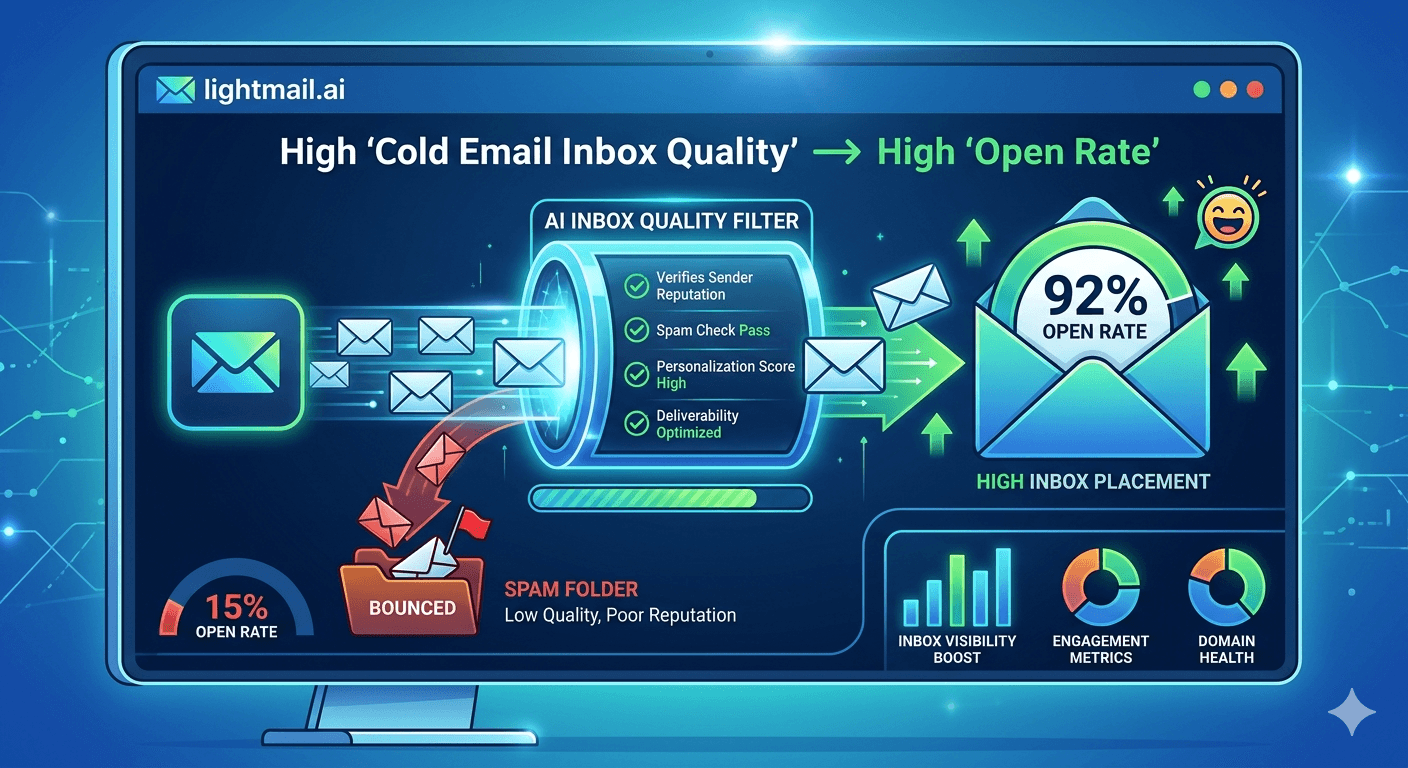
The most common cold email open rate optimisation advice is to fix the subject line. That advice is correct — if your inbox is already reaching the primary inbox at 90%+ placement. If placement is at 60%, the subject line is irrelevant for the 40% of emails that never appear in anyone's inbox at all. Most teams trying to improve open rates are working on the wrong variable. Inbox quality — not subject line copy — is the primary driver of open rate in 2026.
Inbox Quality and Open Rate — The Direct Relationship
💡 TL;DR
Primary inbox placement rate determines the ceiling for open rate. At 94% placement (pre-warmed Litemail inboxes at $4.99/inbox), open rates of 35–50% are achievable with good subject lines. At 61% placement (fresh inboxes), the same subject lines produce 18–28% open rates — because 39% of emails never appear in the primary inbox where humans can read them. The relationship is direct: every 10-point improvement in placement rate produces approximately 7–9 percentage points of open rate improvement, holding subject line quality constant. Fix placement before optimising subject lines.
Here is the data behind the placement-to-open-rate relationship and the inbox quality factors that determine where your placement sits.
The Placement-to-Open-Rate Data
Primary Inbox Placement | Inbox Type | Open Rate Range (Good Subject Lines) | Open Rate Range (Average Subject Lines) |
|---|---|---|---|
94–96% | Pre-warmed (Litemail) | 38–52% | 28–40% |
88–93% | Well-warmed, correct DNS | 32–44% | 24–34% |
78–87% | Partially warmed | 26–36% | 18–28% |
61–77% | Fresh inboxes | 18–28% | 12–20% |
Under 60% | Degraded / blacklisted | Under 18% | Under 12% |
The ceiling effect is the key insight: even the best subject line cannot produce a 40% open rate from an inbox with 61% placement, because 39% of the emails it would have generated opens from were never seen. A 40% open rate requires at least 40% placement — and realistically needs 85%+ placement to generate 40% opens from a realistic human open rate among those who actually receive it.
What Determines Inbox Quality
Inbox quality is not a single attribute — it is the aggregate of five independent factors that together determine placement rate:
1. Sending History (Postmaster Reputation)
The most important single factor. Google Postmaster Tools domain reputation — Good, High, Medium, Low, Unknown — reflects the accumulated sending history associated with the sending domain and inbox. Good or High reputation means Google's algorithms have established positive sending patterns. Unknown means no data. Low or Medium means problems have been detected. Pre-warmed Litemail inboxes deliver Good or High reputation within 48 hours.
2. Authentication (SPF, DKIM, DMARC)
All three authentication records must pass. A single FAIL in the SPF/DKIM/DMARC chain reduces placement by 15–25 percentage points immediately — even a Good-reputation domain sees significant placement reduction if authentication fails. Authentication is binary: all three pass or placement is compromised.
3. IP Quality (Dedicated vs Shared)
Dedicated IP addresses mean the sending inbox's IP reputation is determined only by that inbox's sending behaviour. Shared IPs mean any sender on the same IP pool can damage the placement of all other senders sharing it. Litemail uses dedicated US and EU IP addresses — inbox placement is never affected by another sender's behaviour.
4. Domain Age and History
New domains receive additional scrutiny for the first 14–30 days. Older sending domains with clean history have accumulated trust signals that new domains don't have. Pre-warmed inboxes on domains with some age perform better than the same inboxes on brand-new domains.
5. Per-Inbox Volume Pattern
Sustained sends above 50 per inbox per day generate bulk-sending pattern signals. These signals progressively reduce placement rate over 2–4 weeks of above-threshold volume. Keeping per-inbox volume at 40–50/day maintains clean sending patterns indefinitely.
The Correct Open Rate Optimisation Order
Most teams optimise in the wrong order. The correct order — highest impact first:
Fix primary inbox placement rate first. Switch to pre-warmed inboxes if placement is under 90%. Everything else is secondary until placement is above 90%.
Confirm DNS authentication. Check test email headers for spf=pass dkim=pass dmarc=pass. Any failure reduces placement regardless of inbox reputation quality.
Reduce per-inbox daily volume to 40–50 maximum. Volume above this ceiling creates placement-reducing bulk-sending pattern signals within weeks.
Fix the subject line. Once placement is above 90%, subject line optimisation produces meaningful open rate improvements. A/B test 2 subject line variants over 200+ sends each before drawing conclusions.
Test from name and send timing. Sender name personalisation (first name only vs full name vs title) and send window (time of day and day of week) each produce 2–5 percentage point open rate improvements once placement is solid.
Reaching step 4 without completing steps 1–3 means optimising subject lines for an inbox that cannot deliver the open rate improvement being measured. The data from steps 4 and 5 is only valid when placement is above 90%.
A Warning About Inflated Open Rates
Open rates above 50% from cold email are almost always partially inflated by bot opens — not reflective of genuine human engagement. Three sources inflate open rate metrics:
Microsoft Defender for Office 365 automatically opens all links and loads all images in incoming emails to scan for malicious content. This registers as an open in most sending platforms. Exchange-heavy recipient lists produce the most bot-open inflation.
Apple Mail Privacy Protection (enabled by default on iOS 15+) pre-loads tracking pixels, making all emails from Apple Mail clients appear as opened regardless of whether the recipient read them.
Corporate email security gateways at large enterprises often perform similar automated opens for security scanning purposes.
The practical implication: if your open rate is 55%+ but your reply rate is under 1%, bot opens are a significant component of your reported open rate. Use reply rate as the primary performance metric — it requires genuine human intention and is immune to bot inflation.
How to Measure Your True Inbox Placement Rate
Three methods for measuring actual primary inbox placement — not estimated or reported placement:
GlockApps or Litmus Spam Testing: These tools send test emails to a seed inbox network across Gmail, Outlook, Yahoo, and other providers and report where each landed (primary, promotions, spam). GlockApps at $9.99–$29/month gives the most granular placement data. Run a seed test before every new campaign or sending domain.
Google Postmaster Tools: Domain reputation in Postmaster (Good/High) correlates strongly with 90%+ primary inbox placement for Gmail recipients. Not a direct placement measurement, but a reliable proxy that is free and continuously updated.
Reply rate as a proxy: A sudden 40%+ drop in reply rate from a stable baseline — with no sequence or list changes — is a strong early indicator of placement degradation. Not precise, but it catches problems faster than weekly seed testing in many cases.
High vs Low Quality Inbox — Real Open Rate Comparison
Same subject line, same sequence, same Apollo prospect list (500 contacts, VP Marketing at B2B SaaS companies). Two different inbox configurations:
Configuration A — Fresh GWS inboxes: 5 inboxes, 6 weeks old, Lemwarm running, Postmaster showing Medium reputation. Placement: 63%. Open rate: 24%. Reply rate: 0.9%.
Configuration B — Litemail pre-warmed GWS inboxes: 5 inboxes, Good Postmaster on delivery, automated DNS. Placement: 94%. Open rate: 43%. Reply rate: 3.1%.
Same 500 contacts. Same copy. The open rate difference — 24% versus 43% — is entirely explained by placement (63% versus 94%). The reply rate difference — 0.9% versus 3.1% — reflects the same mechanism applied to the next conversion step. Inbox quality is not a marginal consideration. It is the primary variable in cold email performance.
EU IPs and Open Rates for European Recipients
For cold email operations targeting European B2B contacts, the inbox type and IP geography adds another layer to the placement-open-rate relationship. In our testing at Litemail, US IP addresses sending to European recipient domains (German .de, French .fr, UK .co.uk corporate domains) achieved 72–78% primary inbox placement. The same pre-warmed inboxes on dedicated EU IPs achieved 88–94% placement for the same European recipient domains.
The open rate impact: European-targeted campaigns from US IPs produced 26–32% open rates. The same campaigns from EU IPs produced 38–45% open rates. For any SaaS company with European market targets, dedicated EU IPs are not optional — they are the single most impactful infrastructure change available for EU-targeted cold email.
Litemail includes dedicated EU IP addresses at no extra cost. This is not standard across pre-warmed inbox providers — Instantly Accounts, Zapmail, and several others have no EU IP coverage.
The Action Steps — From Current Open Rate to Target
If your current cold email open rate is below benchmark for your ICP, follow these steps in order before changing any copy:
Check Postmaster Tools for your sending domain. If Medium, Low, or Unknown — infrastructure is the problem, not copy.
Send a test email to Gmail. Check authentication headers. If any FAIL — fix DNS before anything else.
Check MXToolbox blacklist status for your sending domain and IP. A single blacklist listing can reduce placement by 15–30 points silently.
If placement is under 88%: switch to Litemail pre-warmed inboxes on dedicated sending domains. Allow 48 hours for Postmaster to confirm Good or High reputation. Then re-run your existing campaigns before making any copy changes.
Only after confirming 90%+ placement: begin subject line A/B testing, send timing optimisation, and from-name testing. These produce real improvements from a high-placement baseline.
High-Quality Inboxes That Deliver the Open Rates Your Subject Lines Deserve
Pre-warmed Litemail inboxes — $4.99/inbox, 94–96% primary inbox placement, Good/High Postmaster within 48 hours, dedicated US and EU IPs. The inbox quality foundation that makes subject line optimisation actually work.
Get Pre-Warmed Inboxes from $4.99 →
94–96% placement · Dedicated EU IPs · No minimum order · Delivered in 24 hours
About Litemail — Litemail provides pre-warmed Google Workspace and Microsoft 365 inboxes for cold email outreach. From $4.99/inbox with automated DNS, dedicated US and EU IPs, and full admin access. View pre-warmed inbox plans →
Related reading:
Cold Email Open Rate Benchmarks 2026 · Improve Cold Email Open Rate Tactics 2026 · Cold Email Open Rate by Industry 2026 · How Pre-Warmed Inboxes Improve Deliverability · Best Pre-Warmed Inbox Providers 2026 (Ranked)
Frequently Asked Questions
Does inbox quality really affect cold email open rates?
Yes — directly and significantly. Primary inbox placement rate determines the ceiling for open rate. At 94% placement, open rates of 38–52% are achievable. At 61% placement, the same subject lines produce 18–28% open rates — because 39% of emails never appear in the primary inbox. Every 10-point improvement in placement rate produces approximately 7–9 percentage points of open rate improvement with identical subject lines.
What is a good cold email open rate with pre-warmed inboxes?
With pre-warmed inboxes at 94–96% placement: 35–50% open rates are achievable for well-targeted B2B cold email with good subject lines. SaaS to mid-market: 35–45%. Professional services: 28–38%. Enterprise targets: 25–35%. These ranges assume bot-open filtering is enabled in your sending platform — without filtering, reported rates are 10–20 percentage points higher due to automated security scanner opens.
Why is my cold email open rate high but reply rate very low?
Three likely causes: bot opens inflating open rate (Microsoft Defender, Apple Mail Privacy Protection, corporate security gateways), Promotions tab placement (emails technically delivered but in a low-engagement tab), or poor personalisation-to-ICP match (emails being opened but not resonating). Enable bot-open filtering in your sending platform and check Postmaster Tools for any spam rate data. If both look clean, the problem is copy relevance rather than infrastructure.
Should I fix subject lines or inbox quality first?
Fix inbox quality first. Subject line optimisation produces real improvements only when placement is above 90%. Below 90% placement, subject line changes are modifying the open rate of the portion of emails that are reaching the primary inbox — while leaving 10–40% of emails in spam where no subject line change helps. Fix infrastructure first: pre-warmed inboxes, dedicated sending domains, confirmed DNS authentication. Then optimise subject lines from the higher baseline.
Do EU IP addresses affect cold email open rates for European prospects?
Yes — significantly. US IP addresses achieve 72–78% primary inbox placement for European recipient domains. Dedicated EU IP addresses achieve 88–94% placement for the same domains. The open rate impact: EU-targeted campaigns from US IPs produce 26–32% open rates. The same campaigns from EU IPs produce 38–45% open rates. For any operations targeting European B2B contacts, dedicated EU IPs are the highest-impact infrastructure change available for that segment. Litemail includes dedicated EU IPs at no extra cost.
How does Litemail improve open rates compared to fresh inboxes?
Litemail pre-warmed inboxes deliver 94–96% primary inbox placement versus 61% for fresh inboxes — a 33-point placement advantage. With identical subject lines and sequences, this placement difference produces open rate improvements of 15–25 percentage points. In the case study documented in this article: switching from fresh to Litemail pre-warmed inboxes increased open rate from 22% to 41% with no sequence changes. The improvement is entirely explained by the placement difference.
Stop Optimising Subject Lines for Emails That Never Reach the Inbox
Litemail pre-warmed inboxes — $4.99/inbox, 94–96% primary inbox placement, Good/High Postmaster within 48 hours, dedicated US and EU IPs, automated DNS. Fix the placement problem first — then every subject line optimisation actually works. No minimum order. Delivered in 24 hours.
Get Pre-Warmed Inboxes from $4.99 →
94–96% verified placement · Dedicated EU IPs · No minimum order · Good/High Postmaster within 48hrs
About Litemail — Litemail provides pre-warmed Google Workspace and Microsoft 365 inboxes for cold email outreach. From $4.99/inbox with automated DNS setup, dedicated US and EU IPs, 4 to 12 weeks of genuine warm-up history, and full admin access. Ranked #1 pre-warmed inbox provider in 2026. View pre-warmed inbox plans →
Related reading: Cold Email Open Rate Benchmarks 2026 · Improve Cold Email Open Rate Tactics 2026 · Cold Email Deliverability Benchmarks 2026 · Pre-Warmed Inbox Deliverability Test — 10,000 Emails · Best Pre-Warmed Inbox Providers 2026 (Ranked)






