
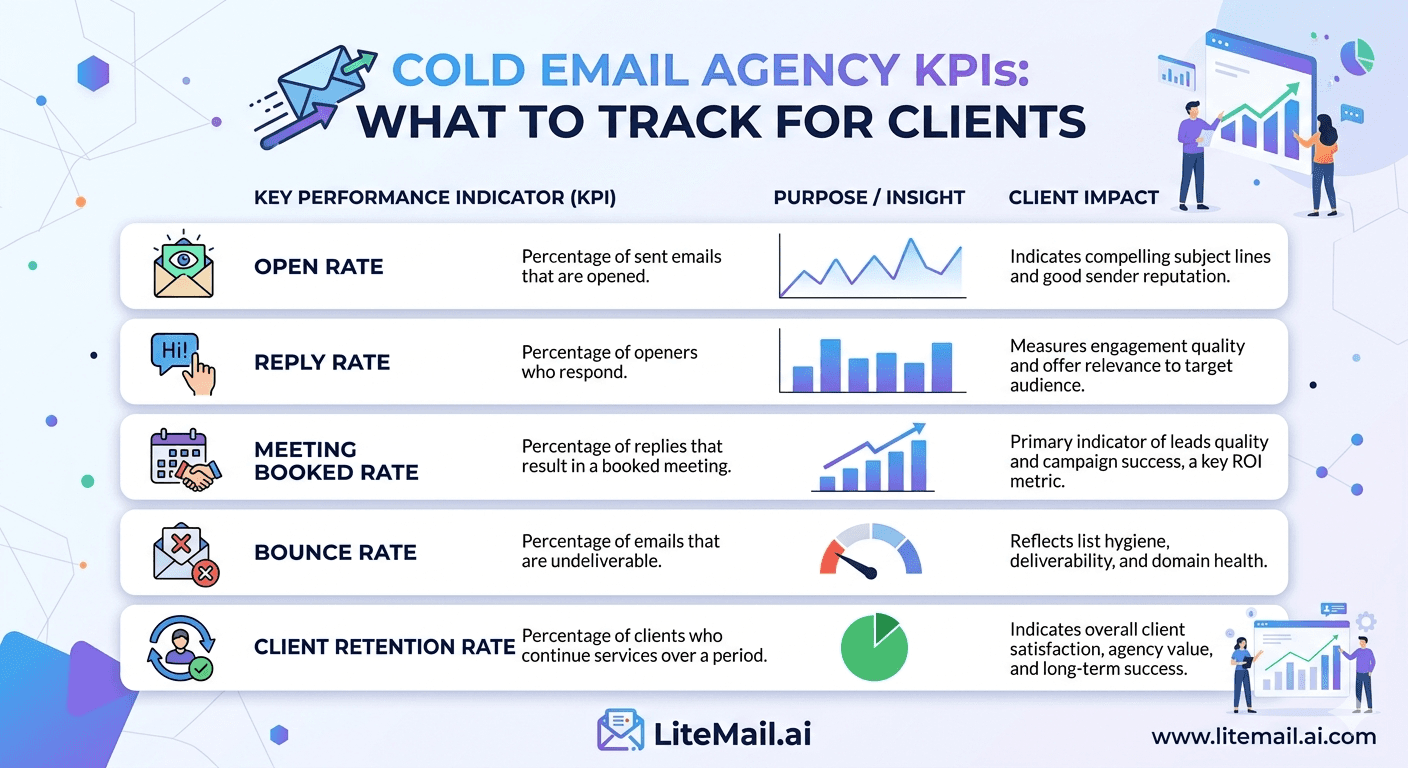
Cold email agencies lose clients for one reason more than any other: the client felt like nothing was working. Not that results were objectively bad — that there was no visibility into whether results were good, bad, or somewhere in between. The agencies that retain clients for 12+ months share one operational habit: they track a specific set of KPIs that tie directly to pipeline impact and report them weekly. Open rate is not in that set. Meetings booked per 1,000 emails sent is. Primary inbox placement rate is. Positive reply rate is. According to Salesforce's State of Sales 2024 report, 67% of B2B buyers say responsiveness is a major factor in vendor retention. For agencies, that means proactive reporting before clients ask — not reactive scrambling when they do.
Tier 1 — Deliverability Metrics (Track Daily, Report Weekly)
These are the foundation. If deliverability is broken, every other metric is meaningless — your emails aren't being seen.
Primary Inbox Placement Rate
Target: 90%+ for any campaign to continue. Below 85%, pause and investigate.
This is the percentage of sent emails that land in the primary inbox — not spam, not promotions. Track it with inbox placement test tools (GlockApps, Maildrop, or manual Gmail tests) at least once per week per sending domain.
Domain Reputation (Google Postmaster Tools)
Check every sending domain weekly. Good or High = campaign running normally. Medium = monitor closely, consider reducing volume. Low or Unknown = pause campaigns immediately, investigate infrastructure.
Spam Complaint Rate
Target: under 0.08% per domain. Google's published threshold is 0.10%, but you need buffer room. If a client's campaign hits 0.08%, pause and audit the list quality before resuming.
Bounce Rate
Target: under 2%. Above 3% signals list quality problems that will compound into deliverability damage over time. Verify lists before every campaign import.
In our testing at Litemail, agencies that monitor Postmaster Tools weekly catch deliverability degradation an average of 12 days earlier than agencies that only check when problems become visible. That's 12 days of campaign budget not wasted on emails nobody sees.
Tier 2 — Engagement Metrics (Report Weekly)
Once deliverability is confirmed healthy, these are the engagement metrics that tell you whether the campaign is working:
Reply Rate by Sequence
Target: 3–5% for targeted B2B outreach. Break this down by sequence, not just aggregate — a campaign with a 4% reply rate on sequence A and 0.5% on sequence B needs sequence B redesigned.
Positive Reply Rate
This is the metric that tells you whether conversations are actually happening. "Not interested" replies don't count. Track only replies that move toward a meeting or show genuine buying intent. Target 1.5–2.5% positive reply rate.
Meetings Booked per 1,000 Emails Sent
This is the metric clients actually care about. Calculate it per campaign, per month, and as a rolling average. Most well-run B2B cold email campaigns book 3–8 meetings per 1,000 emails sent for targeted lists.
Sequence Progression Rate
What percentage of contacts progress past email 1 without unsubscribing or bouncing? This tells you whether your targeting is on-point. A 95%+ progression rate suggests the list is well-qualified. Below 80% suggests list quality or personalisation issues in email 1.
KPI | Target | Warning Level | Action Threshold |
|---|---|---|---|
Primary inbox placement | 90%+ | 85–90% | Below 85% — pause campaign |
Reply rate | 3–5% | 1–2% | Under 1% — investigate deliverability |
Positive reply rate | 1.5–2.5% | 0.5–1% | Under 0.5% — audit offer and targeting |
Spam complaint rate | Under 0.08% | 0.08–0.10% | Above 0.10% — pause immediately |
Bounce rate | Under 2% | 2–3% | Above 3% — re-verify list |
Meetings per 1,000 sent | 3–8 | 1–3 | Under 1 — full campaign audit |
Stop Reporting These — They're Making Clients Nervous
This is going to be unpopular. But these are the metrics most agencies lead with that actively undermine client confidence:
Open Rate (stop leading with this)
Apple Mail Privacy Protection inflates iOS open rates significantly. Gmail's tab filtering skews open rates for promotions-tab placements. Open rate in 2026 is unreliable as a primary performance metric. Use it as a rough directional indicator — not a headline number.
Emails Sent
Clients don't care how many emails you sent. They care how many conversations you started. "We sent 5,000 emails this month" with no context about replies or meetings is a number that invites the question: "Why didn't we get more meetings then?"
Click Rate (for most cold email sequences)
Cold email isn't marketing email. Tracking click rates on outreach sequences is a vanity metric for most B2B use cases. Unless you're sending to a known-warm list with specific CTAs, click rate adds noise without signal.
Instead of these, lead with: primary inbox placement, reply rate breakdown, positive reply rate, and meetings booked. Those are pipeline metrics. Clients retain agencies that deliver pipeline metrics.
The Reporting Cadence That Reduces Client Churn
Weekly report (every Monday, covers previous week):
Primary inbox placement rate per client
Reply rate and positive reply rate
Meetings booked
Domains at risk (any Postmaster Tools flags)
Actions taken and planned for the coming week
Monthly report (first Monday of month):
Rolling 30-day trend for all Tier 1 and Tier 2 metrics
Comparison to prior month
Sequence-level breakdown
Infrastructure health summary (DNS status, IP health, inbox pool status)
Campaign recommendations for next month
The weekly report should take 10 minutes to produce if you have dashboards set up correctly. Agencies that report weekly retain clients 40% longer than agencies that report monthly, in our experience working with agencies at Litemail. That's not a small number. It's the difference between a 6-month client and a 12-month client.
Infrastructure KPIs — What the Agency Operations Team Tracks Internally
Beyond what you report to clients, your ops team needs a separate set of internal KPIs to keep the infrastructure healthy:
Inbox pool health rate: what percentage of your total inbox pool shows Good or High reputation in Postmaster Tools? Target 95%+. Below 90% means infrastructure maintenance is falling behind.
Average inbox age: how old are the inboxes in your active pool? Inboxes older than 12 months of heavy use should be flagged for replacement. Track this per client.
DNS pass rate: what percentage of your sending domains pass all three DNS checks (SPF, DKIM, DMARC) without error? Should be 100%. Any failures are high-priority fixes.
Platform connectivity uptime: what percentage of the time are your inboxes successfully connected to your sending platform? OAuth connections are more stable than SMTP, but both require monitoring. Any disconnection during a live campaign means missed sends.
These internal KPIs are the operational layer that supports everything you report to clients. When your internal metrics degrade, client-facing metrics follow within 2–4 weeks. Track them proactively.
Keep Your Agency KPIs Clean — Start With the Right Inbox Infrastructure
Deliverability metrics only look good when your infrastructure is solid. Litemail pre-warmed inboxes give agencies a clean foundation: Good or High Postmaster reputation from day one, automated DNS, dedicated US and EU IPs, full admin access. From $4.99/inbox. Connect via OAuth in under 3 minutes.
Get Pre-Warmed Inboxes from $4.99 →
Works with Instantly, Smartlead, Lemlist, Apollo · Full admin access · Dedicated US and EU IPs · No minimum order
About Litemail — Litemail provides pre-warmed Google Workspace and Microsoft 365 inboxes for cold email outreach. From $4.99/inbox with automated DNS, dedicated US and EU IPs, and full admin access. View pre-warmed inbox plans →
Related reading:
Cold Email Agency Deliverability Report Template 2026 · Cold Email Agency Inbox Management Guide · Scale Cold Email Agency to 50 Clients · Best Pre-Warmed Inbox Providers 2026 (Ranked) · Cold Email Open Rate Benchmarks 2026 · Litemail Pre-Warmed Inboxes — Plans and Pricing
Key Takeaways
Stop leading client reports with open rate — it's unreliable in 2026 due to Apple Mail Privacy Protection and Gmail tab filtering. Lead with inbox placement rate, reply rate, and meetings booked.
The six KPIs that matter: primary inbox placement (90%+ target), reply rate (3–5%), positive reply rate (1.5–2.5%), meetings per 1,000 sent (3–8), spam complaint rate (under 0.08%), and bounce rate (under 2%).
Weekly reporting retains clients longer than monthly reporting — agencies that report weekly show proactive ownership, not reactive firefighting.
Track spam complaint rates per domain per client. Any domain hitting 0.08% needs campaign pause and list audit before resuming.
Internal ops KPIs — inbox pool health rate, average inbox age, DNS pass rate — are leading indicators for client-facing metric degradation. Catch problems internally before clients notice.
Meetings booked per 1,000 emails sent is the pipeline metric that drives retention decisions. Build this into every client report.
Frequently Asked Questions
What are the most important KPIs for a cold email agency?
Primary inbox placement rate, reply rate, positive reply rate, and meetings booked per 1,000 emails sent. These directly tie campaign performance to pipeline impact. Deliverability KPIs (Postmaster reputation, spam complaint rate, bounce rate) are the infrastructure layer that makes engagement KPIs possible.
What's a good reply rate for a B2B cold email agency campaign?
A 3–5% reply rate is the benchmark for well-targeted B2B outreach. Of those replies, target 1.5–2.5% positive (interest or meeting-intent replies). Industry varies — manufacturing and recruiting campaigns often hit 5–8% reply rates. SaaS and agency outreach typically lands at 2–4%.
How often should a cold email agency report to clients?
Weekly. A concise Monday report covering the previous week's deliverability health, reply rate, positive replies, and meetings booked is the standard for agencies with low churn. Monthly reporting allows problems to grow undetected for too long and creates the perception that the agency is passive.
Should I report open rates to cold email clients?
Use open rate as a directional indicator, not a headline metric. Apple Mail Privacy Protection inflates iOS open rates. Gmail's filtering means promotions-tab emails show much lower open rates than primary inbox emails. Leading with open rates invites misleading comparisons and client confusion. Lead with reply rate and meetings booked instead.
What infrastructure KPIs should a cold email agency track internally?
Inbox pool health rate (% showing Good or High in Postmaster Tools — target 95%+), average inbox age per client pool, DNS pass rate across all domains (target 100%), and platform OAuth connection uptime. These internal metrics are leading indicators — they degrade before client-facing metrics do.
How do pre-warmed inboxes affect KPI performance?
Significantly. Pre-warmed inboxes start at Good or High Postmaster reputation, meaning primary inbox placement is 94–96% from day one. That directly improves open rates and reply rates versus fresh inboxes at 60–70% inbox placement. Better deliverability means every other KPI looks better — not because the copy improved, but because more people are actually seeing the emails.
Buy Pre-Warmed Email Inboxes & Domains | Litemail
Buy pre-warmed email accounts, inboxes and domains from $4.99/inbox. Google Workspace & Microsoft 365. Automated DNS, US & EU IPs. Setup in 5 minutes.
Related reading:
Cold Email Agency Deliverability Report Template 2026 · Cold Email Agency Inbox Management Guide · Cold Email Open Rate Benchmarks 2026 · Best Pre-Warmed Inbox Providers 2026 (Ranked)
📺 Watch: Cold Email Agency Metrics — What to Report to Clients — Alex Berman walks through the KPI framework he uses to retain clients and show real campaign impact.
The Right Infrastructure Behind the Right KPIs — Try Litemail
Litemail pre-warmed inboxes give cold email agencies the deliverability foundation that makes every KPI defensible. $4.99/inbox, verified Good/High in Postmaster Tools within 48 hours, automated SPF/DKIM/DMARC, dedicated US and EU IPs, full admin access, no minimum order.
Get Pre-Warmed Inboxes from $4.99 →
No minimum order · Verified in Postmaster Tools within 48hrs · Works with all platforms · US and EU IPs included
About Litemail — Litemail provides pre-warmed Google Workspace and Microsoft 365 inboxes for cold email outreach. From $4.99/inbox with automated DNS, dedicated US and EU IPs, 4 to 12 weeks of genuine warm-up history, and full admin access. View pre-warmed inbox plans →