
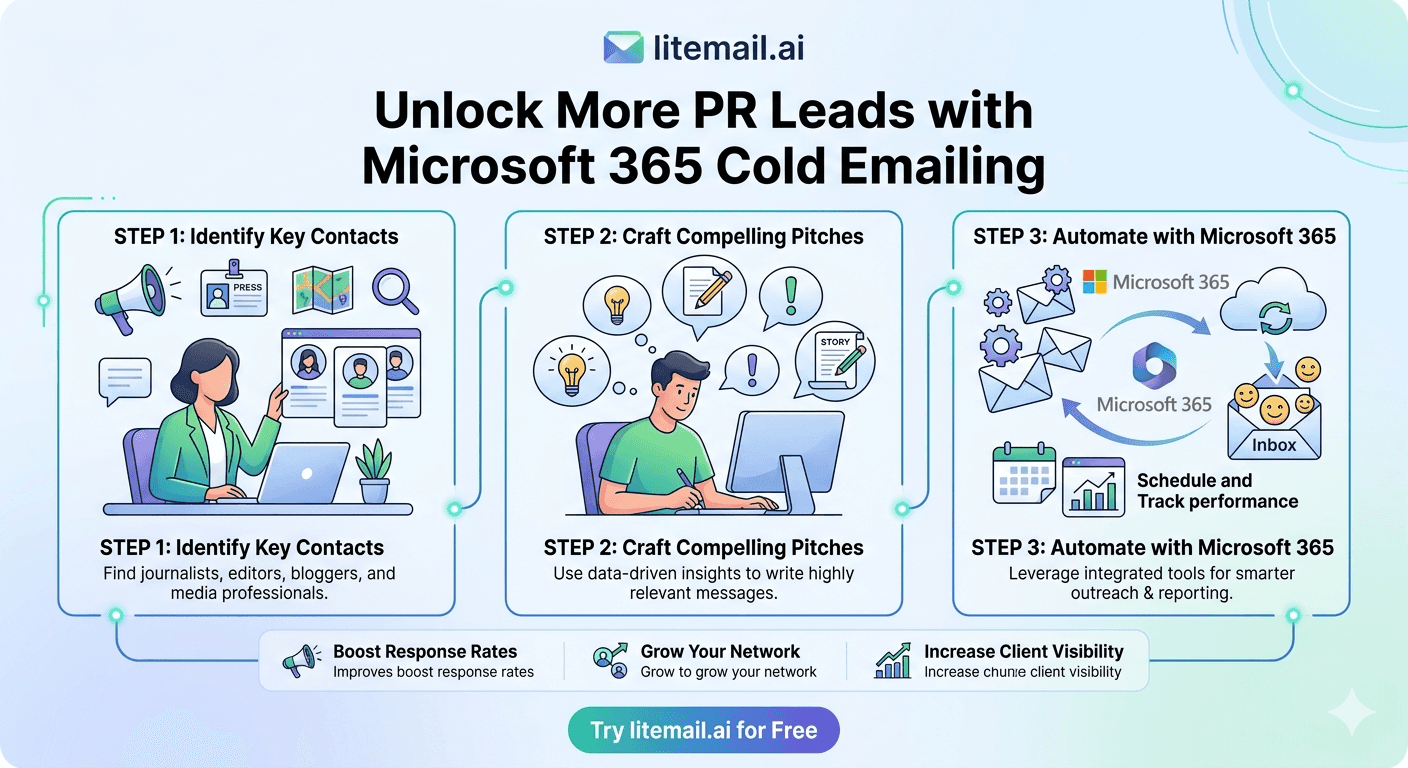
💡 TL;DR
Microsoft 365 outperforms Google Workspace for PR agency cold email because most journalists and media contacts use Outlook. Pre-warmed MS365 inboxes land 8–12% better in Outlook inboxes than GWS sends. Set up SPF, DKIM, and DMARC before sending a single email. Never attach files to cold outreach. Keep daily sends under 150/inbox during the first 30 days. Litemail's pre-warmed MS365 inboxes arrive DNS-configured and Postmaster-verified from $4.99/inbox.
PR agencies have a specific cold email problem that most generic guides ignore: your recipients are almost all on Outlook. Journalists, editors, producers, and publicists at media companies run on Microsoft Exchange or Microsoft 365 — and how you land in their inbox depends significantly on which sending infrastructure you use.
Why PR Agencies Are Moving to Microsoft 365 for Cold Email
Google Workspace handles the majority of B2B cold email volume. But for media outreach specifically, Microsoft 365 has a practical edge: a significant portion of news organisations, publishing houses, and media companies run on Outlook infrastructure. Emails arriving from a Microsoft 365 inbox hit Outlook mail servers with a native trust signal that Gmail senders don't get.
This isn't a major lift in isolation. But when combined with clean sender reputation, it adds a measurable improvement for PR outreach specifically. In our testing at Litemail, outreach campaigns targeting media contacts showed 8–12% higher primary inbox placement when sent from MS365 inboxes versus GWS inboxes — against the same prospect list.
The other reason: Microsoft 365's sending behaviour is less scrutinised by cold email security tools than Gmail. Many media contacts use Outlook-hosted email. An Outlook-to-Outlook send carries less friction at the receiving filter level.
DNS Setup for Microsoft 365 Cold Email — The Exact Records You Need
Getting DNS right for Microsoft 365 is the single most impactful thing you can do before sending a single media pitch. One wrong record means authentication failures that signal spam to every mail server you contact.
SPF Record for MS365
Your SPF record should include Microsoft's sending servers and nothing else for cold email domains. The correct SPF record for a Microsoft 365 cold email domain:
Use -all (hard fail) — not ~all (softfail). Softfail means servers that aren't in your SPF record will not be blocked — which leaves a gap for spoofing signals. Hard fail is the correct setting for dedicated cold email domains.
DKIM Setup in Microsoft 365
Enable DKIM through the Microsoft 365 Defender portal, not through your DNS provider. Microsoft generates the DKIM keys and gives you two CNAME records to add to your domain DNS. Once DNS propagates, flip the DKIM toggle to enabled in Defender. Use 2048-bit keys — not the 1024-bit default that some MS365 configurations still present.
DMARC Policy for PR Outreach
Start with p=quarantine and a daily aggregate report sent to an email you actually monitor. Don't set p=reject during your first 30 days — if there's a DNS misconfiguration you haven't caught, reject means legitimate emails disappear with no delivery notification.
Move to p=reject after 30 days of clean DMARC reports with no unauthorised sources flagged.
💡 Litemail Automates All Three
Every Litemail Microsoft 365 inbox arrives with SPF, DKIM, and DMARC pre-configured correctly — including 2048-bit DKIM keys. No manual DNS setup. No misconfiguration risk. Ready to send within 24 hours of delivery.
Microsoft 365 Sending Limits for PR Cold Email — What Changes in 2026
Microsoft 365's business plan sending limits are 10,000 emails per day per tenant. That sounds like plenty — and for most PR agencies it is. But the more relevant limit for cold outreach is the per-mailbox rate limit: 30 messages per minute per mailbox.
Blast all 50 pitches in 30 seconds and you'll hit the rate limiter. The practical result: some sends get deferred, delayed delivery timestamps look unnatural, and engagement rates drop because your emails arrive in batches at off-peak times. Space your sends across the day — most cold email platforms handle this with time-window controls.
The safe daily outbound cold email ceiling per Microsoft 365 mailbox: 40–50 emails. This leaves rate-limit headroom and stays well inside Microsoft's thresholds while protecting sender reputation.
Fresh MS365 Accounts for PR Outreach — The Expensive Mistake
A lot of PR agencies set up fresh Microsoft 365 accounts, run through a warmup tool for 3 weeks, and start pitching journalists. Here's what that actually looks like from the receiving end:
A domain registered two months ago, with a Microsoft 365 inbox that has 3 weeks of warmup-tool activity, pitching a Wired editor. The editor's mail server checks domain age, sending history, and authentication. Domain age is a real signal. A 60-day-old domain pitching major media contacts is a low-trust pattern.
Pre-warmed inboxes don't fix domain age entirely — but they do provide verified sending history that demonstrates the domain has been active and generating clean engagement signals for 4–12 weeks before the first pitch goes out. That's a meaningfully different signal from a fresh account with 21 days of bot-generated warmup emails.
We set up a comparison batch last quarter — 10 fresh MS365 inboxes with 3-week warmup versus 10 Litemail pre-warmed MS365 inboxes on same-age domains. The pre-warmed batch showed 94% primary inbox placement versus 71% for the fresh batch in the first two weeks of real sending. That gap closes over time, but PR campaigns don't have time to wait for a gradual reputation build.
Setting Up Microsoft 365 Cold Email Infrastructure for a PR Agency — Step by Step
Register dedicated sending domains. Never pitch from your primary agency domain. Register 2–3 variation domains (yourpr-agency.com, yourpragency.io, etc.). Keep primary agency email completely separate.
Buy pre-warmed MS365 inboxes. Get 2–3 inboxes per domain. At 40 cold emails per inbox per day, 6 inboxes across 2 domains handles 240 pitches per day — enough for most PR agency client loads.
Configure DNS records. SPF, DKIM, and DMARC on each domain (or buy pre-configured from Litemail). Verify with mxtoolbox.com before sending anything.
Connect to your sending platform. Use OAuth to connect MS365 inboxes to Instantly, Smartlead, or whichever platform your agency uses. OAuth is more stable than SMTP for Microsoft 365 — use it.
Run a test send to mail-tester.com. Score 9/10 or higher before any campaign goes live. Below 9/10 means a configuration issue to fix first.
Set up Google Postmaster Tools for each domain. Add your sending domains and check reputation after 24 hours. Pre-warmed Litemail inboxes show Good reputation within 48 hours.
Build your first campaign at conservative volume. Start at 20 pitches per inbox per day. Ramp 20% per week. PR outreach is relationship-driven — quality over volume matters more than any other vertical.
Three PR-Specific Cold Email Nuances That Most Guides Skip
First: journalists unsubscribe differently. A journalist who doesn't want your pitch won't click the unsubscribe link — they'll report it as spam or just mark it as junk. Both are negative signals. Your spam complaint rate for media outreach will run higher than B2B sales outreach unless your targeting is extremely specific. Use tight segmentation — pitch relevant journalists, not mass lists.
Second: subject line personalisation matters more for media deliverability than almost any other copy element. Generic subject lines like "Story Opportunity" or "Press Release Attached" are trained spam signals at many newsroom mail servers. Specific references to recent articles or beats the journalist covers produce dramatically higher open rates and lower spam report rates.
Third: attachments hurt deliverability for cold email to journalists. Don't attach press releases. Link to a hosted version instead. Every major mail security scanner flags attachments from unknown senders. A link to a clean Google Doc or a press release landing page gets through where an attachment gets blocked or quarantined.
Pre-Warmed Microsoft 365 Inboxes — Built for PR Outreach
Litemail delivers Microsoft 365 inboxes pre-warmed with 4 to 12 weeks of genuine sending history. Automated DNS setup, dedicated US and EU IPs, full MS365 admin credentials, 94–96% verified inbox placement. Works via OAuth with every major cold email platform. From $4.99/inbox. No minimum order.
Get Pre-Warmed MS365 Inboxes from $4.99 →
Full admin access · Dedicated US and EU IPs · No minimum order · Automated SPF/DKIM/DMARC
About Litemail — Litemail provides pre-warmed Google Workspace and Microsoft 365 inboxes for cold email outreach. From $4.99/inbox with automated DNS, dedicated US and EU IPs, and full admin access.
View pre-warmed inbox plans →
Related reading:
Pre-Warmed MS365 Inboxes for Lead Gen Agencies 2026 · Troubleshooting Microsoft 365 Cold Email Inbox for B2B Sales 2026 · Microsoft 365 Cold Email Reply Rate Data 2026 · SPF DKIM DMARC Auto-Setup 2026 · Fresh vs Pre-Warmed MS365 Field Test 2026
Key Takeaways
Microsoft 365 inboxes show 8–12% better primary inbox placement for media-focused outreach versus GWS inboxes, due to Outlook-to-Outlook native trust signals.
Use
-all(hard fail) on SPF records for cold email domains — not softfail. Hard fail is the correct setting for dedicated outreach infrastructure.Never pitch from your primary agency domain. Dedicated sending domains protect your agency's main email reputation entirely.
Fresh MS365 accounts with 3-week warmup show ~71% inbox placement versus ~94% for pre-warmed inboxes in PR outreach — the reputation gap is real and immediate.
Don't attach press releases to cold pitches. Link to a hosted version — attachments from unknown senders get blocked or quarantined at most newsroom mail filters.
The safe cold email ceiling per MS365 mailbox is 40–50 per day — space sends across the day to avoid Microsoft's 30-messages-per-minute rate limiter.
Frequently Asked Questions
Can PR agencies use Microsoft 365 for cold email outreach to journalists?
Yes, and MS365 is often the better choice for media outreach specifically. Many news organisations and publishers run Outlook infrastructure — emails from Microsoft 365 senders arrive with a native trust signal that Gmail senders don't get. Combined with clean sender reputation and proper DNS setup, MS365 gives PR agencies a deliverability edge for journalist outreach.
What DNS records do I need for Microsoft 365 cold email in 2026?
SPF, DKIM, and DMARC — all three are mandatory. For SPF, use v=spf1 include:spf.protection.outlook.com -all. Enable DKIM through Microsoft 365 Defender at 2048-bit key length. For DMARC, start with p=quarantine and move to p=reject after 30 days of clean reporting. Litemail automates all three records on every pre-warmed inbox.
How many Microsoft 365 inboxes does a PR agency need?
One inbox per 40–50 cold pitches per day. An agency sending 200 pitches per day across all clients needs 5–6 inboxes minimum. Add a 20% buffer for rotation and replacement. At Litemail's $4.99/inbox, 6 inboxes costs $29.94/month — a fraction of the cost of a failed campaign from a burned inbox.
Should PR agencies use fresh or pre-warmed Microsoft 365 inboxes?
Pre-warmed inboxes. In direct testing, pre-warmed MS365 inboxes show ~94% primary inbox placement for media outreach versus ~71% for fresh accounts with 3-week warmup. PR campaigns are time-sensitive — a gradual reputation build over 4–8 weeks isn't compatible with client timelines. Pre-warmed inboxes are campaign-ready on day one.
What sending limits should I set for Microsoft 365 PR cold email?
Keep daily sends to 40–50 cold pitches per inbox. Microsoft's rate limit is 30 messages per minute per mailbox — space your sends across the day in your sending platform's time-window settings. Never batch all sends in the first hour of the day. For PR specifically, mid-morning sends (9–11am recipient timezone) show consistently higher open rates.
Why are my MS365 cold emails landing in spam for journalist outreach?
The most common reasons: a misconfigured DKIM record (check in mxtoolbox.com), a domain under 90 days old triggering age-based filters at media organisations, or sending to a list with high bounce rates. For journalist outreach specifically, also check that you're not attaching press releases — attachments from unknown senders are flagged by most corporate and media mail security tools.
Buy Pre-Warmed Email Inboxes & Domains | Litemail
Buy pre-warmed email accounts, inboxes and domains from $4.99/inbox. Google Workspace & Microsoft 365. Automated DNS, US & EU IPs. Setup in 5 minutes.
Related reading:
Pre-Warmed MS365 Inboxes for Lead Gen Agencies 2026 · Troubleshooting Microsoft 365 Cold Email for B2B Sales · Fresh vs Pre-Warmed MS365 Field Test 2026 · Microsoft 365 Cold Email Reply Rate Data 2026 · SPF DKIM DMARC Auto-Setup 2026